Mammals · Spirit animal
Wildebeest Spiritual Meaning & Symbolism
The herd-wise wanderer who chooses movement, community, and quiet endurance over needless conflict.
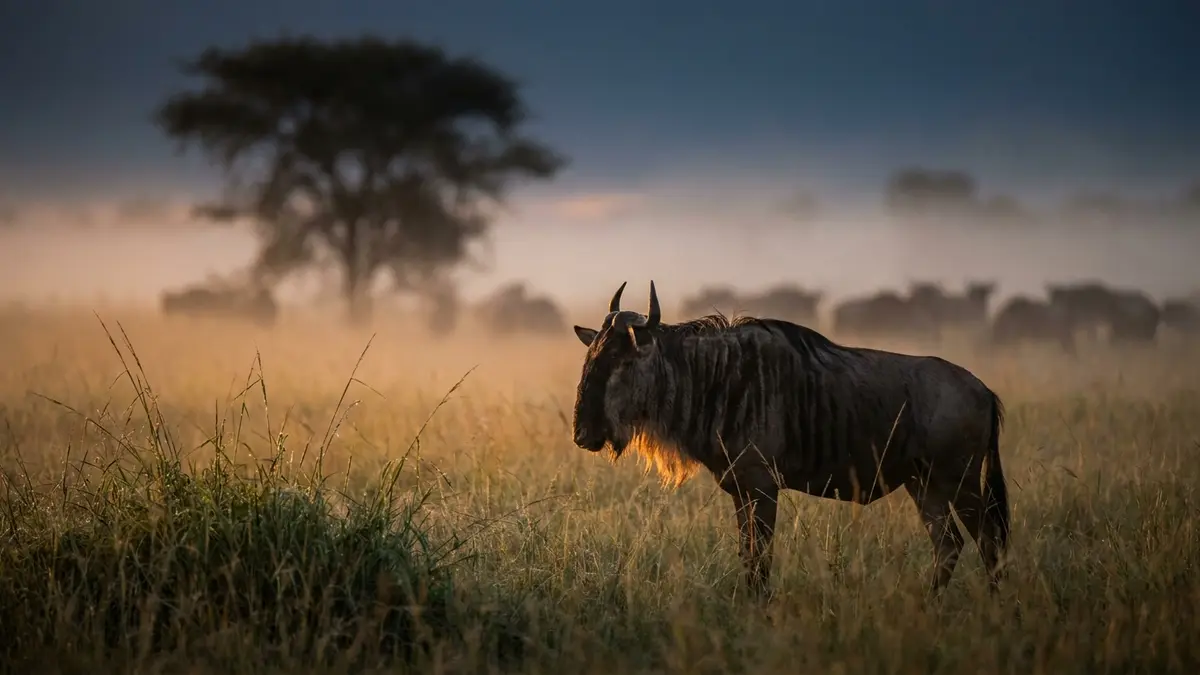
The wildebeest is a powerful symbol of strength found in a community. Instead of acting with needless aggression, it chooses flight and taking the right path as it travels with its herd. They have things to teach us about de-escalating situations, clear communication, and trusting in a shared path when dealing with challenges. They are also very attuned to the seasons, showing us how to ground ourselves and maintain balance in times of transition.
An almanac
- Core message
- Survival and strength through community, not solo effort
- Spirit animal
- Mend family bonds and choose battles wisely
- Totem for
- Socially magnetic, instinct-driven, courageous people
- Power animal
- Steady guidance through big moves and transitions
- In dreams
- Meaning shifts with the animal's behavior
- Cultural roots
- African oral tradition symbol of wisdom and discernment
- Word origin
- Dutch for "wild beast"; Gnu traces to Khoekhoe/San words
- 1998 Serengeti herd
- Topped 1.3 million migrating animals
The wildebeest doesn't seem to match its intimidating appearance. Large and powerful, it wears a shaggy mane, a bushy beard, and curved horns, yet when it's threatened it prefers running away over fighting head-on. This plain-dwelling animal lives in eastern and southern Africa, where its most famous event takes place: a massive migration that sweeps in zebras and gazelles to form a herd that moves from one patch of grass to the next by cooperating rather than compete.
Wildebeest Symbolism & Meaning
The Wildebeest is mostly bluff. When it sees danger, it usually runs away rather than fighting back. That's why people associate this animal with trying to avoid an argument.
Every year, big groups of Wildebeests move across the savanna grasslands, looking for new water and food to eat. When they travel, smaller animals like zebras and gazelles go along with them, because there are so many Wildebeests that a predator is less likely to attack them.
So the Wildebeest is associated with ideas of travel and change, and it shows how animals work together to protect themselves from danger.
There are two different kinds of Wildebeest: a Blue Wildebeest with silvery-bluish fur, and a Black Wildebeest that's smaller. The bigger male Blue Wildebeests have thick horns that come down when they are pointed in one direction and then curve up again.
That is much different from the Black Wildebeest's horns, which go down first and then go up again.
Because the male Blue Wildebeests are so much bigger than the Black ones, people associate them with trust, sincerity, and thinking carefully before doing something. The male Black ones are linked to being in charge and showing a lot of power in their territory.
Wildebeests communicate over long distances through low sounds that other animals can hear, their body language changes when they're scared or excited, and through scents.
Wildebeest Spirit Animal
The wildebeest symbolizes family ties and choosing your battles wisely. If you've been focusing too much on obligations rather than people who genuinely care for you, the wildebeest reminds you to prioritize the latter.
If you've been trying to prove a point by starting fights that aren't worth it, the wildebeest asks you to reconsider and focus on finding peace instead.
The wildebeest's appearance could also be a sign that a major move or transition is approaching, signaling that the help of other people will be important along the way. The animal emphasizes that asking for help is not a weakness; groups like wildebeests have learned how to survive together, not as individuals.
Does Wildebeest fit you?
Tap the ones that sound like you — 6 traits, no right answer.
0 of 6 Nothing picked yet — start tapping.
Wildebeest Totem Animal
Wildebeest people are social and outgoing, and they like to be with their friends as much as possible.
They trust their instinct as much as their planning, but they sometimes have too many plans at once and keep leaving one for another. All the same, they're good at reading people well, and they can figure out who would be best suited to which task. People who like being on stage or around creative types are often drawn to this totem.
Someone with a Wildebeest totem can move around a lot. That doesn't mean it's difficult for them, but that people will notice them in some way if they do so.
Wildebeest Power Animal
Call on Wildebeest's spirit for a wise and levelheaded guide when you need to give voice to unspoken conflicts within your family. Especially if those issues affect other family members, engage them in the conversation so you don't have to carry everything alone. Wildebeest is there to lend you support when a big decision or transition looms ahead in your life, as well.
A constant traveling companion, Wildebeest lends its power of sheer endurance to help you navigate through the personal and practical ups and downs of change, from first realizing that a move or transition is needed to the final moment of settling in.
African Wildebeest Symbolism
In much of African oral tradition, the watchful, calm presence of the Wildebeest within the herd is generally thought to symbolize sound judgment and steadiness. Of course, details vary widely between communities and can't be tracked back to one particular documented source.
Wildebeest in Dreams
If you dream of a wildebeest running or fleeing, your dream suggests that an old wound or an unresolved conflict may be resurfacing in your life. Perhaps you are holding onto a grudge from the past which is now interfering with your present life. A dream of a wildebeest peacefully grazing, on the other hand, reflects contentment. It is a sign that you have been true to yourself and are able to live the life which is right for you.
In the case of several wildebeests together in a dream, it suggests that friends or relatives may be visiting you soon. Finally, if you see a wildebeest wandering aimlessly from place to place, it may suggest that change will occur in your life. You need to be vigilant and do not let these changes prevent you from getting things done.
Wildebeest in the Night Sky
Some traditional San star lore links a close antelope relative of the wildebeest, the hartebeest, to the stars Aldebaran and Betelgeuse. Apparently this pairing belonged to the hartebeest rather than to the wildebeest itself. Among the Zulu people, Spica carries the name "Wildebeest Star." A link is suggested between these antelope's migratory rhythms and the turning of the seasons overhead.
Wildebeest Spiritual Meaning
The meaning of the wildebeest is simple and straight to the point: survival is rarely possible for just one individual, and strength comes not from fighting alone but from reaching out to others. Wildebeest migration is a powerful example of this. Not only do they move together toward a common goal, but they also often forgo their own goals for the group's safety and harmony.
Unlike its imposing size and appearance would suggest, the wildebeest is a humble creature who knows when to back down. Wildebeests use this knowledge, along with their bluffing abilities, to demonstrate emotional intelligence—sometimes, you must recognize that it is better to walk away than to stand up for what you believe in.
If you find yourself surrounded by wildebeests or interacting with them in your dreams or thoughts, take it as a sign that you need to reconnect with your community and remember the value of the group. Additionally, it may signify that it is time for you to accept that some goals are not worth fighting for and recognize the importance of navigating life's seasons.
Wildebeest Calves & the Safety of Numbers
A Wildebeest is bound to the group. Babies are born within a narrow window, a few weeks of the rainy season, and a calf must stand on its feet and be able to keep up with the herd within minutes of its birth. It can't lay for awhile or recover later because then it would be behind; it must move to keep up.
The main reason is that a young Wildebeest is more likely to survive if it's in the herd. It's much easier for predators to pick off the isolated ones than those in the middle. It's like spiritual advice: don't try to face your fears or anxieties or projects alone, find help from others, and know that when you're not alone you are more likely to succeed.
Frequently Asked Questions
What does the Wildebeest symbolize spiritually?
The Wildebeest, though physically strong, migrates with a herd, which is a symbol of strength. In order to avoid conflict with predators, the Wildebeest takes calculated retreat, retreating en masse as if on a schedule. The animal's migrations are timed with the seasons and these show that it's an excellent symbol of staying grounded and connected to the natural rhythm of the earth.
What does it mean when a Wildebeest appears in a dream?
A dreaming Wildebeest can have various meanings. If the Wildebeest is fleeing in the dream, it suggests that some unresolved issues from your past may be surfacing. A Wildebeest that is calmly grazing in the dream suggests contentment and freedom. If the Wildebeest appears in a group, it may indicate that you will soon be visiting friends or family. Finally, if the Wildebeest is wandering in the dream, it may warn you to be patient as you may soon have to make some changes.
What is the difference between a Wildebeest spirit animal and totem animal?
The spirit animal appears at significant moments — usually to repair a family's ties, choose your battles carefully, or prepare for a big move. The totem animal reflects a long-term personality trait: people with this totem tend to be socially magnetic, driven by instinct, and courageous, as well as natural guides toward a common goal.
What does the word "Wildebeest" actually mean, and why is it also called a Gnu?
Wildebeest is a Dutch name for "wild beast" or "wild cattle," and this does look like a good description of the animal, especially at first glance. There's a good chance the name Gnu comes from the Khoekhoe word t'gnu or the San word !nu: both mean "black wildebeest." The original source is uncertain, but either of them could suggest why the call of a wildebeest sounds like "gnu," or at least that's what people think. You can see how an animal wearing two names from two very different sources is suited to representing a spiritual message that might never be all that easy to explain.
What does it mean to dream about a Wildebeest charging at you?
A charging wildebeest in your dream means something different than one that's grazing or fleeing. It's more likely to mean that a big, overwhelming situation is approaching, instead of an old issue from your past. You may be facing a challenge, or dealing with something you didn't want to confront.
The challenge could be anything, and the dream isn't really trying to tell you if it's a good idea to run away or not. Instead it wants you to stay firm and meet this challenge with the same readiness that wildebeests show when they can't avoid confrontation.
Has the Wildebeest's migration shown up in any well-known stories?
Did you know that Disney's The Lion King used the Serengeti's annual Wildebeest migration as inspiration for that death scene when Mufasa dies? Still, it's a telling bit of trivia that such a violent scene in fiction is so directly drawn on the Wildebeest's stampede — it shows how those herds are part of an even bigger story about danger, family, and mass movement.
Wildebeest also represents
Sources
Claims on this page were checked against these published sources.
- Wildebeest
In the Serengeti ecosystem, Tanzania, wildebeest may help facilitate the migration of other, smaller-bodied grazers, such as Thomson's gazelles.
Read the source → - Connochaetes gnou (black wildebeest)
Wildebeests have scent glands that are present preorbitally, under the hair tuft, and on the forefeet.
Read the source → - Stars of the Night Sky
The bright star Spica seen high up looking north in winter is also the main star in the constellation of Virgo. Known by Zulus as iNonqoyi it is also see as the wildebeest star.
Read the source →