Mammals · Spirit animal
Yak Spiritual Meaning & Symbolism
Rugged endurance, quiet loyalty, and steady progress through hardship.
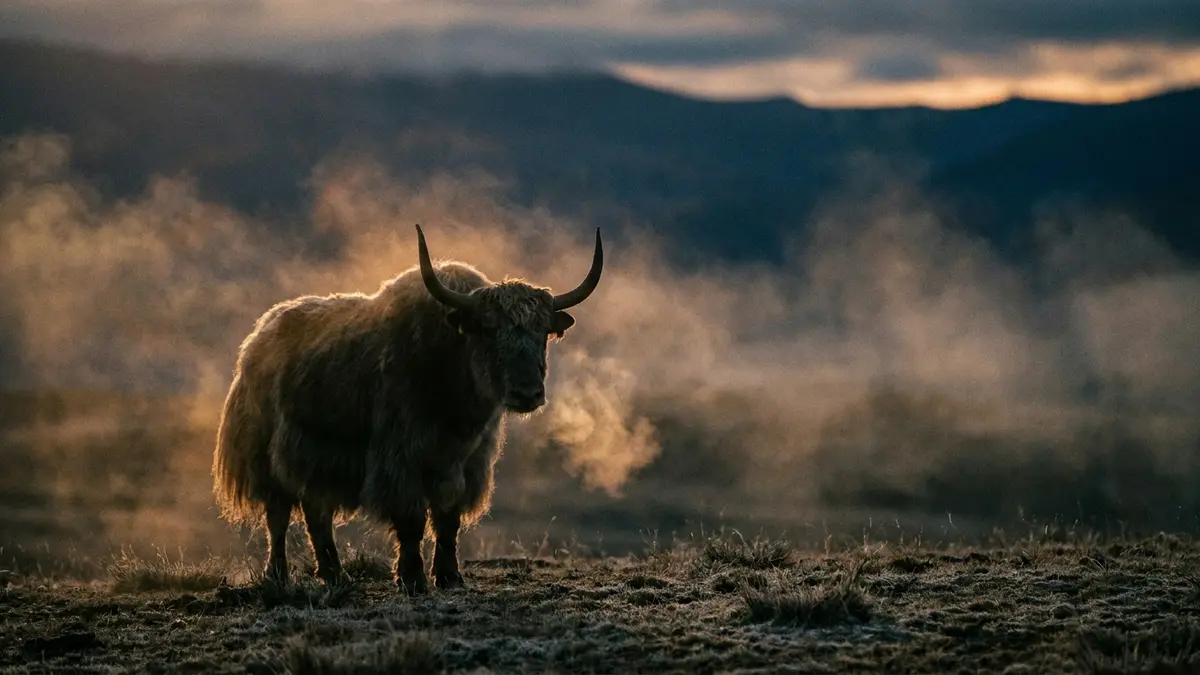
A Yak totem or power animal shows up when you're low on resources or hope, and it tells you that you already have the inner tools to survive tough conditions and find comfort in solitude. The fact that your resources are running low doesn't mean you're doing anything wrong. Your loyalty will remain steadfast, even if the effort required to do the right thing feels hard. You don't need to be glamorous to be good and wise.
An almanac
- Core message
- Endurance is its own form of grace
- Spirit animal
- Guide through scarcity and hardship
- Totem for
- Steady, purposeful, quietly stubborn souls
- Power animal
- Stamina and resolve when strength runs low
- In dreams
- Reflects persistence, direction, and community
- Cultural roots
- Sacred guardian of the Tibetan Plateau
- Built for altitude
- Larger lungs & heart, oxygen-rich blood
- Hybrid kin
- Dzo: a fertile yak-cattle cross
Yaks embody pure endurance. They've adapted to one of Earth's harshest environments, and their ability to survive in the Himalayas shows that you can be built for hardship and thrive. The Yak is a loyal and patient animal, and that's why it means toughness and quiet loyalty in cultures where it lives. Read on to learn more about the Yak's place in Tibetan traditions, what the Yak means as a spirit, totem, or power animal, and what it means if one shows up in your dreams.
Yak Symbolism & Meaning
Picture a shaggy-coated bovine grazing as high as 18,000 feet above sea level (nearly three and a half miles up), and you'll understand why the Yak has such a rugged reputation. Native to Tibet's high plateau, it survives conditions that would defeat most mammals — thin air, jagged rock, and brutal cold.
Despite its bulk (females run around 500 pounds, domesticated bulls up to roughly 1,300 pounds — wild bulls can approach a ton), the Yak lives on a humble diet of moss, tubers, wildflowers, and grass, using its curved horns to dig through frozen ground when food hides beneath snow.
Herders in the region domesticated Yaks several thousand years ago, depending on them to haul heavy loads across passes few other creatures could manage. That partnership makes the Yak a symbol of quiet trust, reciprocity, and hard-won progress. Herds even split by sex outside breeding season, a simple way to avoid needless conflict. The same logic runs through the animal's deeper lesson: look after yourself first, and skip the friction you don't need.
The Yak's endurance isn't just a matter of grit; it's built into its body. Its lungs and heart are larger than those of lowland cattle, and it carries a form of hemoglobin normally seen only in unborn calves — a trait that lets its blood pull oxygen from thin mountain air far more efficiently than an ordinary bovine could manage. It has almost no functional sweat glands, built entirely for cold rather than heat, and its digestion is so efficient that it can hold its condition on roughly a third of the daily forage cattle need. None of that is luck. It's the result of a creature that evolved, piece by piece, to thrive exactly where survival looks impossible, which is why the Yak's reputation for hard-won resilience is grounded in biology, not just poetic license.
Yak Spirit Animal
When you run into a yak, you're at the start of a time when you feel depleted in energy or resources, or feel discouraged and on the verge of losing hope. The guide doesn't have quick fixes — instead, it makes clear that you carry within you the skills and perseverance that will help you reach your goals. Even if others are pushing you to abandon your values, a yak reminds you that you'll keep moving toward your goal.
At the same time, if others are trying to rile you up by starting arguments with you, a yak inspires you to end the argument instead of feeding the anger. It often visits people who want to be alone. Being alone doesn't mean that they're lonely, and it's okay to go away and recharge yourself before coming back.
But sometimes a yak guides people into taking a back seat. Sometimes being unnoticed is more important than being the star.
Does Yak fit you?
Tap the ones that sound like you — 6 traits, no right answer.
0 of 6 Nothing picked yet — start tapping.
Yak Totem Animal
The yak symbolizes strength, steadiness, and purpose. If this animal has chosen you as your totem, these qualities likely apply to you. You're likely an old soul who rarely loses sight of your sense of purpose. You find it difficult to embrace sudden change, but you accept it nonetheless.
At work you're respected for your focus and follow-through, especially if you have little concern for "titles" or the superficial trappings of success. You have little patience for those who shirk their responsibilities. You also crave a simple life of tending to a garden, enjoying a hot cup of tea, or spending time with those you trust.
You're loyal to your family, friends, and lovers — and you put effort into maintaining these relationships even when those involved live apart from each other. Your calm exterior conceals passion; so watch out for a stubborn streak in your younger years — this tendency tends to soften as you mature.
Yak Power Animal
The yak is a power animal for people who feel tired out and need a shot of endurance and determination to keep them going. It can also be called on when creativity or inner energy feel flat. If you're worried about not having enough money, call on a yak to help you find ways to make the best of what you've got.
Yak in Tibetan Culture
The yak's homeland is the Tibetan Plateau, so it has important symbolism in the culture that shares that highland landscape. For many centuries, the yak was essential to survival in these harsh and cold mountains, and that debt has been repaid with genuine respect and love.
Each November, a festival called Gerdorom takes place. During this festival, people leave offerings for the yak spirits: they are seen as ancestral guardians, not just livestock. In a legend about where the wild yak came from, it is said to be among the stars. The yak is thought to protect the land and its people from up above.
Even when the yak dies, its body or bone is used for practical tools like tent fasteners. This use is not seen as exploitation but instead as an ongoing service to those who came before. In Tibetan Buddhism, butter lamps are made for many of the monasteries. They are made out of clarified yak butter. These lamps are lit to dispel darkness and help monks or nuns meditate. The pilgrims who provided the yak butter earn spiritual merit by donating this part of the animal's body.
The yak might also carry dead people from their home to places in the mountains where people believed their bodies were left out for animals to eat. When that duty ended for some yaks, they were set free.
Yak in Dreams
A yak in your dream mirrors what you're doing in real life to stay the course and stay connected.
- A yak looking right at you says you have what it takes to do it. But it also warns you not to go stubborn against common sense. You're probably doing right, but you might be taking the wrong road.
- A yak walking down a clear path reminds you to stick to your purpose and not get distracted. It's good that you want to grow — now's the time to grow, and if you keep going as you are now, things will go your way.
- A yak running back and forth means something in life is distracting you or confusing you or both, but don't panic. Step away from your situation and give yourself time to think. Running at random won't solve anything — a pause for reflection can help get you unconfused.
- A yak trapped in snow with nowhere to go signals that winter is ahead, but be assured that the cold won't last forever. Your inner fortitude will help get you through.
- A herd of yaks all together means that the people around you are good for you. They make life easier for you. Try not to lose them.
The Spiritual Meaning of Yak
However hard it is to face whatever life throws at you, the message of the yak remains clear: endurance is its own form of grace. This animal endures not by way of agility or intimidation, but by steady, patient effort — grazing in blizzards, carrying loads over passes, binding itself to others through trust rather than by exercising dominance.
When the yak energy enters your life, it may be asking you to do things slowly and deliberately rather than by way of taking risks, to put a value on quiet reliability instead of spectacle, and to find real strength in solitude when you need it. The ability to endure whatever happens to you in the world while remaining steadfast in your integrity is itself a spiritual accomplishment worth acknowledging.
The Dzo: When Yak Meets Cattle
In much of Nepal, Tibet, and Mongolia, long ago, people began mating Yak with domestic cattle. The result was a new hybrid animal known as a dzo (male) or dzomo (female). Compared to its parents, the dzo has greater muscle and vitality. It also shows how well two different powers can work together when blended rather than left to compete.
In spirit, the dzo may even offer a deeper lesson than the Yak's stamina. If a change you wish to make involves habits or features you've inherited, don't fear their influence. The ability you've gained from your parents may be exactly what you need to blend with your self-chosen habits or qualities. If you feel split between two identities or ways of working, remember the dzo is no weaker than its parents. It might turn out more potent.
Frequently Asked Questions
What does the Yak spirit animal represent?
If you see a yak in a dream, or it's your spirit animal, take it as a sign that you hold the inner tools to endure through scarcity and hardship, to stay true to your convictions, and to find comfort in solitude without guilt.
What does it mean to have Yak as a totem animal?
People with Yak as a totem animal are steady, purposeful, and quietly stubborn when they're young. As they mature, they become less stubborn and more flexible. They value dependable routines and hard work, and they care about loyal, long-lasting relationships.
What does dreaming about a Yak mean?
Dreams about yaks usually reflect your persistence, sense of direction, and sense of community. If a yak is on a clear path, it suggests that you have a clear sense of direction. If a yak is running aimlessly or is caught in a snowstorm, it suggests confusion or an emotionally cold stretch that you will be able to work through with patience.
Is a Yak the same as a bison or buffalo?
So no, although they're close cousins. They all belong to the same genus as cows, and some research even suggests the yak is closer to bison than to the other cattle. Spiritually, that shared ancestry reinforces the yak's association with raw, ancestral strength, but their specific gift is the endurance needed for living at high altitudes and in extreme conditions (as opposed to a bison's gift of power on the plains).
What does an aggressive or charging Yak mean in a dream?
A dream where a Yak attacks you, or turns aggressive in any way, is a sign that it's time to confront some issue in your life that you've been ignoring or putting off. It's not warning of immediate danger, but it suggests that confronting the issue will open the door to a fresh start.
What does it mean to dream that you are a Yak?
To dream you've become a yak usually means you feel weighted down. It could also reflect an unspoken loneliness under your calm, helpful exterior. Let someone else bear some of the load.
Yak also represents
- Other animals that represent love →Alongside Dove, Swan, Wolf, Seahorse
- Other animals that represent strength →Alongside Lion, Bear, Tiger, Elephant
- Other animals that represent resilience →Alongside Cockroach, Camel, Salmon, Turtle
- Other animals that represent loyalty →Alongside Dog, Wolf, Swan, Penguin
Sources
Claims on this page were checked against these published sources.
- Yak
Males: 350 to 585 kg (772 to 1,290 lb) ... Females: 225 to 255 kg (496 to 562 lb) ... Bulls can reach up to 1,000 kg (2,200 lb)
Read the source → - Yak whole-genome resequencing reveals domestication signatures and prehistoric population expansions
yak were domesticated as early as c. 7500 years ago
Read the source → - Domestic yak
The oldest dated physical evidence of yak domestication is from 2,500 years BP
Read the source → - Wild yak
Their primary diet consists of grasses and sedges including Carex, Stipa, and Kobresia species. Supplementary foods include herbs, winterfat shrubs, mosses, and lichens.
Read the source → - Social, Cultural and Economic Context of Yak Production
In Tibetan farming areas of Sichuan province of China, there is a special festival to offer sacrifices to 'yak gods' or ancestors, called Gerdorom, which takes place every November.
Read the source → - Butter lamp
The lamps traditionally burn clarified yak butter... help to focus the mind and aid meditation... Pilgrims supply lamp oil as a means to gain spiritual merit
Read the source →