Mammals · Spirit animal
Sloth Spiritual Meaning & Symbolism
The unhurried teacher of deep patience, quiet camouflage, and energy well spent
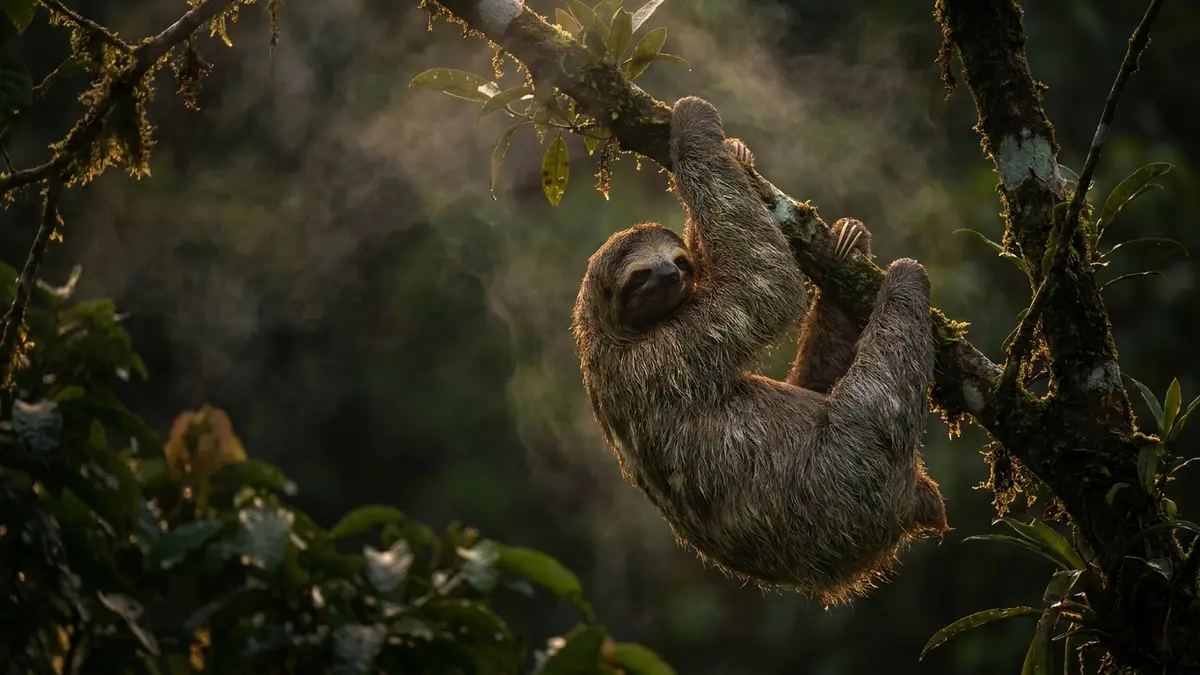
Sloth's meaning as a spirit animal emphasizes the importance of patience, calm stillness, and the wisdom of saving your energy instead of rushing. Sloth reminds you that rest can be a strategy, not a weakness. It urges you to slow down, watch carefully, and let the growth happen at its own pace. In dreams, Sloth can have different meanings depending on the context — either as a signal to retreat and protect yourself, or as a call to really take rest.
An almanac
- Core message
- Slow down, conserve energy, observe before acting
- Spirit animal
- A call to rest, not push through exhaustion
- Totem for
- Patient, harmony-seeking, quietly intuitive people
- Power animal
- Deliberate stillness instead of rushed action
- In dreams
- Meaning shifts with the scene — hiding, exposure, stillness, or rest
- Cultural roots
- Amazonian Mapinguari legend & Brazilian folklore
- Fur world
- Hosts algae, moths & beetles in a tiny living ecosystem
- Digestion
- A single meal can take up to a month to fully process
Watching a sloth move through the trees, you might mistakenly think it's lazy. But it's actually using its unhurried pace to survive. The fact is, the sloth's survival strategy is built around patience, quiet observation and the wisdom of doing less so you do what's important well. If Sloth moves into your awareness, you'll probably never get an earful from it. It will simply sit quietly in a tree until you're ready to slow down enough to notice.
Sloth Symbolism & Meaning
The sloth is a rainforest mammal that lives in Central and South America. It's been evolving this way for millions of years.
If you're only looking at it for a moment, it's easy to dismiss the sloth as lazy. But really, that's not the case.
The sloth moves slowly — very slowly — to conserve energy. But this helps keep it from being noticed by predators. So camouflage is a good survival strategy for a creature with limited energy.
Unlike predators that need bursts of energy, the sloth gets its food from leaves — and leaves provide a steady diet. So there's no reason to sprint around.
You might think the sloth is clumsy when climbing trees or walking on the ground, but in fact they're good swimmers. A sloth can hold its breath underwater for almost 40 minutes!
Even digestion happens slowly with this animal: it can take almost a month to break down one meal!
In their natural environment, wild sloths sleep about the same amount of time as an average human being.
Sloth Spirit Animal
Sloth is a spirit animal that's likely to show up when you need a good reminder to stop and rest. If you feel overextended, anxious, or like you're running on empty, Sloth is here to say that resting isn't a sign of weakness — it's actually the right way to handle these situations. You can't pour from an empty well, so you'll need to learn how to take time to replenish your energy.
Sloth also appears if there's some kind of conflict or threat approaching, and instead of trying to confront it immediately, you should probably just try to stay out of sight and wait for things to blow over. At that point, Sloth will model restraint and patience for you — so even though growth under its guidance won't happen overnight, it will happen eventually.
Because Sloth spends so much time suspended in trees looking around its surroundings, you can use it as an example of the power of self-knowledge. Take a moment for introspection — look at your thoughts and reactions honestly — because understanding yourself better isn't wasted time.
Does Sloth fit you?
Tap the ones that sound like you — 6 traits, no right answer.
0 of 6 Nothing picked yet — start tapping.
Sloth Totem Animal
People who are born under the Sloth totem care a lot about harmony — both in their environment and with the people around them. They often find a lot of pleasure in small things, and this contentment can help lighten everyone's mood. People born under the Sloth totem tend to be better at supporting other people behind-the-scenes than standing in the spotlight, and they also have great intuition, although not everyone trusts it. Usually, these people are very private and reserved, so they will need time before they will open up to someone. These same traits mean that Sloth people rarely get swept away by flattery or fancy sales pitches; they prefer good reasoning before committing to an idea. What's more, because Sloths look at the world upside down from the treetops, people born under this totem may also see situations from an unconventional angle — which can seem strange at first but reveal new insights others might miss.
Sloth Power Animal
When there's a time you have to hold back in the face of doing something, call on the Sloth power animal. This might mean:
- Saving your energy when there's a lot of energy-demanding tasks and there's no need for you to rush through them.
- Waiting for a situation to settle before getting involved in it when there's a conflict brewing
- Taking some time off for recovery or some rest if you feel tired, even when there are more things to be done.
- Thinking carefully and being observant before making any big decision or just rushing to do something.
Sloth power is not about being passive — it's all about being patient so that you can eventually come up with a better outcome instead of one that makes things worse.
Amazonian Sloth Symbolic Meanings
In the rainforest, people tell many legends about sloths. But one, in particular, is especially common. It's called the Mapinguari, and it's a giant monster that roars from deep in the jungle. Most people say that it is like a large monkey, or like an ape. People say it has backwards feet with sharp claws, and matted hair covering its face. One legend says that it has only one eye. And some people tell another legend about the Mapinguari. They say that long ago a shaman gave up being human. In return for this sacrifice, he became immortal and became this huge beast called the Mapinguari.
Most experts think the Mapinguari is related to stories from many parts of the world about giants and big monsters. And they connect it to a kind of big animal, a giant ground sloth, which they think may have looked like an animal bigger than an elephant. These stories say that when someone gets too close to nature or behaves badly in some way toward nature, he may be attacked by this giant monster.
People claim there are sounds in the deep jungle which sound like roars from the Mapinguari. Some people point out claw marks on trees as evidence of his existence.
Brazilian Sloth Symbolic Meanings
A popular story tells how Sloth is reluctant to cross paths with Jaguar.
One day, faced with a dinner emergency, Sloth secretly visited four neighbors and got them to lend him food in return for promises to pay back. He summoned one neighbor after another, who pitying his apparent ill health all waved off the debt in turn, leaving Sloth with enough food for many days.
But when all four neighbors showed up at once (a chance assembly they found unbelievable), chaos broke out. Mouse was swallowed by snake, snake was swallowed by boar, and boar was swallowed by jaguar — while Sloth, scarcely getting his body out from under the hullabaloo, bolted in the opposite direction. Even today the story of that day has two morals: don't try to fool a jaguar; and stick with patience if you want to win an argument.
Sloth in Dreams
A Sloth in your dreams is a symbol that changes depending on its surroundings. If you see a dream-Sloth that's barely visible or hidden in leaves, it could mean that you need to be more cautious or protective in a current situation.
If the Sloth is completely exposed, it might be a signal to take more of a leading role in a group or situation.
When the Sloth is stiff and rigid, it could mean that your goals aren't moving forward. Even if you're taking small steps in the right direction, you should count those as progress.
If the Sloth is peeking out at you, it might mean that you need to give extra care to someone who might need more attention from you.
If there are two or more Sloths, it could mean that you should look for people who can help motivate and support you.
If the dream-Sloth is lounging or resting in a hammock, it could indicate that you're craving more downtime and relaxation.
If the Sloth is basking in the sun and fully exposed, it could signify that you need some genuine downtime outdoors, away from screens and obligations.
If the Sloth appears sickly or struggling to move, it could suggest that your self-care practices need some attention. You might be neglecting your body and energy levels, which can impact your overall well-being.
Overall, a dream-Sloth might be drawing your attention to areas of complacency or situations where someone isn't pulling their weight.
Sloth Spiritual Meaning
Sloth's spiritual message reads as a quiet act of rebellion against a culture obsessed with speed. It teaches that stillness can be strategic, that invisibility can be a form of protection rather than avoidance, and that real wisdom often comes from watching carefully before acting at all.
Sloth encourages you to trust your own rhythm, protect your energy like the finite resource it is, and let transformation unfold in its own time rather than forcing it. In a world that prizes hustle, Sloth's steady, deliberate presence is a reminder that slow and thoughtful can still be its own kind of powerful.
Sloth's Hidden Ecosystem
The first thing you notice about Sloth's fur is the way it somehow blends in even in the middle of its hair — the individual strands are coated in a faint blue-green algae. The grooves that let the algae settle also let beetles, moths, and fungi dwell safely at the fur's base, cocooned in their own unhurried self-sustaining world.
From there, it's a short walk to thinking about generosity. There's no reason for Sloth to expect gratitude for its ecosystem, or even recognition; instead it offers its quiet presence as refuge and food simply because that's what it is here for.
There's no need to hustle or be visible or loud — sometimes offering support means existing calmly in your own space and accepting the way others make use of you. There may be more to what you offer than you've given yourself credit for.
Two Kinds of Sloth, One Shared Path
Two kinds of sloth live in Central and South America, and despite looking almost identical, they're only distantly related — from different lineages that branched out 20 million years ago. It's a good example of how two animals can end up living in similar ways.
And this offers a small but powerful reminder that there are many different ways to achieve the same goals. Your hard-won calm is just as valid as someone born unhurried.
Frequently Asked Questions
What does it mean when Sloth is your spirit animal?
It reminds you that it's better to conserve your energy and observe carefully before rushing into something.
What are common Sloth totem personality traits?
People drawn to Sloth totems are usually reserved but with solid reasoning; they avoid drama and prefer to work quietly behind the scenes. They value harmony and tend to see situations from unusual angles.
What does seeing a Sloth in a dream mean?
It depends on how you see the Sloth in your dream. If it's hidden from view, that could suggest you need to protect yourself or retreat. An exposed Sloth might encourage you to be more assertive. A rigid Sloth could signal stalled ambitions, while a lounging one might point to a need for genuine rest.
Why does Sloth have algae growing in its fur, and what does that mean spiritually?
A Sloth's fur is infested with algae that serves as a home to moths and beetles found almost nowhere else. Symbolically, this animal shows generosity and patience — a Sloth sustains an entire community without asking for any credit. By simply being who they are, Sloths provide a calm, steady presence that supports others.
Is Sloth considered a lucky spirit animal?
Sloth isn't a dramatic or flashy omen, but many people consider the appearance of Sloth a fortunate one, since the omen usually arrives just when you need permission to slow down. Its gift is timing — nudging you to rest or to be patient at the exact moment when pushing harder would backfire.
Sloth also represents
Sources
Claims on this page were checked against these published sources.
- Sloth
tropical rainforests of Central and South America
Read the source → - Mapinguari
a man-eating monster that is extremely foul-smelling and hairy, with hook-shaped nails, backwards-facing feet... a single eye like a Cyclops... Various accounts describe it as giant and monkey-like
Read the source → - Why are Sloths So Slow? And Other Sloth Facts
Each strand of a sloth's coarse fur has grooves that run from top to bottom where two types of blue-green algae grow. ... some species, like the sloth moth, live exclusively on sloth fur!
Read the source → - Study shakes up sloth family tree
the three-toed sloth is more closely related to a large family that included ancient elephant-sized ground sloths; meanwhile, the two-toed sloth appears to be the last survivor of an ancient lineage... which likely split off about 20 million years ago.
Read the source →