Animal Facts
Red Panda Facts: What the Popular Version Gets Wrong
The red panda's false thumb evolved for climbing trees, not for gripping bamboo.
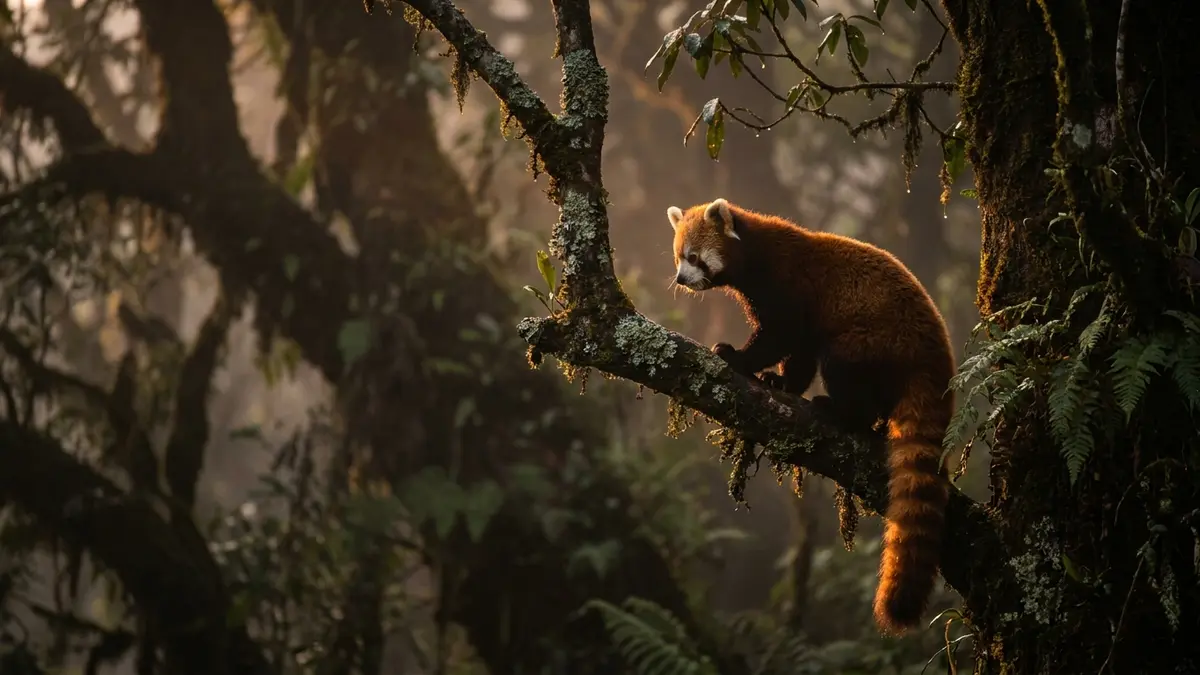
The red panda (Ailurus fulgens) is the only living member of the family Ailuridae, but it is not a lone branch — it sits in the superfamily Musteloidea alongside raccoons, weasels and skunks, not bears. It weighs 3.6–7.7 kg, lives at roughly 2,500–4,000 m across Bhutan, China, India, Myanmar and Nepal, and eats somewhere between 90% and 98% bamboo depending on the source, amounting to 20–30% of its own body weight each day. The IUCN has listed it as Endangered since its 2015 assessment, which gives no global population figure at all.
An almanac
- Scientific name
- Ailurus fulgens (F.G. Cuvier, 1825) — sole living member of the family Ailuridae
- Size
- 3.6–7.7 kg (8–17 lb); body 56–62.5 cm plus a 37–47 cm tail
- Range
- Bhutan, China, India, Myanmar and Nepal, typically 2,500–4,000 m in the Eastern Himalayas
- Diet
- Roughly 90–98% bamboo depending on source and season (National Zoo: ~95%; IUCN: 98%; San Diego Zoo: ~90%), plus fruit, acorns, lichens, eggs, insects and small mammals
- Conservation status
- Endangered (IUCN, assessed 11 April 2015; errata 2017; annotated 'Needs updating'). No global population figure is given in the assessment; a commonly cited expert estimate is fewer than 10,000 individuals
- Lifespan
- Roughly 8–10 years in the wild; San Diego Zoo reports up to 15 years in zoos, while Smithsonian's National Zoo says red pandas 'may live as long as 23 years.' The captive maximum is disputed between sources
- Closest living relatives
- No other species in its own family; its nearest kin sit in the superfamily Musteloidea — raccoons, weasels and skunks, not bears
The red panda is a cat-sized, rust-coloured mammal of the Eastern Himalayan forests, built around one awkward compromise: it belongs to the order Carnivora, keeps a carnivore's short gut and shredding teeth, and eats almost nothing but bamboo. Everything odd about it follows from that — the volume it has to swallow, the leaf-tip fussiness, the wrist bone doing a thumb's job.
Most of what circulates about the species is either a borrowed giant panda fact or a tidied-up guess. The extra thumb is described as a bamboo tool when the fossil record says otherwise. The metabolism is described as freakishly slow when it was measured and found ordinary. The population is quoted as a hard number when the assessment behind it says outright that nobody has quantified the decline.
This page keeps the claims that hold up against their sources and states the disagreements where they exist, including where two respected zoos give different numbers for the same thing.
Red Panda facts that hold up
- Its family has exactly one member, but its lineage is not isolated. The red panda is the only living member of the family Ailuridae, but it is not without close relatives — it sits inside the superfamily Musteloidea alongside raccoons (Procyonidae), weasels (Mustelidae) and skunks (Mephitidae). Its family is monotypic; its lineage is not isolated.
- The red panda had the name first. Western science described it in 1825. WWF-UK notes that the giant panda came much later, in 1869, "acquiring the name 'panda' as both species share similar feeding habits in the wild." The black-and-white bear is the one named after something else.
- There may be two species, but the official listing has not caught up. A 2020 genomic study of 65 whole genomes placed the divergence between the Himalayan (Ailurus fulgens) and Chinese (Ailurus styani) red pandas at about 220,000 years ago. The split is real and well supported genetically, but the arrangement is not yet universal: the IUCN Red List still assesses a single species and files the second taxon as the subspecies A. f. styani, noting only that Groves (2011) argued for separating them. Articles that state flatly "there are two species of red panda" are running ahead of the listing.
- Bamboo is most of the diet, but the share is not settled. Roughly 90–98% bamboo depending on source and season (National Zoo: ~95%; IUCN: 98%; San Diego Zoo: ~90%), plus fruit, acorns, lichens, eggs, insects and small mammals. It also feeds selectively within the plant, taking leaf tips and tender shoots rather than whole stems.
- It eats 20 to 30% of its own body weight in bamboo every day. Smithsonian Magazine puts the reason bluntly: "Because they retained the digestive system of a carnivore, a red panda has to eat 20 to 30 percent of their body weight in bamboo each day."
- About 20,000 leaves in a day. In work cited by San Diego Zoo Wildlife Alliance, "female red pandas were found to eat approximately 20,000 bamboo leaves in a single day."
- Only a fraction of that food is absorbed. Feeding trials (cited in Fei et al. 2017) put red panda assimilation at 22–42%, varying with whether the animal is eating bamboo leaves or shoots. Fei et al. measured resting metabolic rate by respirometry in 17 animals; the assimilation figure is re-cited from earlier studies, not one of that paper's own measurements.
- The metabolism is ordinary for the body size. Fei et al. 2017 (PLOS ONE) found "the metabolic rate of the red panda was similar to that of other mammals of the same size," and concluded that "based on their metabolic rates red pandas would not be limited by their food supply in natural reserves." The famous slow-bamboo-eater figure — daily energy expenditure at about 38% of the mammalian prediction — belongs to the giant panda (Nie et al. 2015, Science) and should not be transferred to this animal.
- The "thumb" is a wrist bone, and it did not begin as a bamboo tool. It is an enlarged radial sesamoid. The Miocene ailurid Simocyon batalleri, a puma-sized meat-eating tree climber with no bamboo in its diet, already had one. PNAS (Salesa et al., 2006): "...the false thumbs of the red panda and of S. batalleri more likely evolved as an aid for arboreal locomotion, with the red panda secondarily developing its ability for item manipulation..."
- It walks down tree trunks head-first. Smithsonian's National Zoo: "Their ankles are extremely flexible, and the fibula and tibia are attached in such a way as to allow the fibula to rotate about its axis." The hind feet swivel backwards, so the descent does not have to be done in reverse.
- It is the first non-primate mammal found to like aspartame. In a Monell Chemical Senses Center study published in 2009, red pandas also drank neotame and sucralose, while ferrets, genets, meerkats, mongooses and lions ignored all three.
- Endangered since 2015. The IUCN listing reads: "Red Panda is listed as Endangered because its population has plausibly declined by 50% over the last three generations (estimated at 18 years) and this decline is projected to continue, and probably intensify, in the next three generations."
- Canine distemper kills them, vaccinated or not. The disease arrives with herders' domestic and feral dogs. The IUCN assessment states that red pandas are "highly susceptible to canine distemper (even developing the disease after vaccination with domestic dog vaccine), which is lethal to them."
- The 10,000 figure is an expert estimate, not a census. The number is attached to the 2015 assessment rather than produced by a global count, and the same assessment says there is no credible quantification of the decline rate anywhere in the species' range. It also carries a "Needs updating" annotation. Treat 10,000 as an order of magnitude; the widely circulated "only 2,500 left" is unsourced.
- A female is fertile for one or two days a year. She can also delay implantation of a fertilised egg for weeks, which is why recorded gestation runs anywhere from 93 to 156 days — the figure measures waiting as much as development.
- Ailurids once lived in North America. Two near-complete skeletons of Pristinailurus bristoli from the 4.5–4.9-million-year-old Gray Fossil Site sinkhole in Tennessee show extreme sexual dimorphism, the larger of the pair being nearly three times the size of today's red panda.
- It leaves a chemical signature on every branch it walks. Alongside anal glands and urine, the red panda has scent glands set between its footpads, so ordinary movement through the canopy doubles as territorial marking.
What the popular version gets wrong
"Red pandas are baby giant pandas, or at least close cousins of them." They sit in different families — the red panda in Ailuridae, the giant panda in the bear family Ursidae — and the red panda's nearest relatives are closer to raccoons, weasels and skunks. The shared name is a historical accident: the red panda was described in 1825 and the black-and-white bear was named after it in 1869.
"The red panda evolved its extra thumb so it could grip bamboo stalks." Fossils of Simocyon batalleri, a puma-sized meat-eating relative from the Miocene with no bamboo in its diet, already had the same enlarged wrist bone. In the red panda's lineage the structure most plausibly evolved for climbing, and only later got put to work on bamboo. The giant panda's identical-looking thumb evolved separately.
"The animal in the Firefox browser logo is a red panda." Half right, and the half that is usually repeated is the wrong half. Mozilla's own moderators say the icon depicts a fox; what came from the red panda is the name. "Firefox" is an old folk name for Ailurus fulgens, adopted in the 2004 rebrand.
"There are only about 2,500 red pandas left in the wild — or exactly 10,000, depending on the article." Nobody has counted them. The 2015 IUCN assessment that produced the Endangered listing states plainly that no credible quantification of the decline exists anywhere in the species' range; the decline was inferred from forest loss and threat pressure, and the assessment itself is flagged as needing updating. Country-level camera-trap surveys, like Bhutan's in 2023, are only now producing real numbers.
"Red pandas are herbivores that eat nothing but bamboo." They are members of the order Carnivora with a short carnivore's digestive tract and shredding teeth, and bamboo is a workaround rather than a specialisation. Alongside it they take fruit, roots, grasses, acorns, lichens, birds' eggs, insects and small mammals.
The red panda in pop culture
The browser came first, and the borrowing runs the opposite way to how it is usually told. Mozilla rebranded to Firefox in 2004, taking an old folk name for Ailurus fulgens — "firefox" was the animal's name long before it was software. What the company did not take was the animal's face. Asked directly whether the icon was a fox or a red panda, a Mozilla Support moderator answered: "hi, the logo is clearly depicting a fox - however the red panda (common name: firefox) is also a cute mascot for our browser." So the picture is a fox and the word is a red panda, which is the reverse of the version that circulates on social media every few months.
The species also gets a periodic visibility spike from film. Smithsonian Magazine published its red panda explainer in 2022 under the headline "Before Seeing 'Turning Red,' Learn These Amazing Red Panda Facts" — an example of how the animal tends to reach a general audience: attached to something else, and usually with the giant panda's biology quietly bolted on.
Individual red pandas on record
There is no verified celebrity red panda in the sources behind this page, and inventing one would be easy and dishonest. What the record does hold is a short list of specific animals that changed what is known about the species.
The first is the type specimen behind the name: the animal F.G. Cuvier described in 1825 as Ailurus fulgens, forty-four years before anyone in Western science named the giant panda. The second set is older by several million years — the two near-complete Pristinailurus bristoli skeletons pulled from the Gray Fossil Site sinkhole in Tennessee, dated to 4.5–4.9 million years ago, whose extreme size difference turned out to be a male and a female of one species rather than two forms. The larger of the pair is nearly three times the size of a modern red panda.
The third group has no names at all: the seventeen animals whose resting metabolic rates were measured by respirometry for Fei et al. 2017, and the red pandas at the Monell Chemical Senses Center who, in 2009, drank aspartame, neotame and sucralose while ferrets, genets, meerkats, mongooses and lions refused. Those unnamed individuals are responsible for most of the reliable numbers on this page.
Frequently Asked Questions
Are red pandas related to giant pandas?
No. The red panda is the only living member of the family Ailuridae, while the giant panda is a bear (Ursidae). The red panda's close relatives sit in the superfamily Musteloidea — raccoons, weasels and skunks. The shared name is a historical accident: the red panda was described in 1825, and the giant panda was named after it in 1869 because the two feed in similar ways.
What do red pandas eat besides bamboo?
Bamboo is roughly 90–98% of the diet depending on the source and the season (National Zoo says about 95%, the IUCN says 98%, San Diego Zoo frames it as about 90%). The rest is fruit, roots, succulent grasses, acorns, lichens, birds' eggs, insects and small mammals. A red panda has to get through 20–30% of its own body weight in bamboo daily, because it digests plants with a carnivore's gut.
How many red pandas are left in the wild?
Nobody knows. The 2015 IUCN assessment gives no global population figure and states that there is no credible quantification of the decline rate anywhere in the species' range; it is also annotated "Needs updating." A commonly cited expert estimate is fewer than 10,000 individuals. The "only 2,500 left" figure that circulates online is unsourced.
Why is the Firefox logo a red panda?
It isn't. Mozilla's own support moderators say the icon depicts a fox. What came from the animal is the word: "firefox" is an old folk name for Ailurus fulgens, which Mozilla adopted in the 2004 rebrand. The name is the red panda's; the picture is not.
How do red pandas climb down trees head first?
Their ankles are unusually flexible, and the fibula and tibia are joined in a way that lets the fibula rotate about its own axis. That allows the hind feet to swivel backwards and grip the trunk, so the animal can descend head-first instead of reversing down.
How long do red pandas live?
Roughly 8–10 years in the wild. The captive figure is disputed between sources: San Diego Zoo reports up to 15 years in zoos, while Smithsonian's National Zoo says red pandas "may live as long as 23 years." Any single number quoted without that caveat is picking one source over another.
More about the Red Panda
More from Animal Facts

Sources
Claims on this page were checked against these published sources.
- Top 5 facts about Red Pandas
However, the plot thickens as the red panda was first discovered in 1825, while the giant panda was discovered much later in 1869, acquiring the name ‘panda’ as both species share similar feeding habits in the wild.
Read the source → - Genomic evidence for two phylogenetic species and long-term population bottlenecks in red pandas
The divergence between the Himalayan (MH) and Chinese red pandas (EH-GLG, XXL-LS, and QL) occurred 0.22 Ma ago
Read the source → - Red panda
Bamboo constitutes about 95% of the red panda's diet.
Read the source → - Before Seeing 'Turning Red,' Learn These Amazing Red Panda Facts
Because they retained the digestive system of a carnivore, a red panda has to eat 20 to 30 percent of their body weight in bamboo each day.
Read the source → - Red Panda
female red pandas were found to eat approximately 20,000 bamboo leaves in a single day
Read the source → - Metabolic rate of the red panda, Ailurus fulgens, a dietary bamboo specialist
the metabolic rate of the red panda was similar to that of other mammals of the same size
Read the source → - Evidence of a false thumb in a fossil carnivore clarifies the evolution of pandas
whereas the false thumb of the giant panda probably evolved for manipulating bamboo, the false thumbs of S. batalleri and Ailurus fulgens more likely evolved as an aid for arboreal locomotion, with the red panda secondarily developing its ability for item manipulation and thus producing one of the most dramatic cases of convergence among vertebrates.
Read the source → - Red Pandas Reveal An Unexpected (Artificial) Sweet Tooth
The red panda is the first non-primate mammal to display a liking for the artificial sweetener aspartame.
Read the source → - Ailurus fulgens (Red Panda) — The IUCN Red List of Threatened Species
Red Panda is listed as Endangered because its population has plausibly declined by 50% over the last three generations (estimated at 18 years) and this decline is projected to continue, and probably intensify, in the next three generations.
Read the source → - Population & Conservation Status — Red Panda (Ailurus fulgens) Fact Sheet
Last IUCN assessment (2015) estimates fewer than 10,000 individuals
Read the source → - First-ever Red Panda Survey reveals over 300 red pandas in Bhutan
red pandas were found in nineteen districts, except for Pema Gatshel
Read the source → - The Gray Fossil Site Annotated Information
the large morph is nearly three times the size of the extant red panda, Ailurus fulgens
Read the source →
Not sure which animal is yours?
Consult the quiz