Mammals · Spirit animal
Pangolin Spiritual Meaning & Symbolism
The scaled, solitary guardian that protects by curling inward instead of lashing out, and treats quiet boundaries as worth defending.
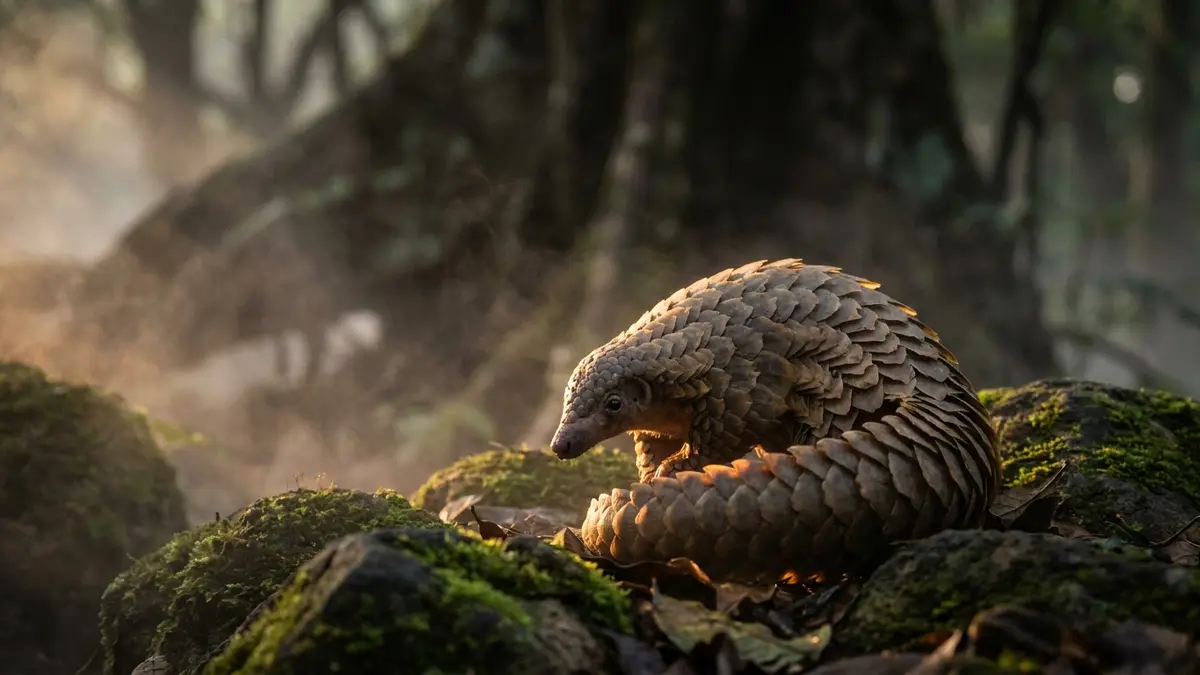
The pangolin protects itself against danger by curling into an armored ball when threatened. As a spirit animal, power animal, and totem, the pangolin inspires the idea of boundaries that protect but are not confrontational; the image of having thick skin — a quality associated with resilience. For these reasons, dream symbolism involving pangolins is usually seen as a positive sign — usually indicative of future healing and protective instincts.
An almanac
- Core message
- Protect through boundaries, not aggression
- Spirit animal
- Discretion, thick skin, clear limits
- Totem for
- Private, nocturnal, hard-to-categorize souls
- Power animal
- Rebuilding protective layers after exposure
- In dreams
- Good fortune, healing, protective instincts
- Element
- Earth (digging, patient effort)
- Species
- 8 total: 4 in Asia, 4 in Africa
Pangolins are tough little mammals who live mostly by themselves and survive by relying on armor, stealth, and clearly marked borders. Covered in overlapping scales made of keratin, they curl into a ball whenever threatened and let their own heavily armored shells protect them. This armor has been around since prehistory. As a spirit animal, or power animal, they speak to people learning to protect their energy, know themselves well, and find the truth.
Pangolin Symbolism & Meaning
The Pangolin is now the most heavily trafficked mammal on the planet, and an entire day each February is devoted to raising awareness of its survival. Native to the woodlands and savannas of sub-Saharan Africa, it keeps a solitary existence, coming together with others of its kind only to mate or raise young.
Spiritually, it's a guide for those who prefer their own company: pangolins have existed since the age of the earliest primates, roughly 47 million years ago, making them something like a living record of the planet's oldest lessons. Its Malay name translates roughly to "the one who rolls up," a nod to its signature defense of curling into a tight, scaled sphere the instant danger appears.
Those keratin plates, making up roughly a fifth of its body weight, are sharp-edged enough to wound a predator's mouth, and if that fails, the animal releases a pungent spray reminiscent of a Skunk, tying its medicine to boundary-setting and conflict avoidance.
Its digging claws root it in the earth element and in patient, determined effort, while its remarkably long, sticky tongue speaks to the power, and the responsibility, behind careful word choice.
That tongue is a stranger piece of anatomy than it looks: rather than anchoring at the jaw, it's rooted deep near the pelvis and the last pair of ribs, and when fully unfurled can reach nearly half the combined length of the animal's head and body. It's put to serious use: a single Pangolin can work through more than 70 million ants and termites in a year. Of the eight living species, four keep to the forests of Asia and four to the woodlands of Africa, and every one of them carries this same essential medicine of armor, discretion, and unclaimed ground.
Pangolin Spirit Animal
When the pangolin spirit animal appears, it invites you to practice discretion and self-restraint. Rather than exposing your vulnerabilities or confronting others, it encourages you to prioritize your safety and well-being. This might mean keeping personal matters private until the time is right, or acknowledging that not all remarks or criticisms deserve a response.
The pangolin spirit animal suggests adopting a thick skin and letting unwelcome words pass by without allowing them to affect you deeply. Additionally, it reminds you that there is no need to conform to others' expectations; instead, celebrate your unique qualities and embrace your individuality.
Finally, the pangolin spirit animal arrives when it's time to set boundaries and communicate your limits clearly. This is especially important with individuals who are not receptive to subtlety and may require direct and assertive communication from you.
Does Pangolin fit you?
Tap the ones that sound like you — 6 traits, no right answer.
0 of 6 Nothing picked yet — start tapping.
Pangolin Totem Animal
People who are especially attuned to the symbolism of pangolins tend to have a lot of the qualities that pangolins possess. For one thing, they tend to be active mostly at night and to feel their most creative and comfortable at night.
These people feel as though they instinctively wish to retreat rather than confront things, which is okay so long as they come back and work with someone else who is closer or stronger when things get stressful.
They don't necessarily fit into one social box, and their style and mood can often change from day-to-day. This unpredictability is part of their charm. They value privacy an enormous amount and prefer for other people not to be near them unless they want to be.
As a result of this, closeness with others can be challenging unless these people work really hard on making themselves feel comfortable being open with other people.
Some pangolin-totem people go for short-term intense relationships rather than for relationships that last very long. In addition, though, they're really good listeners who often know how to make others feel comfortable when talking with them. They're able to catch things others miss in subtle undertones or comments about what the other person is saying.
Pangolin Power Animal
If you need to protect yourself from someone's unwanted attention, get to know the powers of your pangolin power animal. This kind-hearted creature will help you wrap yourself in those protective layers you need.
Your pangolin power animal brings out your need for your own breathing room so that you can choose how to be with people and how much of yourself to reveal. If it helps, wear it as a reminder: show people who you are and let your example open doors for others too.
This powerful protector stands right beside you if someone is being mean or nasty to you. Call on its energy to be the resilience and strength that are already inside you.
Across cultures
2 traditions — pick one to read its take.
Pangolin in African Symbolism
The Sangu people believe Pangolins are sent from the sky, living with ancestors in their realm and blessing the world below. According to tradition, anyone who sees a Pangolin should follow it so they might lead them home. The whole village then celebrates with singing and dancing, the Pangolin even rising up on its hind legs to join in the party. If it cries or laments during those festivities, it's believed to signify the promise of great rainfall soon.
Elsewhere on the continent, the Bamana of Mali make headdresses that incorporate antelope and aardvark forms alongside Pangolin scales, to honor Ci Wara, a spirit who taught them how to till the earth and plow the fields. In this context, the Pangolin represents earth-bound power which is symbolized as fertile abundance.
In Uganda, one of Buganda's most revered families, the Lugave clan of Katende in Mawokota — honored as one of its oldest and most prestigious lineages — is named after this wonderful creature. No one in this family is ever permitted to eat their totem animal: because it's considered too sacred for consumption.
Far Eastern Pangolin Symbolism
The Cantonese word for "pangolin" means something like "a creature that tunnels through mountains" -- a nod to its powerful front claws for digging. In Chinese folklore, the pangolin is said to have carved underground tunnels connecting distant corners of the earth, creating hidden passages safe for travel underground.
This imagery has helped the pangolin take on a symbolic role of quiet, patient effort. Like the pangolin digging through the earth, hiding from view until something valuable turns up, it can encourage those who toil silently and diligently for rewards that nobody can see. With perseverance even unseen work eventually creates its own path forward.
Pangolin Dreams
If you dream of a pangolin, it often means good fortune is coming your way. It can also mean that if you have been feeling ill, soon you will get better.
- If in the dream the mother pangolin is defending her young, it could mean that you want to protect the people or pets or projects you care about most.
- If the pangolin is curled into a defensive ball, it could mean that you are sensing a threat that you are unaware of, and should deal with it now. Or it could mean that you have a secret or fear that you are not telling anyone.
- If a pangolin in the dream is looking for food by digging into the ground, it may mean that when digging deeper into something in your real life, you will be rewarded for your efforts.
- If there are two pangolins together in the dream, this may indicate that someone who is like-minded will come into your life.
Pangolin Spiritual Meaning
Among all the creatures, the pangolin's meaning has a consistency. The teachings of this animal find expression through different cultures in ways that stay similar. One lesson often said is that aggression isn't the same as protection. This is an animal that survives by putting on scales to armor itself, by staying far away from danger, and by keeping quiet and not fighting, rather than by lashing out first and jumping into the fray. The Pangolin's spirit teaches you to think about whether boundaries are a better way to live than a life full of conflict.
The pangolin teaches you that solitude isn't loneliness and being hard to pin down or categorize isn't bad. The pangolin's teachings show what kind of strength lies in inner stability and stillness. Think of the pangolin as showing you how to curl up tight when you have to, dig deep when the truth is buried, and be strong enough to rise back up again after a danger passes.
Frequently Asked Questions
What does the Pangolin symbolize spiritually?
The Pangolin is a symbol of self-sufficiency, natural boundaries, and keeping yourself safe. In the animal kingdom, it's armored skin and tendency to curl up in a ball indicate it prefers peace and quiet over fighting. A creature of ancient origins, its presence symbolizes deep wisdom and a comfort with solitude.
What does it mean when a Pangolin appears in your dream?
If you dream of a Pangolin, you can expect good fortune on the way. If you see a Pangolin mother protectively shielding her young, it hints at protective instincts. If a Pangolin is curled up, it might suggest sensed danger or a hidden secret. Dreaming of two Pangolins together could mean the start of a promising partnership.
When should you call on the Pangolin as a power animal?
Call on pangolin power animal energy when you're exposed or under attack, physically or mentally. It helps you claim and protect your space and bounce back from such assaults.
How many species of Pangolin exist, and where do they live?
There are eight different species of Pangolins, four live in Asia and four live in Africa. Some Pangolins from Asia have hair growing between their scales, but African Pangolins do not. All species have the same core qualities of armored protection, quietness, and digging.
Is the Pangolin considered sacred in any culture?
Yes. The Baganda people of Uganda consider the pangolin to be the sacred animal of one of their oldest clans, the Lugave. Clan members observe a strict taboo against eating pangolins. The reason is simple: to them, pangolins are sacred.
Pangolin also represents
Sources
Claims on this page were checked against these published sources.
- Pangolin
This makes them the most trafficked animal in the world. ... The third Saturday in February is promoted as World Pangolin Day by the conservation NPO Annamiticus.
Read the source → - What is a Pangolin?
Four species are found in Africa south of the Sahara Desert: the ground pangolin, the white-bellied pangolin, the giant pangolin, and the black-bellied pangolin.
Read the source → - 13 Facts About Pangolins
Their brown scales are made from keratin, the same material as human fingernails, hair, animal hooves, and rhino horns. They cover most of their bodies and can account for around 20% of the pangolin's body weight.
Read the source → - Can the power of cultural mythology help give pangolins more than the ghost of a chance?
it was believed pangolins fell to Earth from the sky, sent by the spirits of the Sangus' ancestors... each newly arrived pangolin latches on to an individual human and follows them home... the person and the pangolin be confined at home and participate in rituals, reportedly involving singing and dancing with other community members... some pangolins are reported to shed tears profusely while dancing and this is interpreted as an omen of good rains in the coming year. Dry eyes signify drought.
Read the source → - Lesson Plan: Chi Wara Crest Mask
Ci-wara crest masks represent composite or hybrid mythical beings, combining characteristics from antelopes, aardvarks, pangolins, and humans... the scales of the pangolin... Bamana peoples honor Ci-wara as the spirit who taught their ancestors how to till the earth and grow crops.
Read the source → - How the Chinese legend of pangolins came true — but in a terrible way
Pangolins are said to travel all around the world underground in Chinese legend
Read the source → - Lugave Clan
Clan of Buganda kingdom
Read the source → - Clans and Totems in Buganda Culture
Lugave clan(Pangolin) ... Clans members have totems, and it is taboo for one to eat their totem.
Read the source →