Birds · Spirit animal
Cowbird Spiritual Meaning & Symbolism
Raised by strangers and still itself: resourceful, adaptable, unapologetic about who it turns out to be.
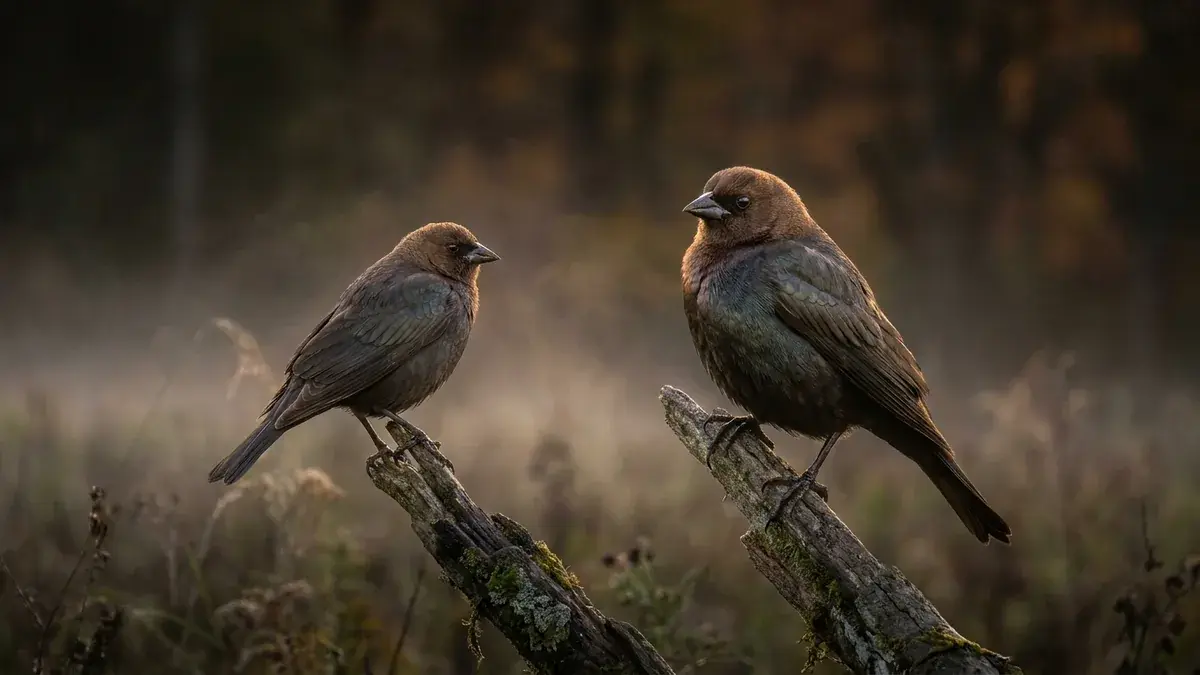
The cowbird is a bird that lays its eggs in the nests of other birds. Cowbird spirit animal energy comes from being self-reliant, adapting to whatever situation you're thrown into, and trusting yourself. It can appear in situations of being left out or neglected, getting in touch with your childlike wonder, or approaching some change of scene. In dreams the cowbird can represent a problem in a parent-child relationship.
An almanac
- Core message
- Own your nature without apology
- Spirit animal
- Abandonment, wonder, and travel
- Totem for
- Inventive, forward-looking free spirits
- Power animal
- Incubating ideas, sharpening instinct
- In dreams
- Strained or one-sided relationships
- Cultural roots
- Oneida legend of the modest song
- Historical range
- Once followed roaming bison herds
- Scientific name
- Molothrus ater — Greek for 'struggle to sire'
Cowbirds get a bad rap for neglecting their young. But in fact, they thrive by letting other species raise them. This practice can be seen as resourcefulness and self-confidence; cowbirds are unapologetic about using all the resources available to them. The same principle is reflected in a Native American legend about how the cowbird earned its modest song.
Cowbird Symbolism & Meaning
Cowbird starts life by putting on a show. Males cluster together in groups called corrals, and try to attract attention with clicking, whistling, and puffing themselves up. That bravado is part of its symbolism as a playful charmer who knows how to get what they want.
The deeper, more debated part comes after mating. Female Cowbirds lay their eggs in the nests of other birds, then stay around to check if their egg gets adopted before moving on. The cowbird's strategy works: they survive, but it's unsentimental and some people don't like it.
All that starts before the birds even hatch. Baby cowbirds are raised by foster parents of different species, so they have to be able to recognize their own kind when they leave the nest to go their own way. This is part of the cowbird's authenticity that no matter what happens to them along the way, they still belong with their own kind.
Male Cowbirds are shiny black and females are plain gray. Both look like they belong on earth — even though they live in the sky — because in the olden days, cowbirds used to follow bison herds across the prairie for food.
Even today many more cowbirds gather in huge flocks in winter than alone. They move in with huge groups of other species, too. Their scientific name includes a word for struggle to sire; it comes from ancient Greek. This hints at something deeper: that strife built into their whole method of reproduction.
Cowbird Spirit Animal
When the Cowbird is your spirit animal, you often find yourself thinking about the role you play in other people's lives and trying to figure out whether you're meeting their needs the way they need you to.
Sometimes this has to do with your own relationship. You might be hurt because someone important in your life has pushed you away or overlooked you. Or maybe it's the other way around--maybe you're the one who doesn't seem as involved as they want you to be.
But it might have to do with how you interact with people in general. Have you become jaded or cynical? Do any of your connections feel like they've been damaged or interrupted? Are people depending on you for love, support, and warmth in a way that feels overwhelming?
Sometimes the Cowbird appears as a symbol for your inner child. As a kid, did someone encourage your curiosity and wonder? Were you raised in an environment where imagination was celebrated and restraints were few? Did bad experiences put those childish parts of yourself on pause?
You can think of this spirit animal as a kind of reminder to set aside time to reconnect with those innocent joys.
Because Cowbirds often fly in search of food, they often appear as symbols of exploration or unexpected change. They can also remind us to be mindful about what we consume--not just our sustenance but our media consumption and our emotional cravings.
Does Cowbird fit you?
Tap the ones that sound like you — 6 traits, no right answer.
0 of 6 Nothing picked yet — start tapping.
Cowbird Totem Animal
People with Cowbird as a totem animal tend not to get deeply involved in relationships or traditional parenting roles. That's not because they're uncaring, but because their attention naturally moves on to the next idea or the next adventure. If you know someone with this totem, keep your interactions straightforward and light, and don't try to pull them into long emotional entanglements or drawn-out drama.
If Cowbird is your birth totem, you're likely a creative thinker who's constantly looking ahead to what's next. You're fascinated by what's unseen and mysterious, whether it's spiritual or just unfamiliar territory. Every new experience gets filed away in your memory, cataloged according to how it felt and what it did for you.
Flexibility and resourcefulness are key qualities for this totem. You may travel with the herd for a while like a cowbird does with cattle, but you never fully settle into the crowd. You know who you are and stay comfortable in your own skin.
Cowbird Power Animal
When the Cowbird power animal's calling you, it's often a sign that you need to keep a secret. Drawing on its energy can help you hide what you're working on, from brilliant new ideas to important plans that are still taking shape. When the right time comes to reveal those things, Cowbirds will help you leave some room for privacy.
Cowbirds will also help you stay grounded when the world's moving too fast and pressure is mounting at your work. And sometimes, this animal might show up if you've reached a roadblock and know you need more help. Or if there's a project that needs more time than you have, Cowbirds can help keep your confidence up until it's time for someone else to step in and take over.
The Cowbird's most powerful lesson, though, is that it sometimes takes wisdom to recognize when we're not the right people for something. Cowbirds show us how to gracefully step away and let someone better suited take the lead.
Native American Cowbird Symbolic Meanings
Some Native American people believe that the Cowbird got its simple, recognizable song from a story about a group of birds who competed to see who could fly highest above the ground. A small, shy bird called the Thrush secretly managed to ride along with a big, strong bird called the Eagle, so that when the birds took off together at dawn, Thrush would reach the top and get the most beautiful song for himself.
Thrush did manage to climb to the highest point in the sky, but he was ashamed when everyone saw him there because he hadn't done it on his own. So Thrush disappeared down a tree and stayed hidden there from that day on. That's where he still likes to sing even today.
Cowbird in Dreams
A dream featuring a Cowbird often concerns a fundamental tension between parents and children. What's specifically going on is the theme of this dream, but you might also see how this sort of tension can be metaphorically applied to any relationship, like between siblings, where one party looks after the other more than they do vice versa.
Interpretations of this dream can vary widely depending on the details. In some cases you're letting someone else look after your responsibility for the moment. In others a person may be pushing out someone else in a way that feels more or less justifiable, and still other times people may be trying to speak their mind in something that doesn't quite come out right.
It's common to find that this type of dream usually deals with real-life unfinished business or ill-advised half-measures. One person hands off something like an unwelcome responsibility to someone else, but only in a half-hearted way. Another feels strongly about making something happen, but does so in such an awkward way that it's unclear who even wanted it to happen. Still another lets past customs become outdated instead of taking action.
In either case — whether changing directions or keeping things as they are — it ultimately results in stalled growth, which is perhaps not what anyone really wants to see happen.
Cowbird Spiritual Meaning
It's remarkable that young cowbirds have no trouble fitting into their foster families —as if it isn't strange to be raised by a different kind of bird! Cowbirds demonstrate that we don't need to behave exactly like others to get along, that we can make new friends, and that we shouldn't confuse the birds who raise us with the ones who look like us. The cowbird's example is also a reminder that our true self remains intact even if we face unusual situations.
Look out for the cowbird if you get a chance. It will teach you to trust your instincts, let go of things you cannot control, and stop blaming yourself when things are different than you think they should be.
Cowbird's Retaliation Instinct
Parasitism in Cowbirds doesn't stop after they lay an egg. Researchers have found that Cowbirds sometimes track down the bird species they tricked and go back to their nest to break it up, throwing out all its eggs and destroying the young. It's a cruel cycle, but it happens.
You don't have to like it or even approve of it, but we're asking you to see how Cowbird could behave this way. It's a less-than-ideal example of what happens when self-trust turns into an us-or-them attitude. Trust is vital, but so is learning from the people who love you when your actions hurt them. We think of this story as a reminder:
- Before you choose to stop dealing with someone, consider what abandoning them does to that relationship.
- Question where your own confidence might be turning into a sense that you're entitled to anything you want.
- Forcing someone to accept your actions may seem justified in the moment, but take into account how your decision impacts others in the long run.
Cowbird and the Changeling Myth
Long before ornithologists had a name for brood parasitism, Europeans told stories of strange fairy children swapped secretly into human families. These changelings were just different enough to be noticed and just similar enough to pass as human at first. Different myths placed changelings all across Europe, from Ireland to Germany to Scandinavia.
No story places changelings among Cowbirds, which lay eggs in other animals' nests. Yet the changeling myth reflects the situation of birds raised outside their natural homes. The tales reveal the uneasy feeling of living with and raising a strange creature that looks like you but isn't. The changeling stories suggest something quieter too: that someone raised outside their own home can still build an identity that's all their own.
Frequently Asked Questions
What does Cowbird symbolize spiritually?
Cowbirds symbolize what it means to be resourceful, adaptable, and confident enough to make unconventional choices without feeling guilty. They symbolize authenticity too, since a Cowbird that was raised by a different species of bird will still return to its own identity.
What does it mean when a Cowbird appears as a spirit animal?
A cowbird spirit animal may remind you of themes of abandonment, such as when you have been left behind or when you left someone who needed you. It may also signal that travel is about to take place or is needed for reconnecting with your inner sense of wonder.
What does dreaming about a Cowbird mean?
It often suggests issues in your parent-child relationship. It could also mean that you're stuck in a role where things are out of balance. Perhaps you've abandoned something worthwhile or are trying to solve a problem without really solving it.
Do Cowbirds retaliate against birds that reject their eggs?
Yes. In more than half of tracked cases, female Brown-headed Cowbirds have returned to a host bird's nest after it removed a Cowbird egg, and destroyed the host's own eggs or nestlings in retaliation. Researchers documented this behavior, which they call mafia behavior, across a range of host species. It's a sobering piece of Cowbird biology that demonstrates the real consequences of failing to trust this bird.
Why is the Cowbird linked to bison and cattle?
When American bison used to roam the continent, brown-headed cowbirds lived on the insects that were stirred up when the bison roamed across the open prairie. When cattle replaced bison in many areas, the cowbirds followed along and watched after the cattle like a shadow. (They still do.)
Cowbird also represents
Sources
Claims on this page were checked against these published sources.
- Brown-headed cowbird
The brown-headed cowbird is an obligate brood parasite; it lays its eggs in the nests of other small passerines. ... Brown-headed cowbirds seem to periodically check on their eggs and young after they have deposited them.
Read the source → - The Legend of the Hermit Thrush
The next bird to stop his ascent was the cowbird, a very fat bird. He, too, was awarded a very simple song. ... The little thrush ... swiftly flew onto the eagle's head and buried himself under the eagle's feathers. ... flew into the deep woods in shame and with a heavy heart hid under the branches of the largest tree.
Read the source → - Brown-headed Cowbird species account
originally assoc with American bison ... Feeds and roosts in enormous flocks with other blackbirds and starlings, esp in winter.
Read the source → - Changeling
A changeling, also historically referred to as an auf or oaf, is a human-like creature found throughout much of European folklore.
Read the source →