Birds · Spirit animal
Cormorant Spiritual Meaning & Symbolism
The tireless diver who bonds family, flock, and flight into one shared rhythm.
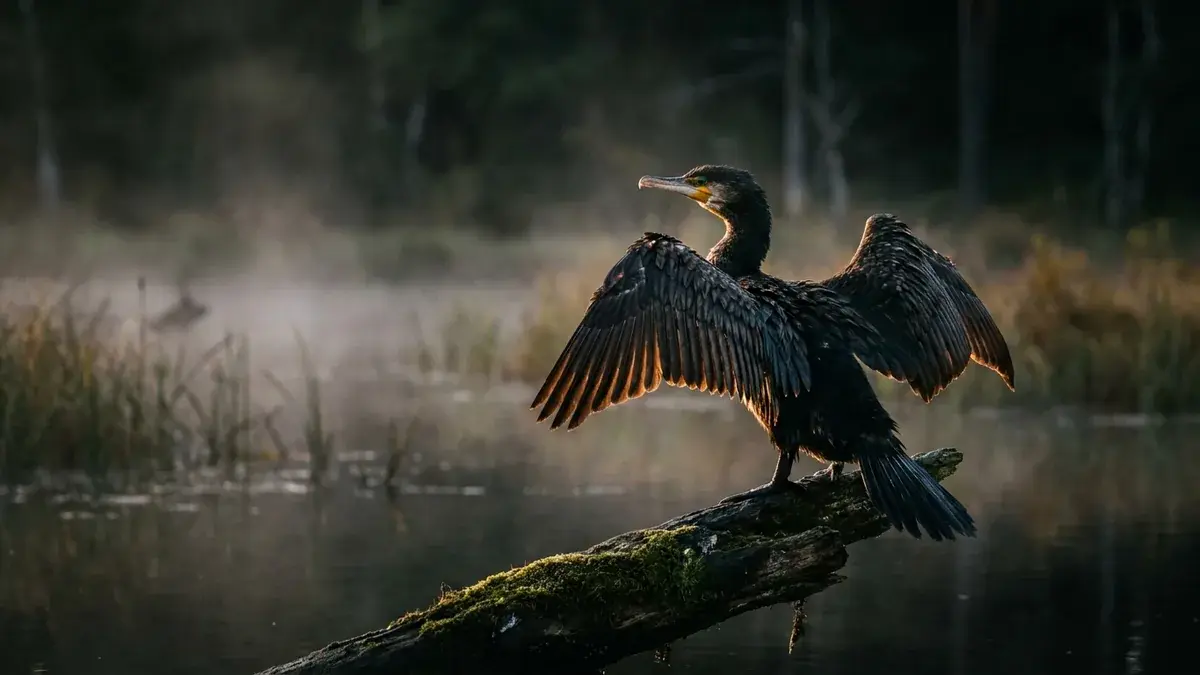
The Cormorant has to do with going deeper than the surface, trusting your instincts, and taking your own actions based on what you find out. Its meaning is about being self-sufficient, having connections in the community, and knowing how to handle a chaotic situation. In folklore, its appearance in a dream might mean that valuable wisdom is close at hand, but it also has been used as a warning about greed or as an omen from the deceased.
An almanac
- Core message
- Dive deep, trust your instincts, share the catch
- Spirit animal
- Stop overanalyzing and act on what you want
- Totem for
- Self-sufficient community-builders
- Power animal
- Boosts stamina and resourcefulness when asking for help
- In dreams
- Valuable insight or wisdom within reach
- Watch for
- Greed, or an omen from the deceased
- Ancient partnership
- Trained for fishing in China & Japan for 1,000+ years
- Wing-drying pose
- Read as a Christian cross in medieval heraldry
Cormorants are sleek seabirds found from the British coast to the Pacific islands. Seafarers for centuries have read a Cormorant's presence as a sign to consider, sometimes lucky, sometimes ominous, tied to the relationship between what you can see on the surface and what is hidden beneath. Their dives deep into the sea, large nests held by colonies, and shared parenting of a brood make this a symbol of family, resourcefulness, and the pull of your instincts.
Cormorant Symbolism & Meaning
Cormorants are seabirds with feathers and dark bodies that nest along rocky coastlines. They dive into the surf to hunt, and fishermen long thought them lucky signs. Sailors on old ships used to see them as good luck for a good catch, but they have a darker history too: Cormorants show up in folklore as a sign of someone missing at sea.
In The Odyssey, Ino, the goddess of the sea, changes form into a Cormorant to give the shipwrecked hero a veil to help him home. Throughout Polynesian culture and beyond, it's often used as an expression of love.
Cormorants have mixed symbolism. In Norway, the spirits of lost sailors at sea are supposed to return home as Cormorants.
Milton uses it as a symbol of greed in his epic poem Paradise Lost. Its name is made up from words that mean bald-headed and raven-like. It's usually given the Latin name for "sea raven". They can dive deep and do it for long periods. This has ties to deep diving with dreams or shapeshifting underwater.
But they can also carry those close underwater associations to family life by how they breed together and live in colonies. A lot of stories about deep diving see the bird as having light and dark associations – which ends up working with the old stories about them.
Feathers aren't very waterproof, but some will dive 150 ft (about 45m) deep where there is little light. The imperial shag has been seen up to 80m deep.
Cormorant Spirit Animal
When a cormorant is your spirit animal, it's time to actually name the desires you keep skimming over in your mind. This bird is more concerned with prompting you to act on what you know than it is with telling you what you want. If you feel nervous about trying something unfamiliar, intimidating, or just a little out of character, the cormorant wants to remind you to trust your gut. It also likes to show up when you're volunteering or doing something as part of a team; it's like your invisible cheerleader reminding you that group effort is a bit awkward but can be meaningful if we let it be.
Think of how the cormorant spreads its wings in the sunlight and lets them dry. This process is like stepping into visibility and letting your efforts be seen. The cormorant asks us to pay attention and take flight regardless of what happens.
Does Cormorant fit you?
Tap the ones that sound like you — 6 traits, no right answer.
0 of 6 Nothing picked yet — start tapping.
Cormorant Totem Animal
The Cormorant totem gives you a strong sense of belonging. You're an excellent community-builder, deeply loyal to family, friends, and neighbors, and can't turn down a request for help. Your practical grace can slip you out of tight spots and get you what you need.
Material success comes easily to people born under this totem. Sometimes they succeed early, and sometimes it takes awhile. When success seems distant or blocked, they see it as a puzzle rather than punishment.
Born under the Cormorant totem, you have a sharp mind and are naturally witty. A deep sense of self-sufficiency is at the heart of the Cormorant personality: avoid outside rescue — learn from mistakes and keep going.
Cormorant Power Animal
Call upon the cormorant, a powerful ally for tackling an unreachable goal. This bird is also useful when you need help asking for support from someone who has benefited from your help in the past. Tapping into the cormorant's energy can also give you more stamina, more confidence in your abilities, and an ability to work around obstacles.
Across cultures
2 traditions — pick one to read its take.
Native American Cormorant Symbolism
For the Ojibwe people, the cormorant represents persistent power. These courageous birds are balanced between water and air. Seeing a cormorant is a message that an answer to a question you have been considering is coming.
The Dakota people take Medicine Men's dreams of cormorants seriously enough that they would perform an entire ritual called the "Fish Dance" to ward off misfortune.
Cormorant in Aboriginal Symbolism
In many Aboriginal Dreamtime tales, the cormorant was one of the creatures who helped people when they were struggling. In some versions of the story, cormorants would bring fire to people and that's why they have dark feathers—because their feathers got burned carrying it.
In these stories, fire is usually brought to people by an animal like cormorants. Some animals who do this are crows and whales.
Cormorants also show up in some stories about the time people first lived on Earth.
Cormorant in Dreams
Seeing a cormorant in your dreams suggests that wisdom and insight are within reach, and that you're almost there. You might need to continue exploring or working with someone who can help you to this higher understanding.
Whether you find what you seek through your own inner exploration or with the help of someone you trust, this understanding will leave you more spiritually mature.
Seeing a diving cormorant suggests that you're only looking at surface matters, and you need to dig deeper before you'll find the real truth.
- A cormorant diving underwater suggests that you need to look further before you will reach the real answer.
- A cormorant holding a fish in its beak confirms that your cleverness and skills are enough to help you succeed in this goal.
- Several cormorants each holding fish shows others will help you with your tasks and reward will be shared.
- Lots of fish surrounding a single cormorant warns that greed is inappropriate in this situation; please separate out genuine need from your desires.
- If a cormorant dives repeatedly before it catches anything, it is telling that patience is needed; keep going and trust the process.
- A still cormorant perched high in the tree is an invitation to reflect on matters. The reflection could range from your physical self to your mental self.
Cormorant Spiritual Meaning
Cormorants teach that the greatest strength arises when you're able to comfortably shift between the visible and the hidden worlds, solitary pursuits and group activities.
When faced with a difficult challenge, it encourages you to dive past the excuses in your mind and go straight to the thing you need to find. Then you can return from that internal journey with a strong catch—and once again, returning home means sharing the find with those who depend on you.
With wings that happily span both air and water, cormorants embody adaptability. They're graceful gliders yet also remarkable divers, deep in their intuitive depths while still following cues from their flock and their community.
Their spirit of quiet resilience makes cormorants fierce helpers in times of great inner growth: dive when you must but take plenty of rest and sun afterward; know that your inner journey gets easier when you return home with that sturdy catch to share.
Cormorant Fishing: China & Japan's Ancient Partnership
Before it became the subject of fairy tales, the cormorant was working alongside fishermen across East Asia. In China, this sort of fishing has been around for a thousand years, and this is where the bird was best known as a working partner.
When cormorants fished with humans, the bird wore a long, loose string tied to its neck. The string wouldn't stop the cormorant from swallowing smaller fish, but it would get caught around its throat if the bird caught a big fish.
Fishing with Cormorants is an old practice in Japan. In Chinese records, people in Japan are said to have trained Cormorants to catch fish. Japan's traditional way of fishing was pretty much made into an entertainment for those with money. At one point in history, an emperor protected this type of fishing by giving it special permission from his government.
Some people still practice this way of fishing with Cormorants today, though there are now only about a dozen places that do it. Some fishermen keep these traditions alive because people pay them for tours to see their birds fishing.
Spiritually, this is a different story than the story we're used to about cormorants hunting alone. It's more like a bond between different kinds of creatures; each depends on the other in order to find what's hidden below and bring it back into view.
It's still like other spiritual stories about cormorants: an instinct for working together between very different species who need each other and give back what they take.
Morfran: The Welsh Cormorant of Arthurian Legend
Like the cormorant, the name Morfran comes straight from Welsh mythology. It's a compound of the Middle Welsh words for "sea" and "crow"—môr and brân—with a root meaning "raven," like the English word cormorant. In The Tale of Taliesin, a cup of magic potion for Morfran turns out to contain magic that instead grants insight to another character. But Morfran survives the disastrous Battle of Camlann despite his ugliness, thanks to his scary appearance frightening some of his attackers into thinking he's an inhuman creature. So this ugly-looking bird has one more lesson to share: don't underestimate something just because it seems plain, ugly, or uninteresting.
Cormorant in Heraldry & Christian Symbolism
In medieval heraldry and church art, the cormorant was almost always depicted with its wings held wide open like a cross. As carvers designed seals, coats of arms, and stonework across Europe, they took that posture as symbolic of nobility and sacrifice. Inherent in that pose is also a matter of exposure: cormorants have to keep their wings spread wide in front of everyone before they can fly again. To the animal-spirit symbolism, that makes for an apt message about making your efforts visible rather than hiding them until they're safe.
Frequently Asked Questions
What does a Cormorant symbolize spiritually?
Cormorants bring deep subconscious wisdom to the surface and empower you to act on it. As water birds that dive below the surface to fish, they symbolize moving between hidden and visible worlds. You need to tune into what the bird reveals before acting on it.
The cormorant can also represent resourcefulness, family cooperation, and courage to act.
Is seeing a Cormorant good or bad luck?
Traditionally, sighting a Cormorant meant good luck to many fishing communities. Others, especially in Ireland and Norway, felt the bird's appearance, especially when perched high up or flying in groups of three, was an omen or a message from those who had passed on.
What does it mean to dream about a Cormorant?
It probably indicates that you're on the verge of uncovering an important lesson or insight. If you dream about a Cormorant diving, that means you need to look past surface appearances, and to understand a bigger story. If you see a Cormorant holding a fish, it affirms your competence in certain situations. And if several Cormorants share fish in your dream, it means that others around you are ready to provide help or support.
Why do cormorants spread their wings out like a cross?
Cormorants don't have water-resistant feathers like ducks, so when they dive, their feathers get wet. After diving they spread their wings out to dry them in the sun and air. Scientists say this is mostly because their feathers are getting wet, and not because it helps them balance or digest food. Craftsmen during the Middle Ages saw spiritual meaning in this posture. They carved it into churches and coats of arms as a symbol for the Christian cross and also for nobility and sacrifice.
Is cormorant fishing still practiced today?
Yes. Though it's no longer practiced on the scale it was in past centuries, in some areas it does survive. In China, for example, there are still some commercial cormorant fisheries, mainly in the southwest. But there they're giving way to modern fishing gear. On the other hand, ukai survives as a sort of tourist attraction in Japanese cities, where today it serves mainly to show visitors an ancient partnership between bird and fisherman that stretches back well over a thousand years.
Cormorant also represents
Sources
Claims on this page were checked against these published sources.
- Cormorant
"Cormorant" is a contraction "probably derived from Latin corvus marinus, 'sea raven'" used since at least the early 19th century.
Read the source → - Homer, Odyssey Book 5 (Murray trans.)
she rose up from the deep like a sea-mew on the wing, and sat on the stoutly-bound raft ... Come, take this veil, and stretch it beneath thy breast.
Read the source → - Great cormorant
The duration of its dives varies from 1–3 minutes, with the bird diving to depths of up to a maximum of 9.5 metres (31 ft).
Read the source → - Cormorant fishing
has been practiced for over one thousand years... it is only in China that cormorants have been fully domesticated... a loose snare near the base of the bird's throat... when a cormorant has caught a fish in its throat, the fisherman brings the bird back to the boat and has it regurgitate the fish.
Read the source → - Morfran
from môr, 'sea', and brân, 'crow', from Common Brittonic *mori-brannos, as in French cormoran... his ugliness led everyone to believe he was 'a devil helping, for there was hair on his face like the hair of a stag.'
Read the source →