Mammals · Spirit animal
Cow Spiritual Meaning & Symbolism
Sacred, unhurried nurture — the abundance and watchful strength that keep everything else going.
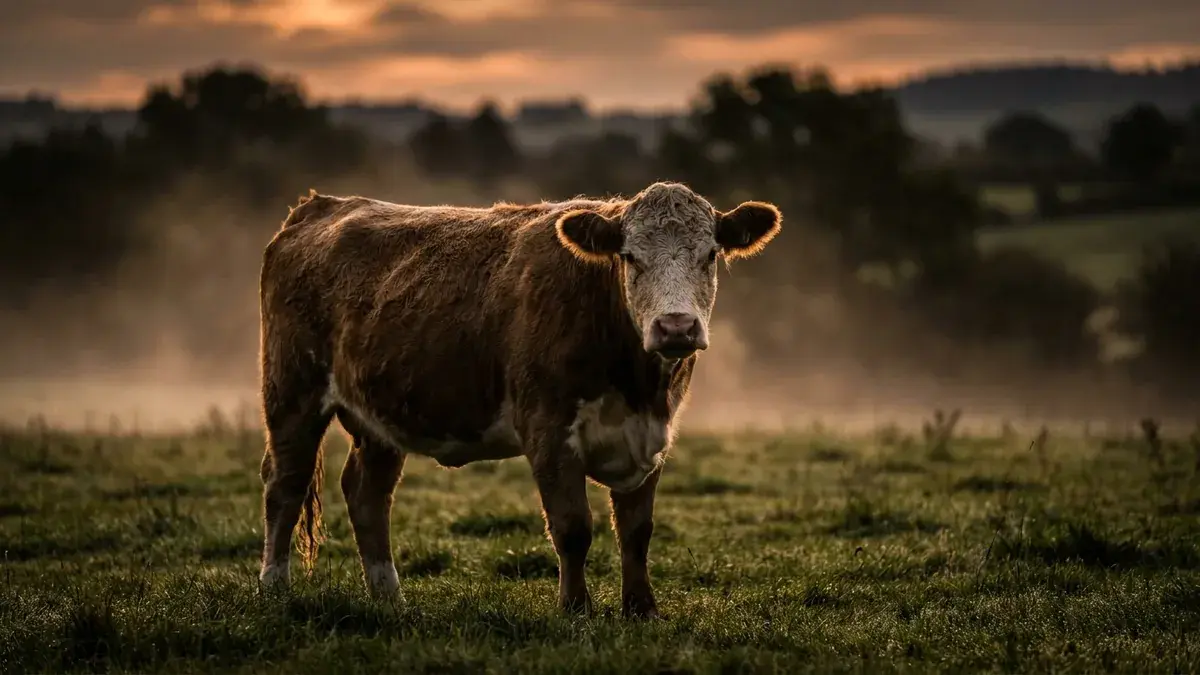
Motherhood and abundance are two of Cow's most powerful symbols. When she comes to you, this sacred animal will offer patient, steady nurturing that gives life the space and time it needs to grow. Her gentle strength, which is found in many different traditions, can seem particularly feminine to some people. In Hindu religion, for example, cows are considered sacred. The mother goddess or the holy goddess Brigit from Celtic culture are also images of the same powerful fertility.
The more familiar you become with Cow, the clearer it will become that life is a process of nurturing—giving our energies out to those around us and then taking the time to recharge ourselves.
An almanac
- Core message
- Nurture life through steady, patient giving
- Spirit animal
- Maternal wisdom and quiet resilience
- Totem for
- Stable, intuitive natural nurturers
- Power animal
- New beginnings and protection
- In dreams
- Fertility, contentment, nurturing
- Cultural roots
- Hindu, Egyptian, and Celtic mother goddesses
- First domesticated
- ~10,500 years ago from the wild aurochs
Cows are the antidotes for the hurried world. They possess a deep reservoir of nurturing energy that nourishes humans. If you see a Cow, she probably wants you to know that being selfless is a necessary part of life. You'll feel the best about yourself, as well as be most useful to others, when your focus is on giving, not taking.
Cow Symbolism & Meaning
Cows carry a special meaning in tradition after tradition: motherhood, abundance, and the cycle of life. Cows are so sacred to Hindus that they don't get killed for food. Instead, they're allowed to live out their lives.
Because cows give us milk and food, they also represent provision and basic needs like food. In Egyptian mythology, the sky goddess Nut is often shown as a gigantic cow arching over Earth. We call her "Mother of the Gods," "Guardian."
That Egyptian goddess shows us something about Cow symbolism. Cows are huge in their protective reach but tender with babies and young animals. Their provision and their protection make them very special to us humans.
Hathor is another Egyptian goddess. She's usually pictured with the sun between her horns, or holding him as she nurses the pharaoh.
The Hindu god Krishna is called "Protector of Cows." He grew up as a cowherder and became divine. Two very different pantheons give us the same idea: when gods take notice of Cows, they protect them like mothers.
That instinct also shows up in everyday idioms that think of cows as cute, or jokes about spilled milk or getting something "for free." When we talk about all cows like this, we flatten all those good traits into punchlines. Nature tells us differently: a baby calf pulls away from food if it doesn't get its mother close by.
Cow Spirit Animal
Cow's a no-nonsense kind of guide. She'll set you straight, for your own good, but she'll do it with love. Someone who struggles with having children? She'll tell you what you need to hear, but even if the news isn't great, it'll be given with respect and compassion.
If you have trouble sticking to your convictions or goals, try borrowing a little of Cow's resiliency. Plant yourself like a cow: solid, immoveable, and watchful. A scary storm? Probably nothing more than a little wind and rain. The real dangers are the ones that threaten your home and family.
Remember that even a gentle moon can move oceans, and keep your boundaries strong. A cow is a sweet picture of steadiness and maternal love.
Does Cow fit you?
Tap the ones that sound like you — 6 traits, no right answer.
0 of 6 Nothing picked yet — start tapping.
Cow Totem Animal
People with a Cow totem have a knack for noticing when others are stressed or upset. Without having to ask, they understand which words and actions will make the other person feel better. When people with this totem start something, it tends to grow steadily over time instead of burning brightly and fading quickly. So it may not be exciting or glamorous right away, but whatever you do will last.
You need care too! It doesn't matter how well you take care of others if you aren't taking care of yourself. The trick is finding ways that work for you to refill your reserves so that you can keep serving others while also serving yourself.
Cow Power Animal
Cow energy can help you create new things, such as a baby, a new career direction, a new home, or a budding romance. You could consider carrying a small carving of a cow to help attract this type of energy.
She is also a protector and keeps negativity away and can even help you sleep if you have disturbing dreams. She provides the same reassurance that mothers give their children.
Working with Cow power causes us to love without holding back and see the abundance in the world. We then use this positive energy to nourish ourselves and get in touch with our inner traits. We do not always need to give out to others. If we do help them, we deserve help in return.
Across cultures
2 traditions — pick one to read its take.
Cow in Native American Symbolism
Of course, cows didn't come to the Americas with Columbus; they arrived there with the rest of the animals that came as part of the Columbian Exchange. However, traditional Native American symbolism doesn't hold any symbolism for cows because cows weren't native to the Americas. If you want to reconnect with your own side that's receptive and nurturing, the Bull is a very useful guide: Bull is about that same softer, feminine energy as Cow in other world myths.
Cow as a Celtic Animal Symbol
Celtic tradition connects the cow to Brigit, the Mother Goddess that rules over child rearing, new beginnings, healing and motherhood, all of which is associated with the cow. In this way she reminds us of the importance of nurturing whoever cannot protect themselves, and protecting their fragile new beginnings.
Cow in Dreams
Dreaming of cows tends to mean something about your life relating to fertility, contentment, and emotional nourishment. The specific cow imagery you dream about changes the dream's meaning:
A pasture full of cows means there's a good chance things will improve with money or family matters. A cow just happily grazing means things at home are going pretty well right now. A cow that looks like it represents you may be a message that you need more nurturing or spiritual replenishment. A cow coming into your life, either by appearing outside your door or inside your home, is a sign that it's time for something good and nurturing in your life. Let that something in. * An injured or dying cow may be about some area where you are putting out too much of yourself.
Because cattle show up paired with bulls in all kinds of myths (you can even see that in star-lore! The constellation Taurus) a cow can also come up as meaning more masculine themes. These themes could include strength, protectiveness, or asking some questions about duality.
Cow Spiritual Meaning
Culture by culture, in story after story, the cow says this same thing: There is life because we make a choice, over and over, to care for it. You're being called to nurture something right now – a child, a project, a relationship, or an injured part of yourself – so bring steadfastness and softness to your devotion and make sure you leave enough room for what the world has to give you back.
Cow in Norse Mythology
Cow is thought of in Norse mythology as the source of not only the gods and giants, but all creation. In the beginning, a great cow known as Auðumbla nourished the first frost giant Ymir with four rivers of milk flowing from her udders, and licked salty ice-covered stones to help her survive during that time. Eventually, her licking of the stones freed a primeval god named Buri who then fathered the father of Odin.
That account is found in the Prose Edda.
What Different Cow Colors Mean
A white cow suggests a strong message of blessing and good fortune. She might show up in a dream or vision as a signal that prosperity is on the way. A black cow, on the other hand, is about what is hidden: perhaps fears that are surfacing, grief that needs to be processed, or secrets that are still waiting to come into the light.
Cows with spots or dappled coats are somewhere in between: a mixture of good and bad fortune. Whatever her coloring, it's important to remember that cows are always about patience and care.
Frequently Asked Questions
What does a cow symbolize spiritually?
A cow's spiritual meaning has to do with motherhood, abundance, and nourishing the living. Cow goddesses were common in ancient Egypt, and cows have long been tied to feminine life-giving energy in Hindu culture. Many cultures understand a cow as a protector of human children and the vulnerable.
What does it mean to dream about a cow?
Dreaming about a cow can mean different things. For one thing, it may signal fertility. It can also be a sign of financial improvement, or point to a desire for peace in your home life.
Cows often represent contentment at home and a peaceful or quiet life. Cows that seem to stand for you suggest that you need more nurturing or spiritual rest.
Is the cow a good totem or power animal?
Yes. People with a Cow totem are stable, instinctive caregivers who easily sense and soothe the distress of others. People who call on Cow as a Power Animal find it easy to make new beginnings. They also need reminding that not only should they give care, they should accept it as well.
Does the Bible mention cows in dreams?
The Bible says that Pharaoh dreamed that seven cows were fat and healthy, and then seven more came that were gaunt and emaciated. In the dream, the second group of cows ate the first group. Joseph tells him that this means that there will be seven years of good harvests followed by seven more years of failure.
What does it mean when a cow crosses your path or you keep seeing cows?
When a cow keeps showing up in your daily life or it feels like you keep running into cows all the time, it's saying something. A cow is usually seen as a message to slow down, to start attending to something you've been ignoring or just not caring for as much. It's not a warning, though. It's more of a helpful little reminder, encouraging you to take care of yourself and whatever it is that keeps you going.
Cow also represents
- Other animals that represent resilience →Alongside Cockroach, Camel, Salmon, Turtle
- Other animals that represent patience →Alongside Turtle, Heron, Spider, Ant
- Other animals that represent luck →Alongside Ladybug, Rabbit, Cricket & Grasshopper, Koi
- Other animals that represent intuition →Alongside Owl, Cat, Wolf, Raven
Sources
Claims on this page were checked against these published sources.
- Cattle in religion and mythology
Modern Hinduism specifically considers the zebu (Bos indicus) to be sacred. Dairy cows are called aghnya 'that which may not be slaughtered' in the Rigveda.
Read the source → - Nut (goddess)
sometimes depicted in the form of a cow whose great body formed the sky and heavens
Read the source → - Hathor
Hathor was often depicted as a cow bearing the sun disk between her horns, especially when shown nursing the king.
Read the source → - Brigid
She is associated with wisdom, poetry, healing, protection, smithing and domesticated animals.
Read the source → - Auðumbla
The primordial frost jötunn Ymir fed upon her milk... the cow Auðumbla's teats produced four rivers of milk, from which Ymir fed... The creature is attested solely in the Prose Edda, composed in the 13th century by Icelander Snorri Sturluson.
Read the source → - Govinda
Govinda can be directly translated as 'protector of cows'... Indra praised Krishna for having attained loving leadership of the cows which Krishna tended as a cowherd, by saying, 'So men too shall praise him as Govinda.'
Read the source → - Genesis 41:1-7 (NRSV)
there came up out of the Nile seven sleek and fat cows, and they grazed in the reed grass. Then seven other cows, ugly and thin, came up out of the Nile after them, and stood by the other cows on the bank of the Nile. The ugly and thin cows ate up the seven sleek and fat cows.
Read the source → - The first aurochs genome reveals the breeding history of British and European cattle
The first archaeological evidence for wild aurochs domestication appears in the Anatolian Fertile Crescent around 10,500 years ago, where cattle breeding developed for the next two millennia, before reaching Greece and further spreading into Europe.
Read the source →