Amphibians & Reptiles · Spirit animal
Gecko Spiritual Meaning & Symbolism
Renewal, resourcefulness, and the luck found in letting go
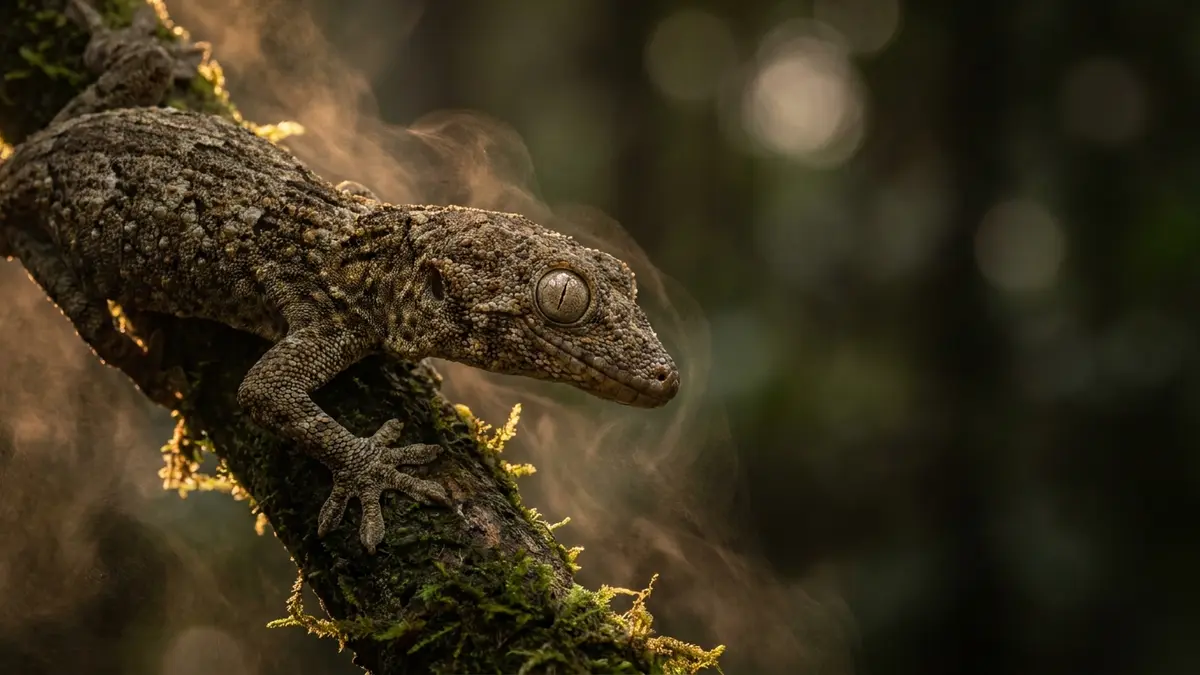
Gecko is a renewal spirit-animal that embodies resourcefulness and adaptability. Its meaning springs from the tail-dropping trick it uses to escape danger and slowly regrow a healthy new tail. It signals that change and rebirth are happening already, so keep moving, trust your instincts, and abandon rigid plans. This story of renewal and rebirth stands at the center of culture and mythology all across the world, from Hawaii's shape-shifting Mo'o to China's good-luck charms.
An almanac
- Core message
- Loss followed by renewal
- Spirit animal
- Change, renewal, and rebirth underway
- Totem for
- Sharp, resourceful, quietly humble people
- Power animal
- Street-smart improvising over rigid rules
- In dreams
- A fear or pressure you can't shake
- Watch for
- Trickster charm tipping into manipulation
- Curious fact
- Believed to be the only lizard that truly calls
- In the Bible
- Named among Leviticus's unclean creatures
In certain mythologies, the gecko is a gentle trickster, a quiet keeper of secrets. The person who chooses this animal as their spirit guide will learn about resourcefulness and adaptability, because the gecko is capable of remarkable changes: It is able to drop its tail and regrow it whole. When you are working with a gecko totem, expect a lesson about loss followed by renewal and good luck for people who change direction quickly.
Gecko Symbolism & Meaning
The gecko is often featured in myth and folklore. Small and unassuming as it is, it carries a reputation in some traditions for slipping ideas into people's dreams. In others, it's held a less positive view: in one Greek myth, the goddess Demeter turned a boy named Ascalabus into a gecko after he teased her over a drink. The story cast the gecko as an animal that angered both gods and mortals.
Its most enduring symbolism, though, concerns its ability to regenerate its tail in case of danger. It drops the part instantly to escape threats, then slowly regrows it. Sometimes the tail will return shortened or with other changes. For this reason the gecko has been associated with change: that constant cycle of endings and beginnings.
Such ideas are reflected in folklore that developed around it. The animal was painted on walls in Spain and Portugal for luck; seen near one pregnant woman it was said to bring good fortune to her unborn child; and wearing a gecko's shed tail tucked inside one's shoe was supposed to bring prosperity.
Gecko Spirit Animal
If gecko comes to you, it means you're going through a big transition. Change is happening now and there's not much use trying to hang on to the past. Gecko understands this and doesn't ask you to accept change willingly, but just to acknowledge what is.
Gecko is good at climbing too. Thanks to tiny pads on its feet, gecko is one of those creatures that can scale walls other people can't. Gecko can show you how not only to move quickly, but to stay balanced at the same time.
Gecko is also one of those animals who can be very still when things are intense. It waits for the right time without being rude or pushy. If things are tough financially, Gecko is good at making the most of what's around.
Gecko is a sharp person. This makes gecko good at staying out of other people's way without being rude and standing back until things calm down enough.
Does Gecko fit you?
Tap the ones that sound like you — 6 traits, no right answer.
0 of 6 Nothing picked yet — start tapping.
Gecko Totem Animal
People who have the gecko as a totem animal are generally cool-headed, clever, and modest; they tend not to worry easily and can’t be tricked. They don’t like playing games or sensing intrigue. People who have the gecko as a birth totem are probably interested in what’s going on around them, but they value their privacy. They spend a lot of time in their heads but will come around once they get to know you. They’re drawn to all kinds of experience but also stretch their resources so that they have something left for when things go wrong. They tend to adapt quickly and keep moving forward.
If you want things to go smoothly with other people, keep your word and be straightforward.
Gecko Power Animal
So if you find yourself looking for quick solutions to problems or seeking a skillful response to difficult situations where rules are vague, lean on the power of the gecko. It can help you identify new ways to solve what may seem like insurmountable obstacles. It can also help with developing sensitivity to energy when reading or balancing an aura.
When the gecko joins your personal crew, it can give you the flexibility to stay honest and make adjustments on-the-fly as situations arise. Not only will this ease your stress, but it gives you a boost of courage and shrewdness when motivation dwindles. When making career decisions, the gecko can weigh different opportunities for you and help you make a wise decision.
Across cultures
2 traditions — pick one to read its take.
Native American Gecko Symbolism
Geckos themselves don't appear very often in Native American tradition, but their relatives the lizards do. Across the Plains, lizards show up often in stories about healing and surviving.
Lizard figures were also important in stories from along the West Coast. They played important roles in creation stories there.
Down in the Southwest, people in tribes there considered lizards such as horned lizards sacred. The Gila Monster, also a lizard, was seen by some tribes as a powerful hero.
Far Eastern Gecko Symbolism
In China, you'll often see gold and silver decals of geckos on the back of a car. In spoken Mandarin, Gecko rhymes with "dodging misfortune," so the little figure can serve as a practical travel charm.
In Japan, a gecko is thought of as a guardian that protects the household.
Hawaiian & Polynesian Gecko Symbolism
Of the roughly 1,800 gecko species worldwide, only a handful made it to Hawaii, where islanders came to revere geckos as gentle creatures with healing abilities — and as an avatar of Moʻo. Moʻo is the rough Polynesian equivalent to dragons in East Asian lore — great shape-shifting lizards. Moʻo served as a go-between uniting the human and spirit worlds. It conveyed its words through dreams.
Islanders spoke of Moʻo as an enormous reptile stretching more than a dozen feet, said to inhabit ponds and fishponds as a guardian of freshwater sources. They respected geckos.
Gecko in Dreams
Gecko in a dream often points to something you can't quite shake — an unfounded fear, or a person whose expectations you feel pressured to mirror. If the dream-Gecko stands in for you, ask whether you've overstayed your welcome in someone else's plans.
- Moving quickly: a decision that needs a fast response
- Missing its tail: time to exit a risky situation — what you leave behind will regrow better
- Inside your home: good news ahead, with fresh ideas and supportive people
- Hiding and watching: someone is observing you, waiting for an opening
- On a car: good fortune and fertility
- In shadow, back turned: emotional distance, yours or someone else's
- Attacking you: a loss caused by a rival; attacking it yourself warns of self-inflicted harm
- Caught gently in your hands: a caring partner on the way
- Unusually large: a challenge too big to face alone, so ask for help
- Color adds nuance: orange for beating the odds, red for passion, yellow for cheerful connection, and the Leopard Gecko for happiness
- Lying still or dead: a hard chapter you're already moving through, not one still waiting ahead
- Eating a gecko: swallowing pride or a hard truth to move forward
Gecko Spiritual Meaning
If you see a gecko, it may be teaching you that no loss is permanent. Let it fill you with confidence to let go, even when that means losing part of yourself. Release knowing that what's lost might return stronger, or show up in a new form.
The spirit animal is telling you to trust yourself to know what signals to follow: big or small. Have patience when choosing how or when to respond. Embrace change as an ally instead of an enemy. If you can do this, renewal might become a purposeful part of your life.
Gecko's Voice & Unblinking Eyes
Among lizards, Gecko is unusually loud. Wildlife biologists say geckos are believed to be the only lizards that truly call. They produce an entire vocabulary of squeaks, clicks, croaks, hisses, and even a barking roar, depending on the species. The Tokay gecko, one of the largest and most vocal of the family, is named directly for its own cry: a loud, repeated "to-kay" that carries through the night and became the animal's common name. Where most reptiles move through the world in silence, Gecko insists on being heard.
Spiritually, that changes the message a little. Gecko doesn't just adapt quietly and slip into the shadows. It also claims a voice when the moment calls for one. If Gecko has crossed your path lately, take it as a nudge to stop swallowing what needs saying and let your own "to-kay" ring out, however small the effort feels at first.
The second oddity lives in its eyes. Gecko has no eyelids at all. Instead of blinking, it uses its own tongue to lick each eye clean and moist. It keeps watch without ever fully closing off from the world. That ceaseless, unblinking attention echoes the sharp instincts already credited to Gecko as totem and power animal — a reminder that real vigilance doesn't look away, even to rest.
Gecko in the Bible
The Old Testament's Leviticus ranks geckos as unclean, on a list of species that includes monitor lizards, wall lizards, skinks, and chameleons. You're not allowed to eat or touch them.
In the Bible, that has less to do with good or bad luck and more to do with ritual cleaning. It also shows that the same animal can have different meanings in different places and times.
Frequently Asked Questions
What does the Gecko spirit animal mean?
The Gecko spirit animal signals that it's time for change. It might also be an indication that you are renewing something old. The trick is to move quickly, trusting your instincts to adapt to the situation. Let an old plan regrow into something new.
Why is the Gecko considered good luck in so many cultures?
Geckos have been signs of good luck for a long time. This is mostly due to their nature of being gentle and how they can recover from injuries. They are sometimes used as charms in Spain and Portugal. They are welcome house guests in the Philippines and car decals in China.
What does it mean to dream about a Gecko?
People dream about geckos for different reasons. Someone might be worried about something. On the other hand, dreaming about a gecko inside your home could be a sign that good news is on its way. If you're dreaming about a tailless gecko it might be time to leave the danger zone.
Does the Bible mention the gecko?
Yes. According to Leviticus 11:29-30, geckos fall into the same category as monitor lizards, skinks, and chameleons. That makes them unclean. It's a matter of purity, not judgment.
Why do geckos chirp, and does it have a deeper meaning?
They use chirps, clicks, croaks, and barks and the species Tokay even makes a loud to-kay cry. It's said that spiritually their call is meant to encourage people to speak up rather than stay silent if they have let a quieter, more adaptable side do the talking lately.
Gecko also represents
- Other animals that represent rebirth and change →Alongside Butterfly, Snake, Dragonfly, Frog
- Other animals that represent protection →Alongside Bear, Wolf, Dog, Elephant
- Other animals that represent intelligence →Alongside Crow, Raven, Dolphin, Fox
- Other animals that represent healing →Alongside Snake, Deer, Dog, Bee
Sources
Claims on this page were checked against these published sources.
- Gecko
Like most lizards, geckos can defensively shed their tail; the predator may attack the wriggling tail, allowing the gecko to escape.
Read the source → - Native American Indian Lizard Legends, Meaning and Symbolism
In Plains Indian tribes, lizards are associated with healing and survival, and also with masculinity.
Read the source → - Mo'o
Mo'o are shapeshifting lizard spirits in Hawaiian mythology... were revered as ʻaumakua... Many fishponds in Hawaii were believed to be home to a moʻo.
Read the source → - What's the Deal With? Gecko Car Stickers
The Mandarin word for gecko is bìhǔ 壁虎, which sounds a little like bì huò 避祸, which means 'to avoid disaster.'
Read the source → - Geckos: 家守, ヤモリ
Yamori is the Japanese term for a gecko. It also means 'house guardian'... geckos are considered lucky in Japan, and they are thought to protect the home.
Read the source → - Gecko | San Diego Zoo Wildlife Explorers
Geckos are believed to be the only lizards that call. Depending on the kind of gecko, the noise might be a squeak, click, croak, hiss, or a 'barking roar.'
Read the source → - Tokay Gecko
This loud 'to-kay' sound is repeated multiple times in a crescendo and is the origin of this gecko's common name.
Read the source → - Leviticus 11:30 Study Bible
the gecko, and the monitor lizard, the wall lizard, the skink, and the chameleon.
Read the source →