Amphibians & Reptiles · Spirit animal
Iguana Spiritual Meaning & Symbolism
The unhurried watcher who teaches stillness, patience, and quiet self-renewal.
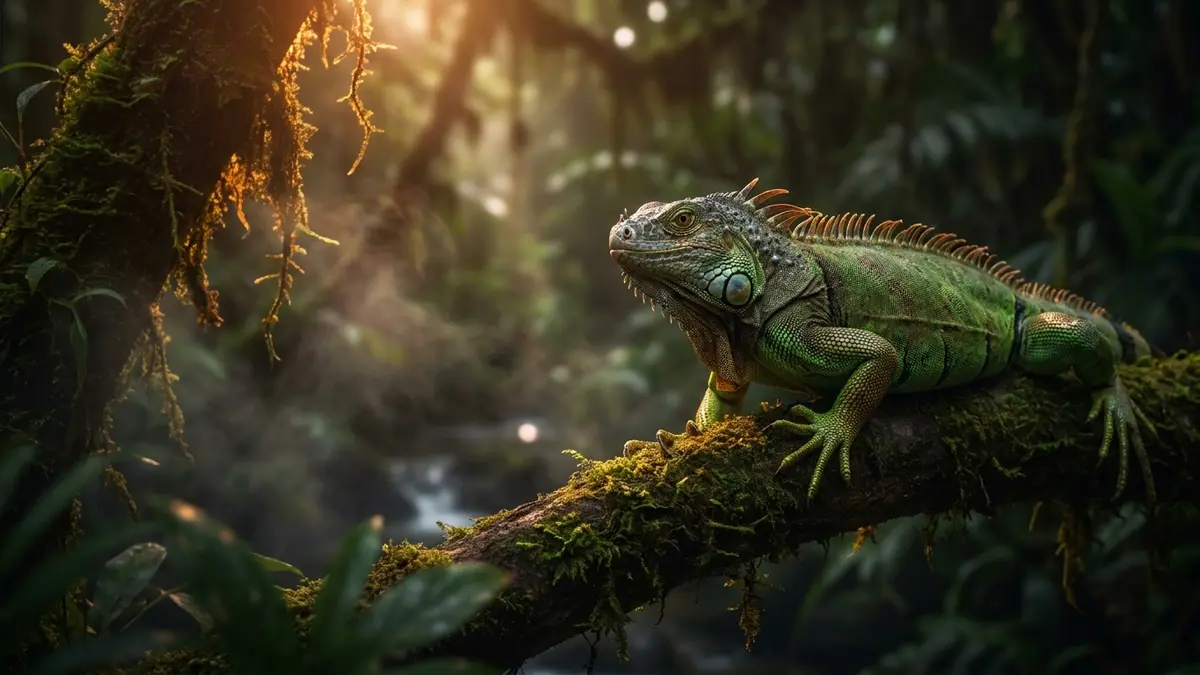
When Iguana is your spirit animal, it means you're a patient, unhurried person, staying calm and watchful instead of getting worked up by every little thing. Iguanas can shed their own tails under threat and regrow them over time.
An almanac
- Core message
- Stillness paired with sharp awareness
- Spirit animal
- Slow down, savor small joys, release what you've outgrown
- Totem for
- Calm, hard-to-rattle, gentle observers
- Power animal
- Patience, smart retreat, steady composure
- In dreams
- Reflects how exposed, controlled, or watchful you feel
- Element
- Fire (Mayan zodiac)
- Hidden sense
- A light-sensing 'third eye' atop its skull
- Rare relative
- The marine iguana is the only lizard that dives and forages in the sea
Nothing strange about hanging out with an iguana: nothing is urgent, and nothing is ignored. That paradox is the whole of iguana's medicine — a creature that takes it easy but tracks everything at once.
Iguana teaches you to be aware while you rest — when you let go, literally or not, renewal will begin.
Iguana Symbolism & Meaning
An iguana soaking up sun looks utterly at peace, moving only when its internal clock tells it to. That ease masks a razor-sharp awareness: its eyes register light shifts, shapes, and motion long before anything else notices, and it uses that same gaze to communicate with its own kind.
A hard stare signals irritation; a single open eye while resting means it's still keeping watch; retreating into a tight space with eyes shut is its way of recovering from stress.
Body language does the rest of the talking. Standing tall warns of alertness, crouching shows surprise, and an arched neck invites a gentle touch. The throat fan, or dewlap, works like a mood flag — held flat it signals calm, but extended stiffly it announces a threat response, sometimes paired with a puffed-up posture and a flicking tail meant to look bigger than life. Keywords tied to Iguana medicine: appreciation, awareness, camouflage, confidence, contemplation, contentment, curiosity, detachment, patience, serenity, and watchfulness.
When cornered, an iguana can shed its own tail to escape, then grow a new one over time — a clean break, and a picture of the renewal that follows a hard release.
There's a second eye behind Iguana's famous stare, one most observers never notice. Just above and between its two visible eyes sits a small, pale patch of skin known as the parietal eye — a light-sensing organ that can't form images but tracks the sun's position and the shifting shadow of anything passing overhead. Biologists think it evolved to warn ground-level and bottom-dwelling creatures about predators approaching from above, a hidden sentinel that keeps watch in silence. It fits Iguana's deeper teaching: some of the sharpest awareness works quietly, beneath notice, and never announces itself until it's needed.
Iguana Spirit Animal
Quit rushing and start noticing. Learn to enjoy the small, ordinary pleasures that an Iguana has every day — like going to a favorite spot and relaxing. Pay attention to the details you usually miss in a hurry.
When Iguana appears in your life as a spiritual guide, it means that it's time to let go of parts of your identity that don't fit anymore. When an iguana sheds its skin, it symbolizes letting go of parts of yourself.
Iguana also teaches you to trust your intuition. The iguana can focus on things far away, without losing touch with the earth under its feet.
The iguana can even help you know when to stay still in times of stress — like when iguanas lie very still when they see something dangerous. They only move when the danger has passed.
Does Iguana fit you?
Tap the ones that sound like you — 6 traits, no right answer.
0 of 6 Nothing picked yet — start tapping.
Iguana Totem Animal
People with iguanas as their birth totem are like the calm, sun-loving, unhurried lizards they resemble. Getting them riled is hard, because they've mastered pausing and thinking before reacting to anything upsetting.
They have an instinctive ability to find contentment in everyday moments. And they're grateful, too. Iguana animals make these people appear serene and wise from a distance.
And though some people see their casual approach to life as lazy, it's mostly just because they prefer their own pace. Steady and cooperative in nature, these people don't argue or start conflicts easily.
But when really upset by something (or someone), iguana animals can be unpredictable. Sometimes they turn cold and distant before a long thawing process begins.
Despite that — or perhaps even because of it — iguanas make great totems. These lizards represent someone gentle, shrewd, compassionate and wise (who serves both themselves and others well).
Iguana Power Animal
Iguana, as a power animal, can help you when you're wanting to learn patience, to sharpen your observations, or to have a steadier nervous system. Maybe it would be good if you thought of using this one when you have to slow down what you're doing or when you need to read a situation carefully before making decisions. When there's trouble or chaos all around and you just have to sit tight, call on iguana.
Maybe there's some threat that will demand your smarter skills for retreat rather than confrontations. If you want your confidence back after a big trouble or problem, iguana might be the power animal you need. This animal knows how to hide and wait, and then re-appear when it wants.
Maybe there's something you'll want from this animal when you have negotiations or time for quiet study.
Iguana in Native American Symbolism
There is not much documented use of the iguana in North American spirituality. Lizards are another story, though. Lizards hold a strong positive meaning for many North American peoples.
People who live on the Plains associate lizards with healing and endurance, so they sometimes make them into a protective amulet for children. In California, people used lizards as part of their creation stories.
The Hopi and Pueblo people both have lizard clans. That means that these creatures are very important in their culture.
South of there, people in Mayan culture thought highly of lizards, including iguanas. They have their own sign in the Mayan astrology system. It's about the element of fire and the direction south.
Iguana in Mexican & Peruvian Tradition
The Afro-Mexican dance Tixtla is thought to have originated during the colonial era and combines two different cultural influences: one mestizo and one Afro-Mexican. The dance reenacts the moves of certain important animals, including the iguana, which moves with slow, deliberate precision. This precise motion has remained a part of cultural memory over time.
In Peru's Moche civilization, iguana often appears in artwork as the companion of a god named Wrinkle Face. The Moche civilization didn't leave behind any written record, but the sheer repetition of this association across the art they did leave behind demonstrates that the people of Moche culture viewed iguana as spiritually meaningful.
Iguana in Dreams
If you dream of an iguana, the creature probably symbolizes the privacy that you are or are not feeling in your waking life.
Here are some common things iguana dreams can reflect:
- A cage containing an iguana may symbolize a relationship in which one person is overcontrolling the other. You might also dream of this if you think of yourself as overly controlling.
- An iguana indicates someone is trying to puff up your ego or sense of obligation beyond what's reasonable, just so they can hold power over you.
- An iguana staring intently at something else suggests that a challenge needs your focused attention and determination — just like the animals' ability to stand their ground and outlast trouble.
- An iguana shifting its gaze back and forth could represent a time when you're not giving yourself enough leeway to make decisions quickly.
Iguana in Astrology & the Mayan Zodiac
In the modern Maya zodiac, Iguana rules people born between December 13 and January 9. Inspired by real Maya symbols but not a real Maya practice, this zodiac is popular with New Agers and other symbolism enthusiasts. Iguanas are animals of a certain strength and certain sharpness. People born under Iguana have a strong sense of honor, usually are prosperous, and tend toward business skills. They tend to approach problems without negativity; pessimism doesn't suit their temperament.
Iguana Spiritual Meaning
Stillness, practiced as discipline: that is Iguana's spiritual message. It shows that true awareness doesn't require constant motion — sometimes the most perceptive being in the room is the one that appears to be doing nothing at all. Its willingness to shed a limb, or an old skin, to survive and regenerate teaches nonattachment: what you release cleanly has room to grow back stronger.
Let Iguana remind you that patience isn't passivity. It's a form of readiness: you gather strength quietly until the right moment arrives, and you trust your own instincts to know when that moment has come.
Iguana Species: The Sea-Going Outlier
Not all iguanas are rock-recliners. In the Galápagos Islands, there's a variety of iguana known as the marine iguana, which is something else entirely. It's the only lizard in the world that makes its home in the ocean — it dives as deep as 30 meters and can hold its breath for an hour while it scrapes algae from submerged rocks. And it copes with salt by sneezing through special glands around its nose.
Charles Darwin saw them and instantly dismissed them. But those very same reptilian qualities let marine iguanas live in a way no other iguana could: they find their niche in places that nothing else can stand. And sometimes standing on your own terms is every bit as triumphal.
Frequently Asked Questions
What does an iguana symbolize spiritually?
Spiritually, the iguana's message is to stay calm and watchful, rather than reacting to problems as they arise. In addition, since it can drop its own tail when attacked and grow it back, the iguana encourages you to let go of what no longer serves you.
What does it mean when an iguana appears in a dream?
Iguanas usually show up when you're feeling exposed, controlled, or watched. A flattened, defensive iguana in a dream means you have hidden fears or worries. A caged iguana suggests trying to control a relationship. A staring iguana means you need to look at and resolve a problem.
What is the Iguana sign in Mayan astrology?
In the modern Mayan zodiac, which isn't an authentic ancient Maya tradition but a system adopted by New Age thinkers, Iguana governs the period between December 13 and January 9. The sign is tied to fire and the south; people with the Iguana sign are known for their strength, keen observation skills, practical judgment, and natural talent in business.
Do iguanas really have a third eye?
Yes, most iguanas have a light-sensing organ on the top of their heads, which is called a parietal eye. It can't see images like human eyes can but it can detect brightness and movement in the sky above. Iguanas may use it as an early-warning system for aerial predators. Spiritually, this sense fits well with Iguana as a quiet and unobtrusive teacher: perception that works in the background and never needs to be spotlighted.
Is the iguana mentioned in the Bible?
No. Iguanas are natives of the Americas; they were unknown in ancient Israel. The Bible does not, however, list Iguanas among the animals that are declared unclean in scripture. There are, though, some lizards which are considered impure in ancient Israelite tradition. Including geckos, monitor lizards, wall lizards, skinks, and chameleons.
Iguana also represents
Sources
Claims on this page were checked against these published sources.
- Green iguana
Their whip-like tails can be used to deliver painful strikes, and like many other lizards, when grabbed by the tail, iguanas can allow it to break, so they can escape and eventually regenerate a new one.
Read the source → - Iguana
They employ visual signals to communicate with other members of the same species.
Read the source → - Why Do Iguanid Lizards Shed Their Skin?
Ecdysis is the scientific term for the periodic removal of the outermost layer of skin, and it's a normal, recurring event that allows the iguana to grow and replace worn or damaged skin tissue.
Read the source → - Lizard Mythology and Folklore
In Plains Indian tribes, lizards are associated with healing and survival, and also with masculinity.
Read the source → - Maya calendar
Misinterpretation of the Mesoamerican Long Count calendar was the basis for a popular belief...
Read the source → - Wrinkle Face and Iguana: Companions to a Moche Epic
Frequently depicted in Moche art are an individual we call Wrinkle Face, and his companion, an anthropomorphized iguana. Wrinkle Face and Iguana participate in such a wide range of activities that they appear to be symbiotic figures playing central roles in a major epic story.
Read the source → - Marine iguana
the only extant lizard that spends time in a marine environment... Specialized cranial glands at the nostrils filter and expel excess salt... Can descend to 30 meters and remain underwater for up to one hour.
Read the source → - Parietal eye
The parietal eye is positioned atop the head, between the regular eyes... the parietal eye uses chemical changes to detect light, rather than rod cells and cone cells as in a normal vertebrate eye... may have allowed bottom-dwelling species to sense threats from above.
Read the source → - Leviticus 11:29-30 (NIV)
the weasel, the rat, any kind of great lizard... the gecko, the monitor lizard, the wall lizard, the skink and the chameleon
Read the source →