Amphibians & Reptiles · Spirit animal
Axolotl Spiritual Meaning & Symbolism
The eternal youngster of the water world: healing, regeneration, and the wisdom of staying playfully yourself.
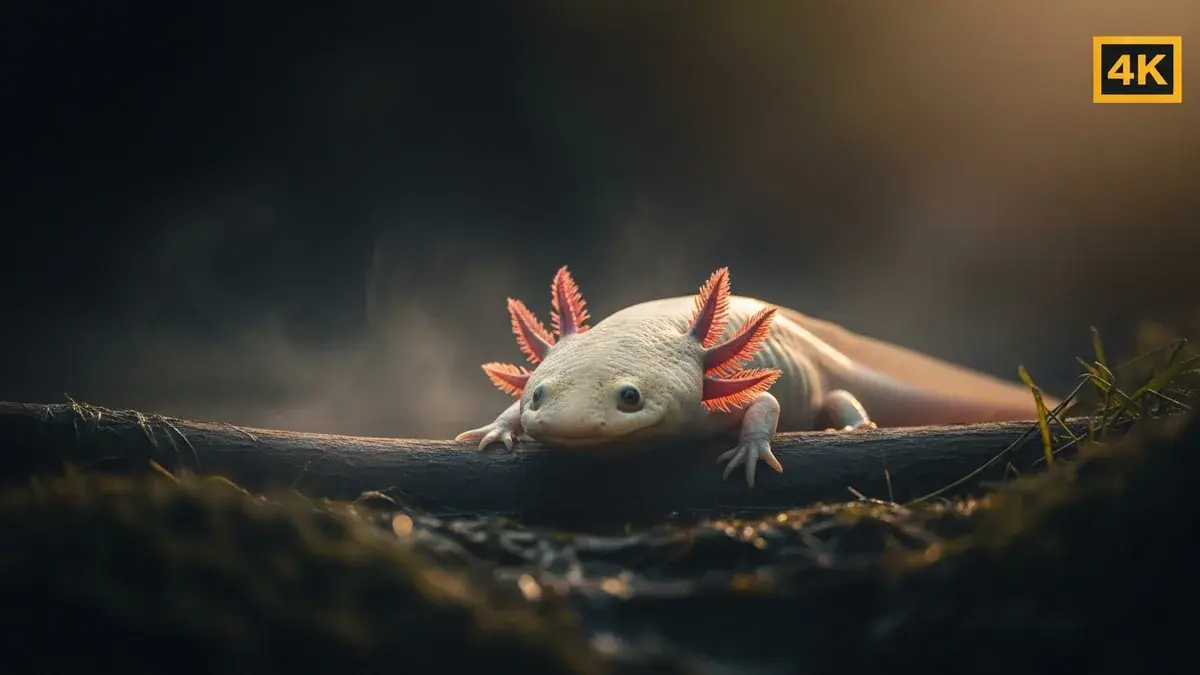
As a spirit animal, the axolotl represents healing and change while staying true to your playful nature. That message is based on how this amphibian stays youthful all its life without transforming as it grows older. It can also heal itself by regrowing limbs, organs, or even parts of its brain, leaving no scar tissue behind.
According to Aztec mythology, axolotls are related to a god with the ability to change shape at will. That myth gives the axolotl's message about transformation through healing a spiritual dimension.
An almanac
- Core message
- Heal slowly, regenerate, stay yourself
- Spirit animal
- Patient healer during fragmented times
- Totem for
- Witty, youthful peacemakers
- Power animal
- Reclaiming playfulness and intuition
- In dreams
- Change stirring beneath the surface
- Cultural roots
- Aztec myth of the god Xolotl
- Conservation status
- Critically endangered in the wild
- Native waters
- Lake Xochimilco & Chalco, Mexico
The Axolotl refuses ever fully to grow up. This amphibian keeps its juvenile gills for life, while others of its kind change as they age, leaving theirs behind in favor of adult limbs.
Axolotl Symbolism & Meaning
Axolotls are salamanders who never grow up. They keep their gills as adults and stay larval-sized for life. That allows them to strike a rare balance between maturity and openness, an accomplishment most animals only dream of reaching.
Their nickname — the "Mexican walking fish" — points back to an Aztec story where a god named Xolotl shape-shifted into an axolotl to escape danger but could never change back. The species has retained that youthful larval form ever since.
Their bodies are soft, almost like socks for little feet. They have big feather-like external gills — and long searching fingers that reach out when anything happens nearby. Their senses work in a blend: smell, chemical signals, sight, and sensitivity to electric fields around them, often read as sensing "auras" or unseen energy.
Their eyes are never closed; they show an unblinking awareness and the ability to see past surface appearances.
If injured or cut apart, they can regrow limbs, organs, even parts of their brain. They don't scar when healing themselves back together again. That makes them a symbol for renewal or restoration, and it comes with a bit of wisdom — "keep your head on" — since axolotls can only heal if the top part stays in one piece.
Different colors add to their symbolism too: gold suggests a higher energy like angels around us; pink warmth and welcome; gray or black nods back to ancient mystery, because amphibians were here longer than dinosaurs.
Axolotl Spirit Animal
You're going through a phase right now that feels fragmented or uncertain. You don't know what to do next or how to get yourself back on track, so the Axolotl is showing up for you to be your patient healer. This spirit animal can walk beside you instead of ahead of you because it takes small but steady steps when it's helping others heal themselves.
If something in your life is working well, do you really need to dismantle it just because you're feeling restless and want to try something new?
The Axolotl can show you how to hold onto your convictions and stay true to yourself when your beliefs are tested by others. It will also encourage you to reconnect with the joy of childhood — daydreaming, wishing, and believing in magic once again.
Does Axolotl fit you?
Tap the ones that sound like you — 6 traits, no right answer.
0 of 6 Nothing picked yet — start tapping.
Axolotl Totem Animal
People born with the axolotl totem animal are often gentle people who try to solve problems in their lives through humor or thinking creatively about things. They don't have an argumentative style of thinking. They keep a youthful appearance even if they get old and they seem like childlike people to most people. The same charm that makes them so attractive to children is what also brings them good love relationships.
While it's true that these types often want lots of love from people, it can become an unhealthy behavior. It can be bad for the other person in a relationship, which may think they're being asked to love too much.
The most common misunderstanding about axolotl people is their image as delicate or fragile individuals who easily break down if things get too much to handle in life. In fact, these types have an uncanny power of picking themselves up when bad times hit and bouncing back with good energy.
The axolotl person prefers careers where they can make changes without being too repetitive about doing the same thing over and over again.
Axolotl Power Animal
Call on the axolotl power animal when you're in the position of being the only responsible adult in the room but are feeling the urge to go have some fun. If you can't seem to carve out enough time for solitude, this power animal nudges you to simply let people know what you need.
The axolotl is a good teacher if your intuitive skills or sensory abilities feel dulled because this species relies on heightened perception to survive. Call on the axolotl when self-preservation instincts are dimming and your need to act or hold back feels unclear; it will help sharpen those senses.
Axolotl in Aztec & Mesoamerican Symbolism
The axolotl gets its name from Nahuatl, which means "water dog" or "water sprite." It is used in modern Mexican literature to symbolize critical thinking, philosophical inquiry, environmental awareness, and the human condition. Scholars have argued that the x at the start of the word means unknown or the other. In art, it's been depicted with feathery gills like a feather on a headdress, which echoes Mesoamerican imagery.
Xolotl was believed to be the twin brother of Quetzalcoatl, son of virgin goddess Chimalma. Xolotl was associated with fire, lightning, the evening star, and the underworld, where he guided souls as a psychopomp. He's still revered as the Xoloitzcuintli dog. Thus, axolotls symbolize not only their ability to adapt between environments but also a god who embodied crossing boundaries.
Axolotl in Dreams
In dreams, an axolotl is a symbol of transformation and change. It could signal that there are hidden messages below the surface of things you've noticed in your life, and suggest staying alert for these subtle clues. A dream may show an axolotl swimming freely to indicate a healing or transformation process already underway, or it might stare at you straight away suggesting you may be stuck in place.
If an axolotl appears in a person's dreams then it is usually interpreted as a representation of someone close who has secrets. The water can be murky if it implies deception rather than simple secrecy but two happy moving creatures together suggest good fortune ahead - especially for families and loved ones. An axolotl trapped behind glass or confined in space reflects restrictions upon one's emotional development which prevents movement; while being pulled from the water indicates exposure without protection.
Finally, seeing an injured animal recuperating quietly at home represents private recovery efforts done away from prying eyes.
Axolotl Spiritual Meaning
The axolotl's spiritual message is about permission — giving yourself permission to heal slowly, to regenerate what's lost, and to hold on to your original self as you take adult responsibilities. The axolotl teaches that transformation doesn't always mean becoming someone else; often the bravest thing we can do is remain true to ourselves while the world expects us to change.
The axolotl reminds us of the power of awareness, patience, and stillness. When life strips away parts of our selves, this creature's regenerative abilities show us that healing, restoring, and returning to wholeness are possible.
Axolotl Conservation & the Waters of Xochimilco
Axolotls live in Xochimilco and Chalco, a network of small freshwater canals and lakes on Mexico City’s far edge. Once these wetlands sprawled across much of the Valley of Mexico; today, though, they’re squeezed by urban growth, their waters shared with carp and tilapia.
The toll: wild populations have fallen to around fifty or maybe a thousand adult individuals at most. Those few remaining are Critically Endangered. In captivity, though, these salamanders thrive. Many aquariums have them; some labs study them by the thousands.
Symbolically, this means something deeper than just regeneration from wounds.
Don’t forget the importance of whatever quiet, hidden place lets you heal—something that exists no matter how hard it is to find, and something we can make worse by destroying its home.
Frequently Asked Questions
What does the Axolotl symbolize spiritually?
The axolotl symbolizes healing, renewal, and keeping an authentic youthful attitude as you mature. It remains young for its whole life as a swimming salamander, never needing to get out of the water even as it grows older. That way of staying underwater symbolizes being young at heart, while its ability to heal itself by growing new cells is an emblem of recovery after hardship.
What does it mean when an Axolotl appears in a dream?
A dream about an axolotl usually suggests either change or healing, but in either case, it often represents letting go of some old part of yourself so that new growth may take its place. Or if this creature seems to represent a person who has come into your life, then the murky water around them could suggest that they are keeping something secret.
Is the Axolotl a good totem or power animal to have?
Yes, Axolotls can be great power animals and totems. People who have an Axolotl as their main guide are often playful, creative, resilient, intuitive, and youthful-looking no matter what age they are; and people with Axolotl as their guiding animal usually have a strong magnetism. If you choose this amphibian for guidance, expect it to help you reconnect with your sense of play, sharpen your intuition, and give you the courage to ask for solitude or space if necessary.
Is the Axolotl endangered, and does that change its spiritual meaning?
The Axolotl is endangered, with only a few individuals remaining in Mexico. This adds urgency to its usual meaning as a symbol of regeneration: it asks you not just to trust your own healing abilities but also to protect the fragile places around you and within you that make real healing possible.
What do different Axolotl colors mean spiritually?
Beyond golds, pinks, and grays -- which have long been linked to angels' sensitivity, warmth, and ancient mysteries -- Axolotls come in many other colors. Folk beliefs attribute white tones to clarity or purity of spirit, blues to calm or emotional balance, and reds or coppery hues to a desire for passion or energy renewal. Remember, though, that each color's associations are not hard-and-fast rules; choose the ones that speak most deeply to you.
What crystals pair well with Axolotl energy?
Many practitioners who work with Axolotl find healing crystals supportive for their self-care routines. Rose quartz helps you be kind and tender toward yourself as you nurture emotional wounds. Clear quartz amplifies your intention, helping you start fresh. Aquamarine soothes overwhelm and encourages calm reflection while near water.
None of these crystals are required to connect with Axolotl's medicine. They're just anchors that may help you sit with its message of patient repair.
Axolotl also represents
- Other animals that represent rebirth and change →Alongside Butterfly, Snake, Dragonfly, Frog
- Other animals that represent resilience →Alongside Cockroach, Camel, Salmon, Turtle
- Other animals that represent healing →Alongside Snake, Deer, Dog, Bee
- Other animals that represent patience →Alongside Turtle, Heron, Spider, Ant
Sources
Claims on this page were checked against these published sources.
- Axolotl
It is neotenic, reaching sexual maturity without undergoing metamorphosis, and the adults remain fully aquatic with obvious external gills.
Read the source → - Xolotl
Xolotl transformed himself into a young maize plant with two stalks (xolotl), a doubled maguey plant (mexolotl), and an amphibious animal (axolotl).
Read the source → - Electroreception and electrogenesis
aquatic salamanders, and caecilians
Read the source →