Birds · Spirit animal
Cuckoo Spiritual Meaning & Symbolism
The trickster herald of spring who trusts the village to raise its young.
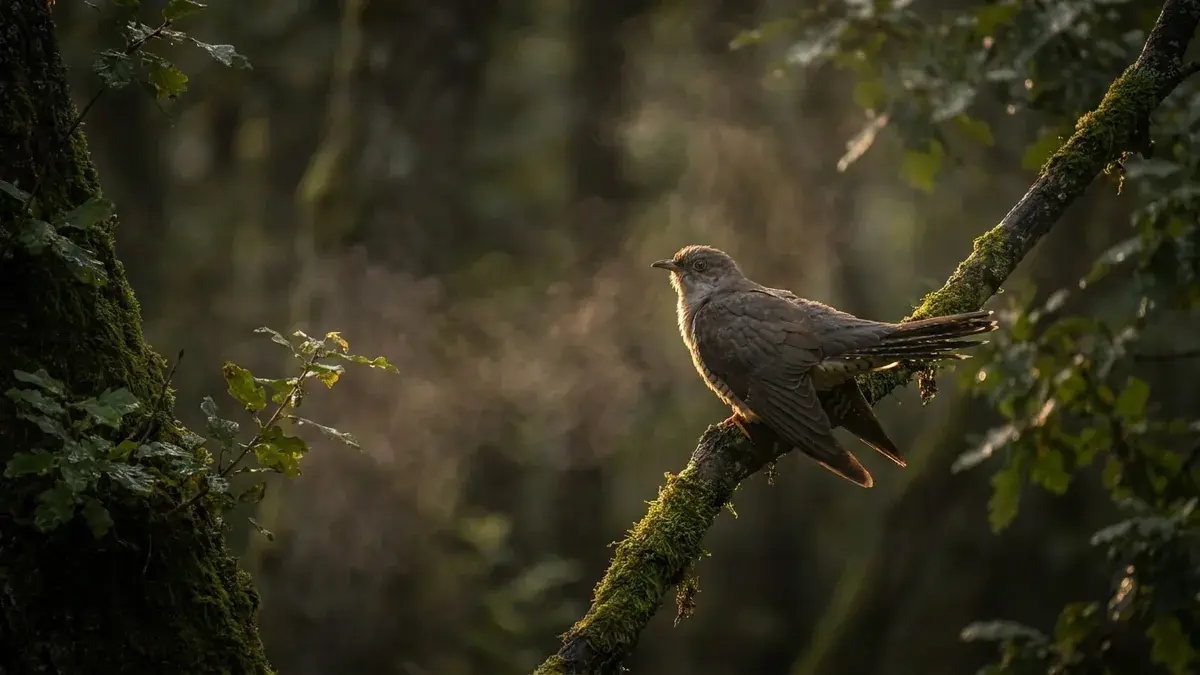
Cuckoo's call may signify a time of meaningful change in your life. Trust unusual paths, stay alert for meaningful news from someone trustworthy but distant, and you may see that speaking more clearly and warmly can serve you well. Cuckoo can inspire resourcefulness over brute force: adapt and lean on others when needed instead of attempting to forcefully push through issues on your own. In dreams, she may point to times of sorrow, questions of family matters, or a hidden truth about to surface, though she might also show herself blossoming in a tree as a symbol for coming prosperity.
An almanac
- Core message
- Trust unconventional paths to growth
- Spirit animal
- Change is already underway
- Totem for
- Sharp instincts, inventive problem-solvers
- Power animal
- Courage to face a new chapter
- In dreams
- Sadness, family matters, or hidden truths surfacing
- Cultural roots
- Celtic prophecy and Far Eastern sign of spring
- Sacred to
- Hera in Greek myth
- First studied by
- Edward Jenner, 1788
The cuckoo is not just a cheery bird. Its song is one of the first signs that spring is really on the way, so it doesn't surprise that it features in nursery rhymes and even clock designs. But there's another side to the cuckoo, one that is less sweet and much bolder. The cuckoo bends all sorts of rules to get what it wants from life. It's a more unusual sort of adaptability than most of us will ever need to understand, but that doesn't mean we can't take something from it.
Cuckoo Symbolism & Meaning
The cuckoo's name comes directly from its own call. Globally, people formed its names — "kuckuck" in German, "coucou" in French, "kak-ko" — to echo the male's vocalization.
The result? Cuckoo clocks. Germany's Black Forest region popularized the timepieces and exported them around the world for centuries. Fewer birds can boast an entire industry devoted to their call.
When you look at a cuckoo, you can tell by its bill shape and the pattern of its feet that it's made for dexterity. It has a slender curved bill and unique foot placement. Its front two toes face forward, while its back two face backward. This gives cuckoos the nimbleness they need to move through trees.
That call comes at the start of spring each year. It signals new life beginning and invokes hope as well as romance in people across the globe. The bird's mating season reaches from late spring into summer.
Migrating cuckoos can be found almost everywhere except Antarctica — some are even known to nest in close proximity to warblers and robins.
Mother cuckoos are notorious for laying eggs in other nests. They will lay more than 20 eggs in one nesting season.
Some lay so many eggs that they can't watch all of them grow; so she'll make off with other eggs so her chicks can have full attention during their first weeks or months. That strategy shifts resourcefulness over brute force.
Her chicks are loud and persistent callers who draw visitors to them for help, which is an old idea — every life takes more than one set of wings to carry it through. Many cultures take advantage of that first springtime call as an omen: Make a wish, or find out how long until love arrives by counting notes of the birds' song.
So it shouldn't be a surprise that science took advantage of the bird's secretive ways as well.
In 1786 and 1787 during summers spent at his aunt's farm in Gloucestershire, England, surgeon Edward Jenner studied cuckoo chicks' behavior in adopted nests before writing about it years later when he won his place as a Fellow of the Royal Society.
Before long that scientist (and years before he became famed for discovering vaccinations) published his findings.
Even older than this scientific discovery though was mankind's understanding through language; right back up until "Sumer Is Icumen In," which was written down around 1240 AD.
Cuckoo Spirit Animal
If you notice the call of a cuckoo stirring something in your chest, it's a sign that a change is already underway in your life. It may happen all at once, leaving you feeling a little off-balance, but it'll steer you where you want to be.
When the cuckoo calls to you, keep paying attention — ordinary attention and a quieter instinctive sense. You can sharpen your ability to tell what's real from what isn't with someone trustworthy who's far away.
When the bird appears with a dark beak, it's nudging you to speak more kindly. If it turns up with a pale or yellow beak, this means you'll move more easily toward your goals if you're more open and upbeat.
Since the cuckoo sometimes lays eggs in other birds' nests, the bird can hint at someone moving away, or someone new settling into your space. Stay open and follow your instincts when things get sorted out on their own.
Does Cuckoo fit you?
Tap the ones that sound like you — 6 traits, no right answer.
0 of 6 Nothing picked yet — start tapping.
Cuckoo Totem Animal
People who have the cuckoo as a totem animal tend to have keen senses and a knack for creative problem-solving, especially when times get tough. Like the bird itself, they are willing to move around if a situation stops serving their needs — whether in their emotions, relationships, or career. Those with the cuckoo as a totem animal do so thoughtfully, knowing that their choices have an effect on those around them.
If you've had the cuckoo as your totem animal from birth, you may be sensitive. It's possible that even a small touch can trigger intense feelings. You probably need a lot of alone time to restore your boundaries.
Carrying the cuckoo as a totem animal also means accepting that life is an unfolding path and that where you are today matters just as much as where you're going. You adapt to new situations, build relationships without rushing things, and make choices with intentionality, knowing that every choice you make affects your future.
Cuckoo Power Animal
Cuckoo comes to you if you need courage in a brand-new situation, or when fate touches your life and your choices feel bigger than they are. You can call on Cuckoo as your power animal when you don't understand what's happening but you can feel its importance, and you need to trust your intuition to push ahead into new territory. Cuckoo power animal also comes forward when the signs and hints that surround you are growing but their meanings aren't quite clear to you yet. That's the time to pull back, shift your focus, and let new ideas come into focus.
Good communication is one of Cuckoo's strengths: she helps you hear the genuine messages other people are trying to send and understand them without misinterpreting, misunderstanding, or being misled. She knows how to speak clearly, in her own voice. She gives the same blessing to yours.
Across cultures
2 traditions — pick one to read its take.
Cuckoo in Celtic Symbolism
In Swedish folklore, the direction from which a Cuckoo's call comes is thought to foretell your fortune — north means grief, east means comfort, south means death, and west means good luck.
In Celtic legend, cuckoos were thought to have the power of prophecy, and they could hint at the identity of a future spouse or foretell the size of a family that was yet to come. At Callanish, legend holds that when a cuckoo calls at dawn on Midsummer Day, it announces the arrival of a radiant figure among the standing stones.
Cuckoo in Far Eastern Symbolism
Cuckoos are popular messengers of the spring in East Asian traditions. A cuckoo can represent an unrequited love in old haiku, when it symbolizes the spirit of someone who has passed and wishes to reach loved ones, or remind us of longings that might surprise us in the summer, when Japan's hototogisu calls out to eager poets.
As Sei Shōnagon described in Pillow Book, even waiting ladies-in-waiting at the court used to run outside just to hear the hototogisu and compose haiku — but only to return empty-handed. Even devoted poets couldn't catch up with this bird's song, moving them deeply.
Cuckoo in Dreams
Dreaming of a cuckoo can sometimes be more of a burden than a help — it can signal sadness, loneliness, or something going on at home that's weighing you down. Its call might also point to stress building up around work or business. The meaning depends on the details:
- If you chase after a cuckoo and catch it, hidden truths are soon to surface.
- If you see the cuckoo settled on her eggs, your plans have stalled because they went too far, too fast.
- If you only hear the cuckoo's call without spotting the bird, news is coming soon.
- Seeing the cuckoo in a blossoming tree means prosperity is on its way and you'll soon be very happy.
Cuckoo Spiritual Meaning
Beyond their songs and spring clocks, cuckoos have other lessons to teach. Cuckoos show us that there are unconventional paths to personal growth, paths that don't require us to force our way through life. They trust adaptation — they borrow support from others whenever they need to, and let their communities take care of what they can't handle on their own.
We can learn from the cuckoo's clear communication and honest instinct when it comes to telling other people about ourselves. That same communication shows us that we'll get further with honesty and clear communication than we will with force. And when a cuckoo enters our lives, whether by means of a sight, memory, or dream, we take this as a sign that we should welcome change, speak more clearly, and lean on others as we move into whatever season comes next.
Cuckoo in Greek Mythology
Cuckoo's ties to marriage and its complications run deep in Greek myth. Ancient sources tell that Zeus, wanting a reluctant Hera as his wife, disguised himself as a storm-battered cuckoo and let her take him to her chest for warmth — only then reverting to his true form. The union that followed was permanent, but the trickery at its start colored the marriage with the very jealousy and struggle it's remembered for.
Perhaps because of that story, the cuckoo was counted among Hera's sacred creatures, alongside the cow and the peacock — a small bird that stood in for the queen of the gods herself. It's a fitting emblem for a creature whose whole reputation rests on borrowed nests and quiet substitutions: even in myth, Cuckoo gets what she wants by wearing someone else's shape.
Frequently Asked Questions
What does Cuckoo symbolize spiritually?
This bird, which reappears every spring, signals new beginnings. But the Cuckoo often lays its eggs in the nests of other birds. After the eggs hatch, these other birds do the work of raising them as their own. That reminds us that we can accomplish far more if we work together and share resources.
What does it mean when a Cuckoo Spirit Animal appears?
Change is already happening in your life. A Cuckoo Spirit Animal asks you to pay attention to messages you are receiving from trusted people at a distance, be aware of how you're communicating with them, and be open to changes in your living situation.
What does it mean to dream about a Cuckoo?
Dreaming of a Cuckoo can mean sadness or strained family relationships. The meaning depends on the context, though: catching the bird reveals a secret that you'll discover soon, seeing it sitting on eggs suggests that you're feeling stuck because of trying to reach unrealistic goals, and seeing it in a flowering tree is a good sign, predicting prosperity.
What does the cuckoo mean in Greek mythology?
In ancient Greek myth, Zeus transformed himself into a beaten-up cuckoo to woo the goddess Hera, changing back to his godly self only after she put him in her bosom to give him warmth. Hera then chose the cuckoo as one of her sacred creatures, alongside the cow and peacock — which seems an odd choice for a goddess of marriage, considering that's how their partnership started.
Did anyone ever scientifically study cuckoo behavior?
Yes. In the late 1700s, a doctor named Edward Jenner—also the person who pioneered vaccinations against smallpox—spent a summer on his aunt's farm in Gloucestershire documenting how cuckoo chicks forcibly evict other birds' young. He discovered that a chick can be born with a small dent on its back for tipping eggs and rivals over the rim, and for this work he earned a fellowship from the Royal Society.
Where does the phrase 'a cuckoo in the nest' come from?
It comes directly from the bird's own habits: laying an egg in another species' nest and leaving the host to raise a chick that isn't theirs. The image was familiar enough by Shakespeare's time that he played on 'cuckoldry' in Love's Labour's Lost, and for centuries since, the phrase has meant an outsider who quietly takes over someone else's space.
Cuckoo also represents
- Other animals that represent death →Alongside Raven, Crow, Buzzard & Vulture, Owl
- Other animals that represent rebirth and change →Alongside Butterfly, Snake, Dragonfly, Frog
- Other animals that represent intelligence →Alongside Crow, Raven, Dolphin, Fox
- Other animals that represent healing →Alongside Snake, Deer, Dog, Bee
Sources
Claims on this page were checked against these published sources.
- Common cuckoo
The cuckoo family gets its common name and genus name by onomatopoeia for the call of the male common cuckoo.
Read the source → - Cuckoo
the English and scientific names [come] from the call of the male common cuckoo.
Read the source → - Swedish folklore cuckoo call directions (search result)
hearing it in the North foretells sorrow, from the East offers consolation, from the South implies death, and from the West brings good fortune.
Read the source → - Mystery of Scotland's Ancient Callanish Standing Stones
early on a midsummer morning a mysterious entity known as 'The Shining One' walks the length of the avenue of the stones. His coming is heralded by the call of the cuckoo, the bird of the Celtic land of Tir-nan-Og, which is another description of the Celtic Otherworld.
Read the source → - The summer cuckoo / hototogisu in Japanese poetry (search result)
The mournful cry of a hototogisu in a lonely wood was associated with the longing of the spirits of the dead to return to their loved ones still living.
Read the source → - Hera
In a Greek myth Zeus was transformed into a cuckoo to seduce Hera. ... sacred animals as cow, cuckoo, peacock.
Read the source → - Cuckoos and Cowpox
Jenner, assisted by his young nephew, spent a summer observing the behaviour of female cuckoos ... a 'dent' in its back which disappears after the first few days of life ... a fledgling was filmed in the act in 1922.
Read the source → - The Birds of the Hyakunin Isshu
the hototogisu as "the Lesser Cuckoo" ... during Japan's Heian Period, the hototogisu "was highly praised during the aristocratic court culture." Sei Shonagon's Pillow Book documents a court expedition where ladies-in-waiting sought to compose poetry about the bird, though they "forgot the poetry entirely and came back...empty handed."
Read the source →