Birds · Spirit animal
Cassowary Spiritual Meaning & Symbolism
The armored rainforest guardian that teaches you how to defend your space, your heart, and your quiet independence.
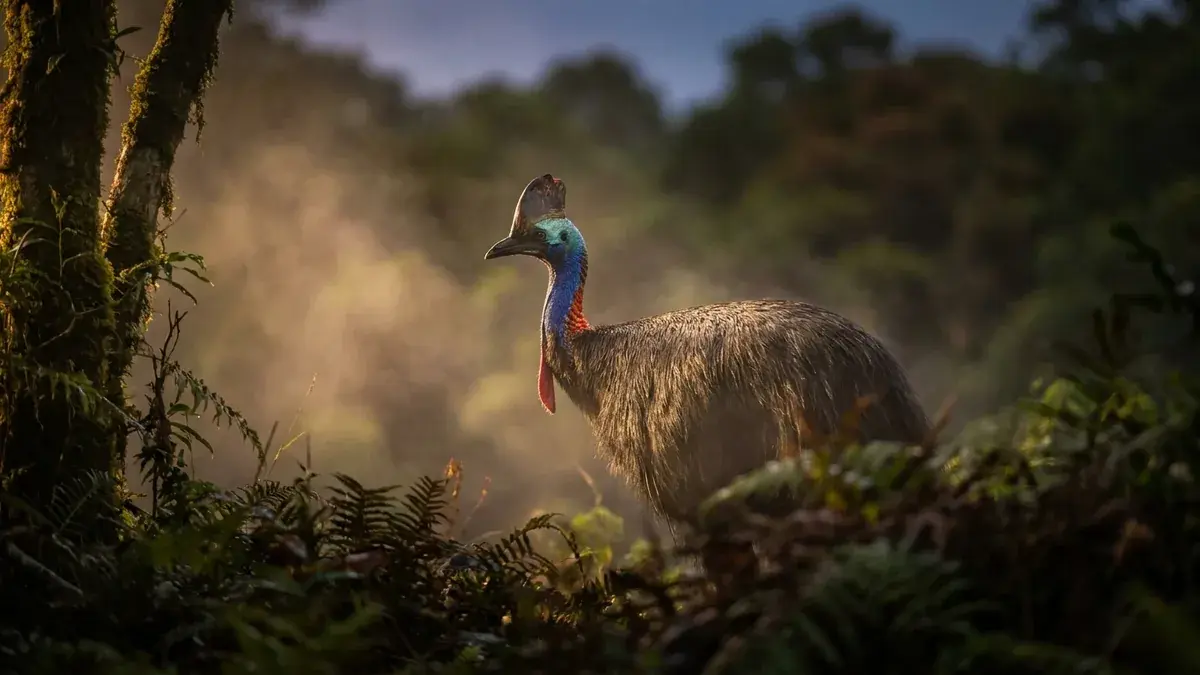
The Cassowary is known for protecting itself with its heavy armored forehead (or "casque") and sharp claws, which symbolize independent boundaries and a quiet inner strength. If the Cassowary appears to you in a dream or as a spirit animal, it may be calling on your natural inclination to fix things while also protecting your own boundaries and energy from harm.
An almanac
- Core message
- Protect what matters, quietly
- Spirit animal
- Guard your energy and boundaries
- Totem for
- Natural fixers with protective instincts
- Power animal
- Courage to stand up for yourself
- In dreams
- Meaning depends on its action
- Cultural roots
- Aboriginal rainforest legend
- Size rank
- 2nd-heaviest bird on Earth
- Conservation status
- Endangered in Australia
The cassowary can carry itself with the armored confidence of a soldier on the battlefield. It lives beneath the helmet-like casque and beneath its razor claws. This guardian of the rainforest knows exactly where its boundaries lie and communicates those limits to you through dreams. This spirit guide covers what it means to be a cassowary and how people experience it as a totem, animal spirit guide, or power animal.
Cassowary Symbolism & Meaning
The Cassowary scatters seeds, meaning it's an important creature in creating the thick canopy of the rainforest. It lives in New Guinea and northern Australia, where it has a keratin-covered casque that might help it shed heat and might be used to woo mates. If you see a Cassowary, don't mistake its careful, tough-minded behavior for weakness, which is a common mistake when dealing with a bird.
A full-grown Cassowary carries an inner claw sharper than a dagger. But this bird isn't as ferocious as you'd expect from how it looks: it's usually shy and avoids people. It takes risks to protect itself and its young, but usually isn't aggressive unless threatened.
The male Cassowary cares for its babies after they hatch.
Cassowary Spirit Animal
The Cassowary is known for guarding its territory, even if that just means its own safety and energy. If the Cassowary shows up as your Spirit Animal, it's a sign that you need to start protecting what's yours.
Empaths especially often need to learn how to protect themselves from the opinions and feelings of others. This bird will help with that; a stronger shield can be yours with its help.
Sometimes a problem will seem unsolvable until the Cassowary's magic clears the air. It can show you how to shift your perspective to look at an issue from every angle.
When someone you love is in trouble, the Cassowary might reveal how much strength you possess when you put your mind to it. It can also remind you to check in with your home and make sure everything is in order there.
Does Cassowary fit you?
Tap the ones that sound like you — 6 traits, no right answer.
0 of 6 Nothing picked yet — start tapping.
Cassowary Totem Animal
People born under the Cassowary totem often sense trouble coming and don't let others ignore their advice. They're natural fixers. Many care about environmental issues, particularly water, and may end up as environmental activists. This group strongly believes in right and wrong with little patience for gray areas. People under this totem tend to be sensitive to their environment so they need a natural, uncluttered home and clean products to stay healthy. Because they're territorial, they expect others to respect their personal space and return the courtesy. They also become the keeper of others' secrets thanks to an instinctive urge for privacy.
Cassowary Power Animal
The cassowary bird is known for its large size, strength, and the sharp talons on its powerful legs. It's typically shy and reserved unless it feels threatened. To attract its spiritual protection, you could set an offering of fruit down during a meditation session.
If you feel stuck, the cassowary animal spirit can be helpful. It can empower you to move forward when fear or other negative feelings stop you in your tracks. Sometimes we let those feelings stop us from confronting negative traits in ourselves rather than from facing a direct threat.
The power of the cassowary may be about being brave: facing your fears and having the courage to stand up for yourself. You can call on this ally when obstacles seem too big to overcome or when you're tempted to keep quiet when you really need to speak up. If you're trying to face down one of your own flaws, rather than an external threat, the cassowary spirit may have just what you need.
Cassowary in Aboriginal Tradition
According to Aboriginal storytelling, the cassowary is not a warrior but rather a protector of the forest. Even its silly-looking helmet carries an important story about defending what the cassowary loves. Once, some animals laughed at the cassowary and told it to fly away. Embarrassed, it fled in terror and crashed into a boulder. The rock left its mark on the poor bird's head, and now everyone laughs at its helmet.
One day, the bird met a wise seahawk who reminded it that every animal has its own gift. Then snakes attacked the seahawk, but the cassowary rushed to defend its friend. They also scared off other hungry animals with their claws and helmet.
Today, Aboriginal people keep cassowary feathers and bones to remember this story.
Cassowary Dreams
A cassowary waddling through your dreams is a reminder to let down your guard, face challenges directly.
It might attack something, which means you're avoiding a confrontation, but once you face it head on, it'll probably be easier than expected.
It could stand alert in the forest, which means an imbalance in your daily routine. Like work versus home or body versus spirit. Stepping back could help to realign things.
Or it could be sleeping peacefully, which is a sign that you've reached a crossroad and could use some perspective. If you step back from the situation for a moment, the right path will become clearer.
If the cassowary appears white, it's asking you to trust your intuition and believe in yourself. You are growing spiritually and becoming more in tune with the world around you.
Cassowary Spiritual Meaning
Protection is a deep subject for the Cassowary. People sometimes forget that boundaries and softness can coexist, and sometimes they forget that caring for their own space isn't selfish. The Cassowary brings us a reminder of these things and a reminder that real strength doesn't have to be noisy. When it comes to things that matter to them, people should defend themselves only when defense is necessary; no more, no less. Sometimes they do this gently, and sometimes they can do it fiercely. The Cassowary would encourage you to be aware of these different ways of acting. When someone asks you to trust your instincts, when they tell you that it's not selfish to protect yourself when it's important, or when they simply remind you to find pride in what matters most — the Cassowary is walking beside them.
Cassowary & the First Rainforest Keepers
Back in the day, human beings were picking up Cassowary eggs and hatching them by hand. They were doing that on sites in New Guinea 18,000 years ago. Not that any of it was easy.
Cassowary chicks are well known for imprinting on whoever handles them. They quickly fall for any person who looks after them. They grow up strong and powerful creatures too, with weapons in the shape of big claws on their feet. It takes a huge amount of courage to nurture a creature as unique as this. Cassowaries are untamed animals whose lives we respect but don't try to tame.
Taking on the power of Cassowaries means admitting you can't control things that feel threatening or worrying. It does not mean taming them down to make them seem less risky. It means working with the most intense, unpredictable part of ourselves in a way that makes us even more powerful.
Cassowary Tattoo Meaning
A Cassowary tattoo isn't a showy kind of thing. It's a silent declaration you make to protect your boundaries, quietly and firmly—without needing to tell anyone why.
Its most obvious meaning comes from the way this bird naturally fights for its safety, without growing unnecessarily aggressive. It's a symbol of courage that wants to be seen as thoughtful and steady strength, not as fear-based power. For people who'd rather focus on peace than threats of violence, the Cassowary speaks in a way that's more natural than loud.
Wearing a Cassowary also says something to anyone who has felt judged as too scary. There's nothing aggressive about this bird in the wild—it's shy and reclusive by nature. To many people, it brings the reminder that if you're treated with suspicion before any real conversations begin, you don't have to give that person what they seem to want from you.
And finally, some people find this bird fascinating because it plays an important role in its ecosystem. Because Cassowaries help keep rainforests alive and strong through their huge role in seed dispersal, this tattoo can also become a quiet homage for anyone who cares about conservation and sustainable ways of living on Earth.
Seeing a Cassowary in Real Life
Seeing a cassowary in real life -- either on the hoof, at a zoo, or unexpectedly in photos and videos -- is not the same as dreaming of a cassowary. The real-life bird is likely to land differently than the dream.
If you encounter a calm, confident cassowary, this may signal that whatever protective boundary you've been building up is strong enough. If the bird seems agitated, that may indicate another confrontation already brewing in your waking life and may advise you to protect yourself. The cassowary is by nature territorial and rarely seen.
Even if you don't spot it, a near-cassowary sighting can be significant as it indicates that its journey toward you wasn't merely accidental -- they're incredibly shy and elusive birds. Listen to your instincts when interpreting these occurrences.
Frequently Asked Questions
What does the Cassowary symbolize spiritually?
The cassowary is a shy, solitary bird with a powerful, armored body and long, sharp claws. In nature, it's all about survival, and for a cassowary, personal safety and independence are like oxygen. We can learn from the cassowary that the best spirituality isn't showy — it's quiet and protective.
What does it mean to have a Cassowary as a Totem Animal?
Having a cassowary as your totem animal means that you have strong protective instincts, a kind of early-warning sense that tells you when danger is near. You feel a deep connection to the environment, especially to clean water and natural surroundings. You are firm in your convictions and tend to be trusted with secrets.
What does it mean to dream about a Cassowary?
It depends on the context of the dream: a calm appearance might signal that you need to come out from behind your self-consciousness, while a confrontation with one could indicate an upcoming conflict, and a white Cassowary might mean you need to keep your eyes open for insights from your intuition.
Is the Cassowary endangered?
Not globally, but its population in Australia is endangered, mostly because of lost habitat and attacks by wild dogs.
Also spiritually speaking, the bird's presence has a double meaning. It's just common enough to have a lesson for us. It tells us that something is valuable at home, even though it is more common in the wider world.
What does a Cassowary tattoo mean?
A Cassowary is a non-aggressive armored bird that chooses to defend its boundaries only when it's necessary. This large yet timid bird is known for quiet courage, but people mistake it for aggression because of the way it looks, with its armor and dagger-like claws.
What does it mean to see a Cassowary in real life?
Unlike a dream encounter, a real-life Cassowary sighting is usually read as immediate confirmation that your instincts about a boundary or brewing confrontation are correct. A calm sighting reassures you that your defenses are appropriately placed, while an agitated one mirrors a conflict you should stop avoiding.
Cassowary also represents
- Other animals that represent strength →Alongside Lion, Bear, Tiger, Elephant
- Other animals that represent freedom →Alongside Eagle, Horse, Hawk, Butterfly
- Other animals that represent protection →Alongside Bear, Wolf, Dog, Elephant
- Other animals that represent intuition →Alongside Owl, Cat, Wolf, Raven
Sources
Claims on this page were checked against these published sources.
- Cassowary
Fruit from at least 26 plant families has been documented in the diet of cassowaries.
Read the source → - Southern cassowary
The southern cassowary is distributed in Indonesia, Papua New Guinea, and northeastern Australia.
Read the source → - Cassowary | San Diego Zoo Animals & Plants
Although the emu is taller, the cassowary is the heaviest bird in Australia and the second heaviest in the world after its cousin, the ostrich.
Read the source → - Late Pleistocene humans may have hatched and raised cassowary chicks
the data presented here may represent the earliest indication of human management of the breeding of an avian taxon anywhere in the world, preceding the early domestication of chicken and geese by several millennia
Read the source →