Insects · Spirit animal
Centipede Spiritual Meaning & Symbolism
Quiet, unstoppable momentum that trusts touch and instinct over sight, and is not afraid to go alone.
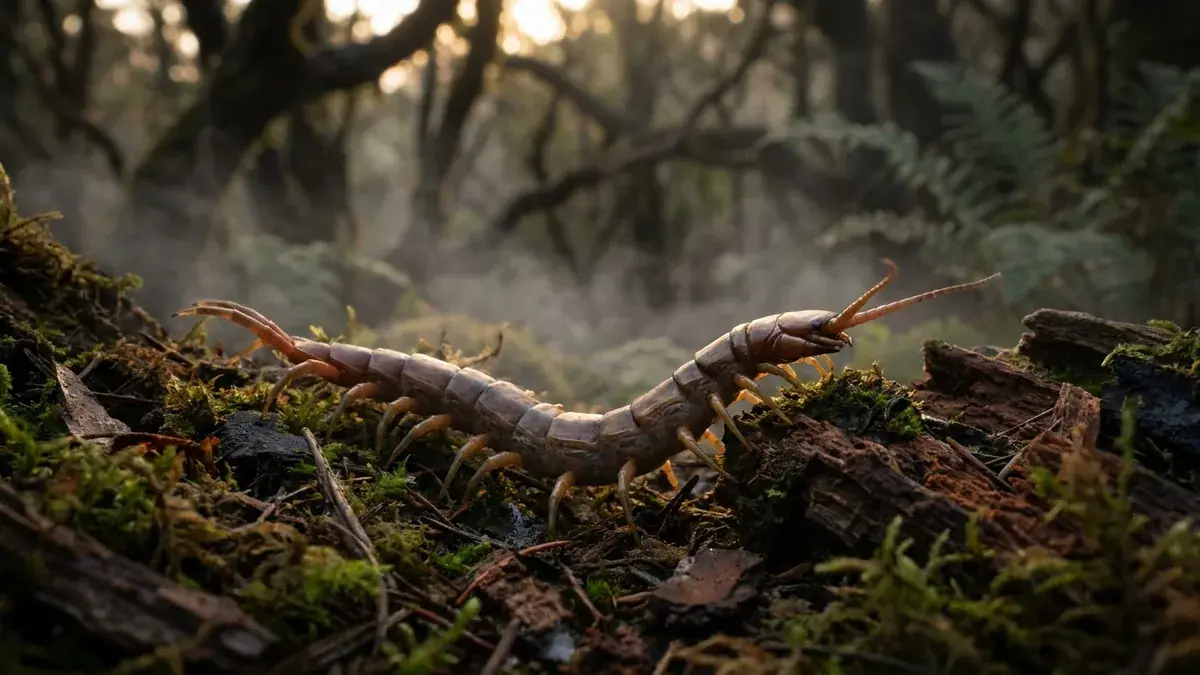
Centipedes carry out their lives in an instinctive and adaptable way, without being guided by anything they can see. They move on silently and swiftly, at times even alone when the situation demands it. As an animal spirit totem or power guide, centipedes point to these qualities — self-worth, solitude for clear thinking, a steady forward momentum that comes from listening to one's inner senses (touch and vibration) more than sight or outside noise. In Eastern lore they are linked to good fortune and rivalry with snakes; also to a pearl said to bring good luck.
In your dreams they will usually symbolize moving ahead (if they are alive and active) or stalling your plans (if they are slow or dead).
An almanac
- Core message
- Trust your instincts and keep your own steady pace
- Spirit animal
- Own your self-worth; seek solitude for clarity
- Totem for
- Warm, resilient, quietly independent people
- Power animal
- Reclaiming strength; plant-based and land-healing work
- In dreams
- Progress despite rivalry, or a hidden truth surfacing
- Element
- Water
- In ancient Egypt
- Sepa, protector god who guarded against venom and the dead
- Hidden ability
- Can fully regrow a lost leg in a single molt
Centipede has a lot of legs, more than most animals really need, and is built to be invisible in dark or damp places. Because of this, it's known as a guide that's powerful, quiet and deeply focused on its own instincts. Its long antennae are like psychic probes for people with poor eyesight who must rely on their ears and skin to tell them what's going on. When Centipede shows up as a spirit animal, totem, or power animal, it's usually reminding you that it's okay to pay attention to what your senses are telling you, even if it doesn't jibe with what everyone else is seeing or hearing. It's okay to walk at your own pace, even if others think you're going too slowly; and it's okay to stand alone if the situation calls for it.
Centipede Symbolism & Meaning
A centipede's venom is injected through its front legs instead of fangs.
Many types of centipede need sheltered habitats and moist ground; intuitively, that may make people think of water.
All centipedes travel quickly and quietly. This can represent great inner stability for someone who feels unsteady in the world. It could also mean a quest to gain or share that stability.
Most centipedes have front antennae. They are used for sensing. If you consider that many types of centipede are actually blind, their antennae represent their only way of knowing anything beyond themselves.
A male and a female centipede will touch their antennae during mating. Then the female leads her mate to a place that's safe and shielded, preparing for what both must commit to wholeheartedly. This may be what happens for anyone who meets his or her mate so suddenly it feels as if they've recognized each other before.
The sharpness of the centipede's bite reminds us that we must take care when giving our words to others or we may hurt without intending it. We should also be careful about taking on more than we can handle.
Centipede Spirit Animal
The centipede is never going to win a beauty contest, but it has a way of carrying itself with a quiet confidence. The message here for us is to not hide our light under a bushel. When you are happy with who you are, you start to see the same glow in others and it becomes easier to feel connected.
This spirit guide also can show up to give you permission to retreat, when you need some time alone. But that retreat also needs to be honest: look at how you are using your resources — are they supporting your whole self or are you chasing something that's not even possible?
Does Centipede fit you?
Tap the ones that sound like you — 6 traits, no right answer.
0 of 6 Nothing picked yet — start tapping.
Centipede Totem Animal
If you were born into a family whose totem animal is the centipede, you'd always land on your feet. People would see you as someone who's warmly straightforward but also fierce when it counts. You'd never worry about your desk or hair looking a bit messy because your attention is always on big things, like caring for others and working to heal the planet. Budgeting would never be easy for you, but when you need money, you'd somehow get it. It sounds like you're a natural lifelong learner who keeps absorbing new information. Your mind might fill up faster than you can process the information, though, and then you could get a bit scattered. As for relationships, people might ask for help sometimes, but that's ok with you. It's important to draw the line at becoming someone's permanent crutch, though — that way you can continue to grow into independence and watch people around you do the same.
Centipede Power Animal
Bring the power of Centipede with you when you feel like you're falling apart. It can help you reconnect with your own inner strength and begin to feel your way back on track, even if the wrong path was partly your own fault.
Once you've taken some time for yourself, Centipede is good at helping you get moving again on whatever steps are next for you.
This power animal is also a great help to anyone who's involved in the environmental movement. It helps sharpen your connection to Earth's healing wisdom and natural magic. And it's especially helpful for anyone who cares deeply about the restoration of land and animal habitats.
Far Eastern Centipede Symbolism
In Chinese legend, centipedes are the rivals of snakes. It's not uncommon to hear stories about a centipede coming to the rescue of a human against a snake. For this reason, it's believed that if you're seeing a lot of centipede symbols in your life, that means there is danger nearby.
Instead of being scared of them, they might be used as protective charms because one poison counters another.
Centipedes are also important in Indonesian folklore. It is believed that medicine men will travel into caves every few months to look for giant centipedes. They carry out this task by chanting in order to help release a pearl.
When thinking about centipede pearls, it is important to remember that they are actually mucus that centipedes produce themselves and then harden on their tail or heads. Gamblers often use them as charms because they believe that it brings them luck.
The Japanese also have many legends surrounding centipedes. In one particular legend, known as Ōmukade was a giant centipede with the body size of seven and a half coils around Mount Mikami near Lake Biwa. It preyed on both serpents and dragons but had a weakness; an arrow coated in saliva was enough to bring it down.
Centipede in Dreams
When you have a dream involving centipedes, it suggests that good fortune is about to enter your life despite the fact that you are in competition with other people. It might also be an indicator that there is a hidden truth in your life. You will only be able to discover the truth when a certain emotional trigger hits you.
You can face the conflict head on and stop pretending that you do not know about the consequences.
The behavior of the centipede can also indicate things:
- A fast-moving and smooth centipede in a dream suggests that your goals are very close and you should remain patient.
- A slow-moving and sluggish centipede indicates that things are slowing down because you are doing too much and things will become better once you slow down.
- A dead centipede signifies insecurities, distrust, cynicism, and fear of rejection creeping into your life.
Centipede Spiritual Meaning
In numerology, the number one points toward independence and leadership, and zero speaks to infinite potential. Together, they represent the centipede's ability to move through the world on its own terms, unafraid, yet still connected to the Divine.
Alone and in solitude, the centipede lives attuned to spiritual connection. It has no reason to fear unknown paths; it only needs to keep going.
That's why you'll feel a sense of this centipede's support when it appears as a guide. If you follow its lead by advancing steadily and quietly on your own path — trusting your instincts along the way — you'll find that at every turn, you remain connected to something greater than yourself.
Centipede in Ancient Egypt: Sepa the Protector
Long before Centipede arrived in Chinese or Indonesian folklore, ancient Egyptians had already named the creature. They revered Sepa — a centipede god whose appearance morphed over time from a mummified human wearing twin horns.
Sepa's central function in Egyptian mythology was protection. In his many incarnations, he was believed to command venomous creatures — and was specifically invoked to protect people against their bites.
Sepa's reputation also extended into the afterlife. True centipedes devour insects that eat corpses — so by extension, he guarded the deceased against insects that would devour them. This aligned him with Anubis, and at times may have even connected him with Osiris.
Sepa is more than a protector, though: because centipedes eat earthworms that help keep the earth alive, he also represented fertility. Sepa's different incarnations underscored his two intertwined aspects: as protector and guardian of dark depths as well as harbinger of fresh new life.
Centipede Leg Regeneration: A Living Symbol of Resilience
One key feature of Centipede's symbolism as a healer and guide into resilience is the way it can truly regenerate a lost leg. Researchers who study house centipedes have documented what they call "explosive regeneration", which is the ability to regrow a full, fully functional new leg in just a single molt, something very rare among land-dwelling arthropods. They found that when a leg is lost, Centipede's wound seals over instantly and quickly at a weak point along the exoskeleton where an original leg broke off. Below the skin, Centipede's flesh compacted to make room for the new leg almost as soon as the wound sealed, and a new leg immediately started coiling in shape underneath. That meant it was ready by its next molt, and after it grew back out of its skin, it was rejoining all the other legs as one more appendage. As far as Centipede was concerned, no time had been lost.
Symbolically speaking, that means that even if you think you've been permanently severed from an ideal or an opportunity by losing something important, your need to mourn is often way out of proportion to any true necessity: your wound seals almost instantly, there's room for new growth below the injury site, and life moves forward. And the speed with which what was lost comes back indicates how fast and automatic can be your own regeneration. If you're seeking advice from Centipede after losing something in real life that left you grieving because you were afraid of what will take so long to grow back or whether it will ever return at all, Centipede's symbol shows just how little time you might spend grieving.
The House Centipede: An Unlikely Household Ally
Turns out: they're great to have around. They're native to the Mediterranean but are found worldwide now. They help around the house because they feed on creepy crawly things that we humans want gone: things like cockroaches, bed bugs, termites, silverfish, ants, and spiders.
Their venom is mild, and their small forcipules struggle to break human skin — it's very hard for them to sting us even once. When it happens, someone can feel a bit like they've been stung by a bee.
It's pretty eerie to look at one if you don't know what it is; but it looks more surprising than dangerous — people often mistake its appearance for a much worse hazard.
Spiritually speaking: there's a parallel between this kind of centipede and how people react to each other. People tend to misjudge another person based on their appearance, before knowing anything about what they actually do.
The frightening appearance of one of these centipedes shouldn't scare us away from welcoming them as part of our house. Let the centipede remind us not to focus on someone's outward appearance before getting to know who they really are inside.
Frequently Asked Questions
What does the Centipede spirit animal mean?
Centipede is a common spirit animal symbolizing self-worth and inner confidence. It is often seen as a reminder to think clearly, rather than being swayed by the voices of others, and to trust your own instincts and feelings. Another important meaning of Centipede is that your words have power—so watch what you say.
Is seeing a centipede a good sign?
Many people think that seeing a centipede is a good sign. For example, in Chinese tradition Centipedes are heroes who protect people from snakes. In Indonesia, the rare centipede pearl is said to bring good luck.
What does it mean to dream about a centipede?
In dreams, a centipede usually implies good fortune is on the way but may also indicate there's some hidden truth to find out about. A centipede moving rapidly is a good sign of progress, but if it's slow-moving, that suggests progress has been stalled. And a dead centipede is a warning about insecurity or fear of being rejected.
Are centipedes dangerous or poisonous to humans?
Not really. House centipedes, the species you're most likely to encounter, have venom with little effect on humans — the delivery system, forcipules, may not be long enough to pierce the skin, and a sting would cause only brief discomfort and no more. Spiritually, the gap between a centipede's threatening look and its minor danger makes a point: Looks can deceive you.
What does it mean to kill a centipede in a dream?
Killing a centipede in a dream is like reclaiming control over a fear, rivalry or something hidden that you feel is stressing you out. If you are killing a centipede in a dream, try to identify what's causing you to feel uneasy and confront that. Don't just wait for it to go away.
Why does Centipede symbolize protection in ancient traditions?
Several unrelated traditions give the centipede a reputation as a protector. The ancient Egyptians worshipped Sepa, a centipede god, as a protection against venomous animals. In Chinese folklore, the centipede was one of several legendary 'Five Poisons,' animals that carried venom, including scorpions. According to the same traditions, people could wear imagery of the Five Poisons as talismans for protection. It's not hard to imagine why both of these groups regarded this creature so highly -- in nature, centipedes hunt creatures that spread venom.
Centipede also represents
- Other animals that represent freedom →Alongside Eagle, Horse, Hawk, Butterfly
- Other animals that represent resilience →Alongside Cockroach, Camel, Salmon, Turtle
- Other animals that represent determination →Alongside Salmon, Ant, Beaver, Falcon
- Other animals that represent intuition →Alongside Owl, Cat, Wolf, Raven
Sources
Claims on this page were checked against these published sources.
- Centipede
Despite the name, no species of centipede has exactly 100 legs; the number of pairs of legs is an odd number that ranges from 15 pairs to 191 pairs.
Read the source → - Scolopendra gigantea
a length exceeding 30 centimetres (12 in)
Read the source → - centipede
from centi- ("hundred") + pēs ("foot")
Read the source → - Sepa (god)
Sepa was an ancient Egyptian centipede deity. ... He was believed to have control over venomous animals and was worshiped to prevent attacks from venomous animals. He also held a role as a fertility god because centipedes will hunt earthworms which helps make soil more fertile. Sepa also was a protector of the dead because centipedes were sometimes seen attacking insects eating dead bodies. Sepa was depicted either as a mummified man with two centipede-like horns or as a mummified man with a donkey head.
Read the source → - Ōmukade
The Ōmukade is a giant man-eating centipede that lives in the mountains. While it eats humans, the Ōmukade has a weakness to human saliva. ... a giant centipede made its lair at Mount Mikami near Lake Biwa. ... Hidesato shot two ineffective arrows, but the third arrow smeared with his saliva proved lethal.
Read the source → - Five Poisons
The Five Poisons...can refer to an ancient Chinese set of poisonous or otherwise hazardous animals. ... The fifth day of the fifth month or Duanwu in ancient Chinese folklore symbolised the beginning of the Summer...was seen as one of the most inauspicious and dangerous days of the year...because all the poisonous animals and bugs would then begin to appear.
Read the source → - Explosive regeneration and anamorphic development of legs in the house centipede Scutigera coleoptrata
Centipede appendage regeneration is categorized as 'progressive' or 'explosive', with the latter involving full regeneration of the appendage after one molt... The genetic predisposition allows house centipedes to regenerate legs within one molting cycle, which is unique among land arthropods and rare in marine taxa.
Read the source → - Scutigera coleoptrata
Scutigera coleoptrata is indigenous to the Mediterranean region, but it has spread through much of Europe, Asia, North America and South America. ... House centipedes feed on spiders, bed bugs, termites, cockroaches, silverfish, ants, and other household arthropods. ... Their mild venom and small organs of envenomation render the species nearly incapable of harming humans. Even then, the relatively small forcipules of a house centipede have difficulty penetrating human skin, and even successful stings produce only mild, localized pain and swelling, similar to bee sting.
Read the source →