Birds · Spirit animal
Kiwi Spiritual Meaning & Symbolism
The grounded, wingless wanderer who trades flight for fierce loyalty and quiet endurance
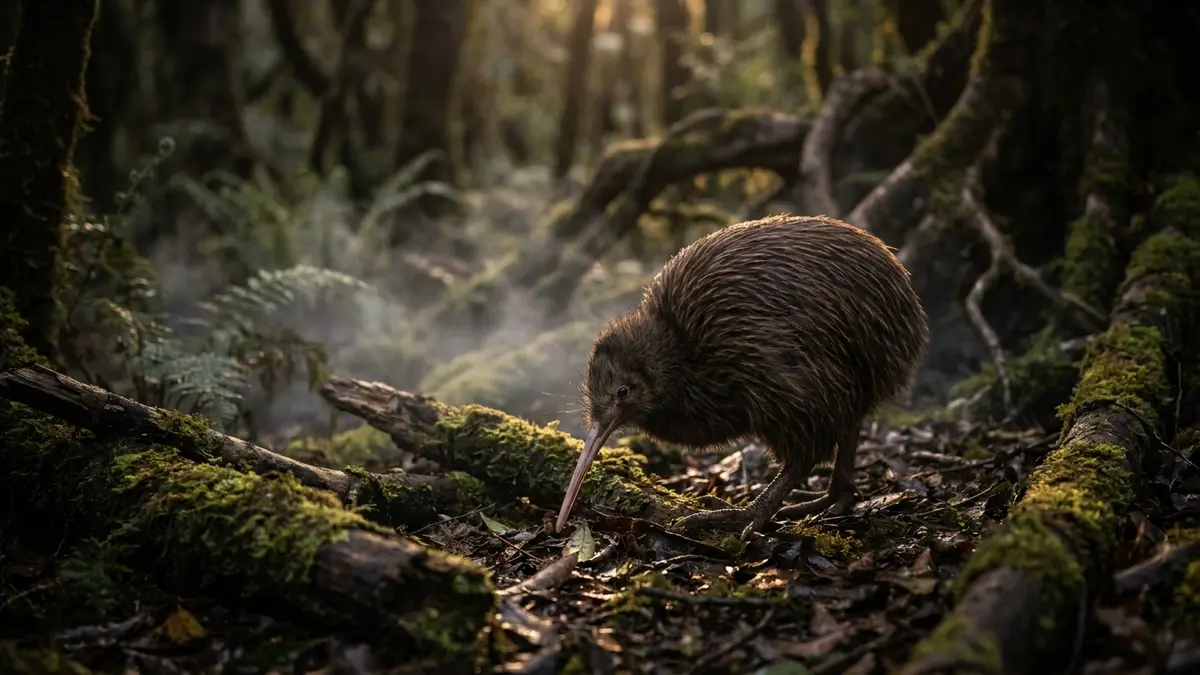
You know that mate-for-life bird whose commitment to one partner rather than many is the stuff of lore? It's the Kiwi. Its message? Devotion outlasts spectacle. If this resilient, mystifying, and loyal spirit animal appears in your life, it's nudging you to trust your instincts. It's time to show up for the people you love. You're also home-loving by nature and interested in hidden mysteries. A dream about a Kiwi often signals rising creativity or calls for an honest reflection about a relationship.
An almanac
- Core message
- Devotion outlasts spectacle
- Spirit animal
- Show up fully, trust your instinct
- Totem for
- Reserved, home-loving night owls
- Power animal
- Building lasting intimacy
- In dreams
- Creativity rising or a relationship needing honesty
- Cultural roots
- Maori legend of sacrifice for the forest
- Genus name
- Apteryx — Greek for "without wings"
- First kept in captivity
- London Zoo, 1851
In New Zealand, the kiwi is both a national symbol and an iconic bird. It has no wings, no tail, and a sense of smell that makes it fit better in the wild like a fox rather than like a chicken. The strange mix of traits won't quite help them get off the ground. In fact, they can't even fly. But Kiwis are faithful, determined little birds that do just fine by working together with their instincts to make things work.
Kiwi Symbolism & Meaning
The Kiwi has been a secret. Its history, meaning, and form have all been mysteries. Kiwis are New Zealanders' symbols of strength and hope.
Kiwis borrowed their name from Maori people. That word means "the hidden one." A hidden bird made sense to New Zealanders. They were still trying to find out how Kiwis got there.
Kiwis don't have any useable wings. Most birds' noses start at the base of their beak instead of where they are in Kiwi birds.
Kiwis have whiskers on their noses for feeling in the dark when they hunt or look for danger. That made them honorary mammals.
The Kiwi bird's military insignia started in the 1800s. By World War I, it was another symbol for bravery and courage.
Kiwis lay eggs much bigger than they are! Their chicks find food five days after they hatch — almost at birth! No help from parents here! It sounds like independence and determination.
There are only about 68,000 wild Kiwis still living, though. There is an estimated 2% drop every year, and there's only one group of just a few hundred in the rarest subspecies!
The rarest bird stands for saving themselves despite bad odds! It's about having hope and courage even when you're in trouble.
Kiwi Spirit Animal
The kiwi bird is monogamous in the wild, so it might be showing up to prompt you to be fully present in your relationship. Are you holding back emotionally or perhaps physically? Are you able to communicate with your partner without beating around the bush?
The kiwi is instinctual and powerful in their way of moving through life. Relationships take work, and every day that you're in a relationship matters.
Another subtler theme in all of this is clairalience — knowing something about people or situations without necessarily having a reason or being able to fully justify it. Follow your instincts: If something feels wrong, follow your gut instead of talking yourself out of trusting yourself. And if something feels right, trust that gut feeling. It's an important message for leadership and decision making.
Because the bird relies heavily on their sense of smell in the wild, that sense extends into the spiritual world as well. Be aware that what others say to you and how they act may not align with what they "feel" about a situation; once again, this comes back to trusting your gut feeling and instincts.
Does Kiwi fit you?
Tap the ones that sound like you — 6 traits, no right answer.
0 of 6 Nothing picked yet — start tapping.
Kiwi Totem Animal
If the kiwi is your totem animal, you might be on the reserved side, preferring subtle colors to flashy ones. You might also be a night owl instead of a morning person. Your clearest thinking comes after the sun goes down, which may make you more inclined to work at night or in the evening.
Your sense of home is strong. You prefer to be surrounded by trees and bushes and greenery, and while you can settle down almost anywhere, you need to feel secure. That sense of security is also important in your relationships. You're built for one person rather than multiple partners, and breakups are more difficult for you than they are for most people.
You might seem quieter than most people, but deep down you have great leadership potential. People trust you because instead of asking for authority, you earn it. It's not that leadership is a perk to you; it's something that carries responsibilities and that you take very seriously.
Kiwi Power Animal
Call on Kiwi when you're ready to commit to lasting change and you need the support to follow through. Intimate relationships require sharing at depth, which can feel exposing, and Kiwi is with you to help open up without risking being shut down by your fear.
Kiwi is also a valuable ally when you want to find better ways to show love to your partner. Sustaining a relationship requires ongoing effort and the imagination to keep the spark alive rather than letting things go flat. Kiwi's energy supports you in meeting—or exceeding—the hopes of your loved one for more intimate connection.
Maori Symbolic Meanings
Apparently, the god Tane Mahuta asked if any of the birds in his care would come down from the forest canopy to eat insects on the ground. Not one would until Tane-hokahoka called the bird's children down from the trees. The Tui was scared of the night, so it's supposed to have two white feathers near its throat to show that it refused to give up its wings. The Pukeko said that the ground was too cold and damp.
Every single bird refused until the Kiwi said it would help even though it knew its life would change. It'd have to live on the ground and walk instead of flying, but in exchange, it'd save all of Tane Mahuta's children who depended on those trees.
The Kiwi earned respect for offering itself up for them.
The bird's image later showed up on some of New Zealand's first coins in the 1930s, and people started calling airmen from New Zealand "Kiwi," even though Kiwis never fly.
The connection ran deeper than a few coins; its silhouette was printed on florins from 1933 through 1966. The bird stayed on 20-cent pieces.
Kiwi in Dreams
The appearance of a kiwi in your dreams often means that you will be flooded with creative inspiration — fresh ideas ready to move from your imagination into reality. The details of the scene surrounding the kiwi often point you in a specific direction:
- If you see a group of kiwis approaching, it's a sign that something difficult might be coming, but if they just pass by, you can expect this moment to pass quickly.
- If a kiwi lands on you, it means news is coming to you from far away.
- When there are two kiwis together, it suggests an intense longing for love — or perhaps more commitment in an existing relationship.
- If a kiwi circles around you or your partner, it encourages you to have an honest conversation about your commitment level in the relationship.
- If a kiwi takes flight, it signifies something amazing happening in your waking life or an opportunity to grow and become more spiritual.
- When the kiwi tries to hide, it's a warning to be careful about how much outside pressure may be straining your relationships.
- And if you see a kiwi foraging in the ground, it means that there's something beneath the surface of what you see that could be important.
Kiwi Spiritual Meaning
The kiwi is a flightless New Zealand bird.
The kiwi's message, despite its odd appearance, is simple: devotion outlasts spectacle. It has the instinct to survive without wings or dramatic plumage. It can matter without attracting attention.
A sight of the kiwi asks you to trust your instincts and what you sense beneath appearances. Choose loyalty over spectacle and put your trust in what you've already made commitments to.
Don't wait for perfect conditions.
Kiwi and the Wisdom Beyond Sight
Kiwi biology offers another paradox worth wrestling with: relative to body size, the Kiwi has the smallest eyes of any bird alive. Scientists examining its eye structure, visual fields, and brain functions found a pattern in each: one set of sense organs takes center stage at the expense of the others. Wild Kiwi can even survive without vision completely, foraging and thriving.
If this is a blind spot, it's one way for an animal to interpret its surroundings: walking forward nose-first isn't less effective than circling and scanning, or whatever your strategy is.
Frequently Asked Questions
What does the Kiwi symbolize spiritually?
Spiritually, the Kiwi is associated with loyalty, mystery, and survival against the odds. As a flightless bird with a mammal-like nose, it symbolizes paradox and instinct. Because it's endangered, the Kiwi has come to represent hope.
What does it mean if Kiwi is your totem animal?
A kiwi totem animal is a sign that you are a person who is reserved, home-loving, and thrives at night. You value stability and commit fully to one partner. You are a natural leader who has earned others' respect through fairness rather than force.
What does dreaming about a Kiwi bird mean?
It may suggest increased creativity, or a need for honest reflection in a relationship. Pay attention to details: a Kiwi landing on you suggests good news, but if the Kiwi is hiding, this hints at outside pressures affecting your relationship.
What does the Kiwi's scientific name mean?
The genus Apteryx, from which the Kiwi gets its scientific name, means "without" and "wing." Naturalists gave the bird this name because of its unique trait: it thrives without the one thing every other bird relies on. A missing or unusual trait doesn't define a creature, or a person.
Can Kiwi birds actually see?
Kiwi birds' eyes aren't up to much. They have very small eyes for their size, and studies have shown that wild Kiwi can survive quite well without using their eyes at all. They're able to compensate using their excellent sense of smell and touch, in line with Kiwi's spiritual reputation for relying on instinct over appearances.
What does a Kiwi tattoo symbolize?
Someone getting a tattoo of a kiwi bird is probably seeking to express themes. Kiwis are loyal, quietly resilient, and proud of who they are and where they come from. Perhaps, too, the tattoo is meant as a way to signal to others that the person is from New Zealand—since the kiwi bird is so tied into New Zealand's identity.
What does it mean to dream of a dead Kiwi?
Dreaming about a dead kiwi is less about loss and more about the end of a phase. Kiwis represent devotion and endurance, and when one dies in your dream, it indicates that a commitment or effort is coming to an end. This makes room for a new commitment rather than foretelling an abrupt ending in your waking life.
Kiwi also represents
- Other animals that represent love →Alongside Dove, Swan, Wolf, Seahorse
- Other animals that represent strength →Alongside Lion, Bear, Tiger, Elephant
- Other animals that represent resilience →Alongside Cockroach, Camel, Salmon, Turtle
- Other animals that represent loyalty →Alongside Dog, Wolf, Swan, Penguin
Sources
Claims on this page were checked against these published sources.
- Kiwi (bird)
kiwi are the only birds with nostrils at the end of their long beaks
Read the source → - Honorary mammals
The kiwi's habits and physical characteristics make them un-birdlike in many ways.
Read the source → - Kiwi (people)
The image of the kiwi had appeared on military badges since the South Canterbury Battalion used it in 1886.
Read the source → - Kiwi facts
They emerge from the nest to feed at about five days old and are never fed by their parents.
Read the source → - New Zealand Maori Legend - How the Kiwi Lost his Wings
you will have to grow thick, strong legs so that you can rip apart the logs ... you will loose your beautiful coloured feathers and wings so that you will never be able to return
Read the source → - New Zealand pound
distinct New Zealand coins in 1933 ... A kiwi facing left ... on the 2/– (florin) denomination
Read the source → - Hidden Bird of Tane
Tūī has worn two white feathers at his throat, indicating his uselessness
Read the source → - Kiwi Forego Vision in the Guidance of Their Nocturnal Activities
Paradoxically, in the nocturnal and flightless Kiwi (Apterygidae), the eyes are exceptionally small with respect to body mass. Kiwi show minimal reliance upon vision indicated by eye structure, visual field topography, and brain structures, and increased reliance upon tactile and olfactory information.
Read the source →