Birds · Spirit animal
Hoatzin Spiritual Meaning & Symbolism
An ancient, odd-looking bird whose slow digestion and tight-knit flock life teach patience, self-protection, and belonging.
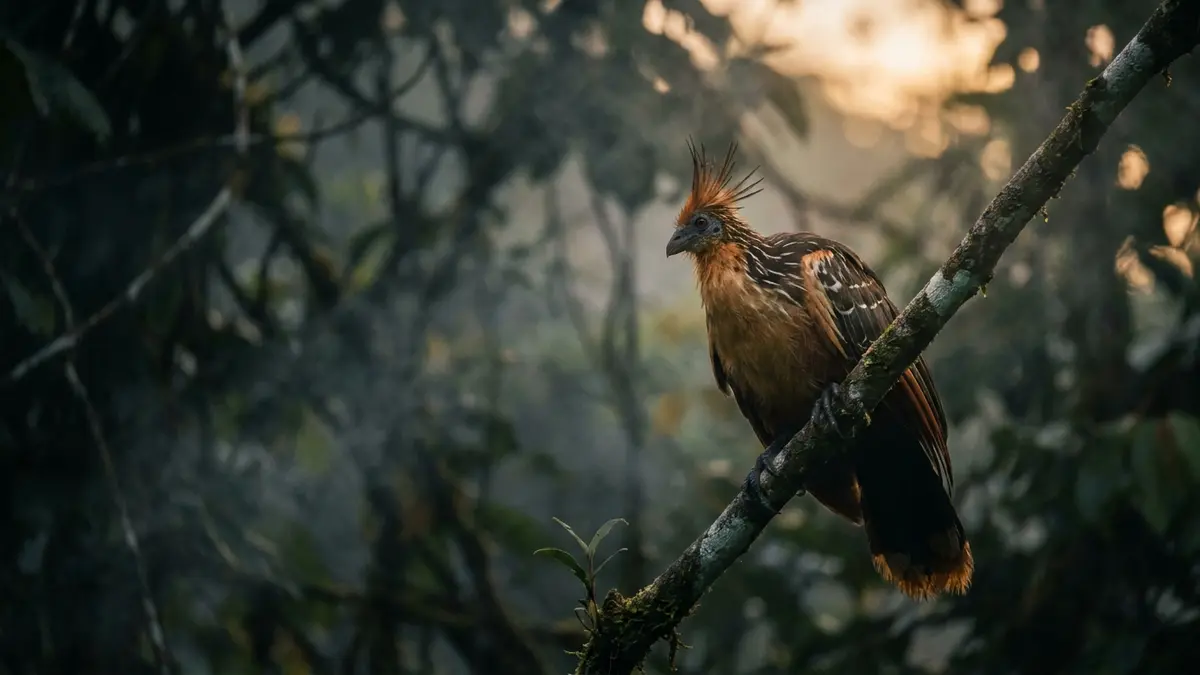
The Hoatzin bird is symbolic of patience, self-preservation, and community. It urges you to take things slowly and consider your options before acting, like the way it leisurely ferments its food to make it digestible. Its crude smell can be a powerful message of healthy boundaries. Its rumpled crest and ancient lineage say something about inner guidance, while its tight grouping behavior shows that security comes from support networks rather than isolation. In dreams or visions, it often means change is about to happen after a period of lack of growth or movement — what sort of change depends on the situation.
An almanac
- Core message
- Patience, protection, and belonging
- Spirit animal
- A riddle urging patience and caution
- Totem for
- Quiet old souls who avoid confrontation
- Power animal
- Processing the past and holding boundaries
- In dreams
- Unpredictable change after stagnation
- Watch for
- People not acting in your best interest
- Nicknames
- Stinkbird, Flying Cow, Canje Pheasant
- Range
- Amazon & Orinoco Basins
The Hoatzin is Guyana's national bird, and it's lived in the wetlands of South America for many millions of years. It looks like it came from an earlier story, and every detail from its spiky crest to its unusual digestion to its loud colonies tells you that it's a spirit animal meant to teach patience, protection, and belonging. When you feel the strangeness of this bird, let it guide your journey rather than turning you away from it.
Hoatzin Symbolism & Meaning
Fossil records trace the Hoatzin's ancestry back 36 million years, but genetic studies place the bird's lineage among dinosaurs' contemporaries. This evidence marks Hoatzins as a messenger from a long-ago and distant world. They're named Opisthocomus, from the Greek for "long hair behind," due to the signature tail plumes.
A testament to its ancient origins, baby Hoatzins feature claws on their wingtips for scrambling away before learning to fly.
Traditional symbolism connects these tail feathers to mystery, fresh starts, and unseen energy.
Its home turf is the flooded forests, where it thrives in colony of a breeding pair with helpers — doing anything but fly. It stays close to its perch and leans on a reinforced breastbone for balance after a heavy meal. Despite its ungainly flight, Hoatzin carries itself with absolute confidence in its own limits.
The unique internal fermentation Hoatzin produces earned it the derogatory nickname "Stinkbird." This stomach-smell works like a shield and makes the bird a symbol of self-preservation, setting boundaries and reflecting on what is healthy.
It thrives in community. When a disaster threatens its safety, the Hoatzin sounds an alarm call and hides in dense cover, while chicks can drop straight into water and swim off when attacked.
Hoatzin Spirit Animal
When the Hoatzin spirit animal comes into your life, it's a sign that you need to stop and think before you act. This bird has an unusual way of breaking down the food it eats, and that can tell you something about your own approach to problems. You may be trying to take in too much or not giving yourself enough time to digest what you're thinking. Make sure you're drinking enough water, and take a closer look at what you eat.
The Hoatzin also teaches you to slow down and think before acting. This bird is gentle when it's with its own family but will fight for what it wants if someone comes near its territory. Look at the people in your life. Are they helping or hurting you?
Does Hoatzin fit you?
Tap the ones that sound like you — 6 traits, no right answer.
0 of 6 Nothing picked yet — start tapping.
Hoatzin Totem Animal
If you're born under the Hoatzin totem, you like to take things slow, especially when emotions are involved. You don't rush to conclusions; instead, you spend time talking to people on both sides of a disagreement before deciding if — and how — you want to become involved. That way, you usually get a clearer picture of what's happening than others do who let emotions rule their decisions.
You also have a gift for piecing things together. You're great at finding things that others missed and fitting the pieces together. Because of that gift, many people turn to you as a quiet sage who can make sense of something no one else can. That part often feels natural and easy for you.
Family matters a lot to Hoatzin people. You know that "family" can look very different from person to person, and that everyone deserves respect for what it means in their own life. As a result, even brief conversations with people feel important and leave both people a little richer.
You have an unassuming way about you but a strong sense of yourself. You say little but mean it when you do speak up. Your true self shines through in any situation or relationship.
Hoatzin Power Animal
Call on the energy of the Hoatzin when old memories keep resurfacing and you just can't get rid of them — this power animal can help you retrace your steps and find out the truth, even if it's a painful truth.
The Hoatzin can also help you when you need to set boundaries — if people are getting too close, let your discomfort do the talking. And if you're feeling unsteady, like everything is slipping out from under you, this bird is a great ally — it knows what it's like to be perched at an unstable height and can help you find your own footing again.
Hoatzin in Dreams
A Hoatzin flying in dreams is usually a sign that something unusual, unpredictable is coming your way, especially if you've been feeling stuck or bored. If you see this bird taking certain actions, it will give you guidance and direction.
If a Hoatzin dives from above as if it were flying toward you, it's time to leave any relationships or dynamics that are toxic for you. They will just cause you unhappiness and hurt in the long run.
If a Hoatzin swims underwater in your dream to get to safety, it's a good sign that your choices and efforts to become well will get you there.
When a Hoatzin climbs up to make a nest, it's a sign that there's a home base waiting for you or perhaps your loved ones, and the more secure this base is, the better.
If this bird sits in trees to watch all around it or in general birdwatching terms "perches high," this means that you should look into your family background or roots. Past events can inform how to create a better present for yourself.
Seeing two Hoatzins together could mean that soon you'll meet someone special who will be lifelong friends with you.
Seeing one that's caged means that something in your life prevents you from fully being yourself. Maybe examine where this is coming from and fight against its effects!
Hoatzin Spiritual Meaning
One truth runs through the Hoatzin's oddities: the more good you want to absorb, the longer you need to wait. There's no hurry with its shabby digestive system; it takes time and hard work to digest right. Holding on to that makes a good, firm fence: one built with spiritual meaning.
The way this bird smells says something, too.
It thinks for itself, in a quiet way. And it stays true to its own self.
These things mean that there's nothing wrong with looking funny. Its family is close by and important to it. Its family is its world.
Because it looks off-balanced, it can't stand up straight on its own. But it finds its balance and stands tall — which shows how balance and imperfection don't have to fight each other.
It all means that holding off till the good times feel real is OK. Being part of something real is best of all for you.
The Hoatzin's Many Names
The Hoatzin comes by its names honestly. Guyanese locals know it as the Canje Pheasant, a proud reference to the river and forestlands that shelter it. Some ornithologists refer to it as the "flying cow," reflecting how the leafy material hoarded in its crop seems to belong on the cattle range instead of a jungle. Scientists even rendered its genus name from Greek words that mean "long hair behind," as if echoing its most striking physical feature — wispy, spiky feathers resembling a prophet's crest.
If there is one lesson to learn from this bizarre creature's many names and roles, it may be that you do not have to conform to one thing only. The same way you might play more than one part in a community or family structure, or hold several titles in your spiritual life, this bird demonstrates that you are not bound by strict labels — even scientific ones — but rather by your acceptance of contradictory parts of yourself. Embrace who you are and what your destiny brings: even if no single appellation does justice to the complicated truth of who you are, opening yourself up to ambiguity will lead you on a personal journey toward wholeness.
Frequently Asked Questions
What does the Hoatzin symbolize spiritually?
As a symbol, the Hoatzin represents the values of patience, self-protection, and familial devotion. The bird’s ancient lineage and unusual traits hint at subtle psychic powers, prudence before taking action, and a strong desire to protect oneself and close family members.
Why is the Hoatzin nicknamed the 'Stinkbird,' and what does that mean symbolically?
The Hoatzin ferments its food, giving it a strong odor and helping keep its predators and humans at bay. In symbolic terms, the smell is a boundary that helps the bird stay safe.
What does it mean to see a Hoatzin in a dream?
Seeing a Hoatzin in a dream can mean different things. If it was diving, that usually points to a toxic situation. Swimming usually indicates you're moving toward safety and well-being, while a nest means you're trying to build a secure home for your family. Seeing two together can symbolize a soul mate or a close friend.
Is the Hoatzin really as ancient as it looks?
Fossil evidence ties the Hoatzin's lineage to something roughly 36 million years old, but genetics suggests it is more like 64 or 70 million years old, enough that it probably branched off around the time when non-avian dinosaurs vanished. Spiritually, it suggests that some of your roots are deeper than they appear.
What does it mean to dream of eating a Hoatzin?
As far as Hoatzin dreams go, this one might scare you — and folklore around it does lean cautionary. But instead of panicking, it probably means that you should prepare. Look for places to shore up your resources and lean on the people closest to you. Take things slow, because while breaking down their food might take these birds a while, processing what's happening to you will be worth the wait in the end.
Hoatzin also represents
Sources
Claims on this page were checked against these published sources.
- Hoatzin
the national bird of Guyana
Read the source → - Hoatzin (Opisthocomus hoazin)
bronze-green and ends in a white band
Read the source → - Hoatzin
The enlarged foregut accounts for up to 25% of their body weight.
Read the source → - Diet and Foraging - Hoatzin
These plant materials are digested in the crop with the aid of bacteria and other microbes in a process akin to the fermentation process used by ruminant mammals... This fermentation-based digestion is why the bird is colloquially called a "flying cow."
Read the source →