Spirit Guides
South Symbolism & Spiritual Meaning

South is the direction of Fire, tied to the summer season and the life stage of childhood into the teen years. It carries full-bodied aliveness, passion, and love. Its primary totem is Wolf, its stones are Carnelian and Red Coral, and across cultures its animals (Coyote, Rooster, Snake, Horse, and more) run warm, active, and always pointing toward renewal.
An almanac
- Element
- Fire
- Season
- Summer
- Totem Animal
- Wolf
- Healing Crystals
- Carnelian & Red Coral
- Life Stage
- Childhood into the teen years
- Hindu Guardian
- Yama
- Feng Shui Trigram
- Li (Fire)
Face South and you're facing the sun at its highest point — the direction of Fire, heat, and full-bodied aliveness. It's the season of summer, when everything the earth planted earlier ripens into abundance, and there's a felt sense that, for this moment at least, there's enough.
In the arc of a human life, South lines up with childhood into the teen years — restless energy, curiosity, a hunger to grow. Physically it lends stamina; mentally, growing self-trust; emotionally, it's the direction most tied to love. Left unchecked, that same fire can curdle into anger, but worked with consciously, it settles into warm coals rather than wildfire.
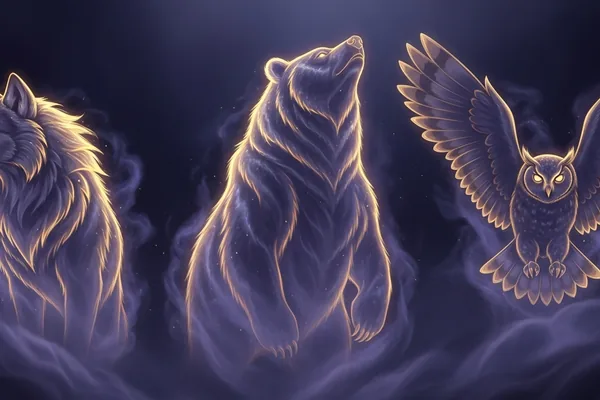
Wolf: Totem Animal of the South
The animal most closely tied to this direction is Wolf. Old folklore painted wolves as menacing hunters, but they're deeply social, playful with their young, and communicate through a wide vocabulary of howls, each carrying its own meaning. That's Wolf medicine: learning which "voice" a moment calls for.
Just as the southern sun illuminates the world at midday, Wolf asks you to shine light on whatever you've been avoiding. Are you really listening to your gut, or talking over it? People who carry Wolf tend to be fiercely independent while still valuing their people — proof that being wild doesn't require being alone.
If Wolf shows up now, it may be a nudge toward balance: defending territory that doesn't need it, or staying quiet when you should speak plainly. Find your real voice and use it.
South and the Element of Fire
South belongs to Fire, one of humanity's oldest sacred symbols. Long before it warmed a stove, fire was the center of a community — where stories got told and strangers welcomed in. Shamans used smoke from communal fires to prepare ritual tools; the smoke carried prayers upward and stood for the sudden spark of a new idea.
Fire has to be tended so it neither dies out nor rages out of control, which is why some traditions kept a dedicated fire-keeper, and why people relocating to new land would carry an ember from home.
Metaphysically, Fire is credited with birthing the universe, with the sun as its everyday expression — motion, raw passion, courage, will. A South-facing altar suits candles as centerpiece, paired with stones like amber, carnelian, or fire opal, cloths in red or gold, and warming incense like cinnamon or dragon's blood.
A few real creatures earn an honorary place here for heat tolerance: the Tardigrade (water bear), which survives past 300°F in hot springs and brutal cold alike; the Pompeii worm, found near deep-sea vents in water close to boiling; and the Sahara desert ant, which forages above 122°F on long legs that lift it clear of hotter sand.
Older mythology adds the Salamander, a Greco-Roman fire-spirit said to live and die by flame. Even the word "south" carries this sun-logic: Old English roots meant "sun" or "toward the sun," a Finnish term meant "front" — the direction a home's entrance should face — and an old Hebrew word linked it to dryness, the sun's parched path near Jerusalem.
Healing Crystals for the South
Two stones are traditionally paired with this quarter: Carnelian and Red Coral.
Carnelian carries a gentle warmth, like early autumn sunlight rather than harsh noon glare. It's a stone for anyone who feels stalled or drained of energy — ancient orators reportedly used it to steady their nerves before speeches, warriors wore it for protection, and it was once carried as a ward against plague.
If you're building anything, literally or figuratively, keep it close; some treat it like a worry stone when motivation dips. It's also linked to luck with money, protection from tool accidents, and easing jealousy so you can see what's actually true. It's tied to the sacral chakra, just below the navel.
Red Coral speaks to making peace with change. It's reached for when self-worth feels shaky, since it nudges you back toward self-respect, and it's carried as a fertility charm — for literal children or a project you're birthing into the world.
Native American Symbolism for South
In Native American teaching, South acts as a purifier, clearing the way for new opportunity. Its animals include the playful Coyote, the pack-minded Wolf, and the fertile Rabbit. Its element is Fire, its season Summer, its time of day noon, its human stage youth into the teen years — upbeat, hopeful, passionate energy pictured in red or burnt orange, light strong enough to chase off shadow, though real vulnerability remains at a stage that hasn't yet crossed into adulthood.
In the modern Native American zodiac (a New Age system popularized in the 20th century rather than an ancient tribal tradition), South spans three signs. Beaver (April 20–May 20) is about efficiency — work first, play later — with a sharp mind and helpful nature, though bluntness is the thing to watch. Deer, sometimes called Stag (May 21–June 20), brings quick wit, real care for appearance, and a knack for reviving stale relationships. Woodpecker (June 21–July 21) is the nurturer: an attentive listener who shows up when support is needed, alongside romance, thrift, and quiet devotion.
Celtic Symbolism for South
Celtic tradition ties the South to inventiveness, drive, passion, and Fire. Its creatures include the Rooster — linked to the sun and dawn, a spirit of illumination — the Boar, a fierce fighter, the Cow, associated with the goddess Brigid and the fairy realm, sacred-well Fish as a symbol of renewal, and Sheep, tied to the birthing season around Imbolc.
Celtic tree astrology places three signs under the South. Sea-Serpent (April 15–May 12) stands for renewal and drawing people together — natural healers, magnetic but ready to fight when it matters. Fox (May 13–June 9) is quick-witted and mischievous, drawn to adventure and shrewd decisions. White Horse closes the group: purity, and a felt connection to the divine, with stamina in service of others and a fierce need for freedom; in dreams it reads as coming good fortune.
South and the Fire Signs of Astrology
South's link to Fire carries into Western astrology's three Fire signs: Aries the Ram, Leo the Lion, and Sagittarius, half-man and half-horse. Broadly, Fire signs read as bold leaders — zealous, extroverted, a touch rebellious, rarely rattled by pressure. They run warm, nearly glowing, and while comfortable alone, they crave companionship and throw themselves into life with real intensity.
That heat can inspire others as easily as it can singe, so read the room — Fire signs love spontaneity but can burn hot when provoked.
South in Chinese and Japanese Tradition
In Shinto practice, the Rooster is tied to the South and sometimes allowed to roam temple grounds. The Fire Dragon carries the same association: solar power as a beneficent guide, and a dragon in a dream reads as luck, adaptability, and success.
In Hindu tradition, the fire god Agni appears in three forms — sunlight, lightning, and flame — a messenger between gods and people. Chinese folklore describes garments woven with the essence of the fire-spirit Salamander, immune to flame — Marco Polo, after visiting the source, identified the real material behind the legend as mined asbestos, not silk.
The creature shared by Chinese and Japanese tradition here is the reddish Vermilion Bird; its color echoes the iron-rich soil of southern regions.
Two zodiac animals fall under this quarter: Snake and Horse. Snake people carry their life lessons with them and aren't easily fooled — they need periodic solitude to shed old skin, returning steadier than before. Horse people speak plainly, without hidden motives, earn recognition without chasing it, and adapt well to change while preferring simple pleasures.
South in Divination
When South comes up as a marker in divination work, it points toward action — steps you've already taken, or ones you're about to. Looking backward, it can be a reminder that burning a bridge rarely served you as well as it felt like it would.
Looking ahead, it signals that a choice in front of you matters more than it might appear to. There's no need to rush it, but don't ignore it either — movement is coming, and it's worth meeting it awake.
Yama and Virudhaka: Guardians of the South
Beyond Agni's fire, Hindu cosmology assigns each cardinal direction its own protector deity — the Dikpalas, or "guardians of the directions." Standing watch over the South is Yama, god of justice and death, who keeps order along the boundary between the living and the departed. Where other directions attract wealth (Kubera, North) or govern wind and rain (Indra, East), Yama's post asks something heavier of the South: honesty about endings, and the humility of remembering nothing burns forever.
Buddhist tradition keeps its own southern sentinel. Virudhaka, one of the Four Heavenly Kings who ring Mount Meru, guards the southern slope and leads the kumbhanda and preta, lesser spirits under his charge. His name comes from a Sanskrit root for sprouting grain, so it reads as "growth" or "increase," and he's usually shown armored with sword raised — less an aggressor than a protector who clears space for beings to mature in virtue. Between Yama's sober justice and Virudhaka's push toward growth, the South carries a dual charge: let go of what's finished, then get on with growing.
Feng Shui: The Fame Gua and the South-Pointing Compass
In feng shui's bagua map, South belongs to the trigram Li — fire, the sun at its peak, clarity so complete it can't help but be seen. That's why the southern sector governs fame and reputation: not celebrity so much as the truth of who you are once it's out in the open, visible enough for the world to judge. Traditional palettes lean on reds and warm purples here, echoing this direction's Fire association everywhere else in this guide.
The pull toward South runs deeper than home design, too. The earliest Chinese compasses, dating to the Han dynasty, weren't built to find north at all — they were south-pointing spoons carved from lodestone, called sīnán, used for geomancy and fortune-telling centuries before anyone thought to carry one to sea. A 1st-century account describes tossing one onto a flat surface and watching it settle, pointing south every time. Only by the Song dynasty, around the 11th century, did the same instrument migrate from ritual tool to genuine navigation.
Frequently Asked Questions
What does the direction South represent spiritually?
South is tied to the Fire element, the season of summer, and the life stage of childhood moving into the teen years. Spiritually it represents full aliveness, passion, self-assurance, and love — the emotional heartbeat of a community — while its shadow side shows up as anger or resentment left untended.
What animal represents the South?
Wolf is the primary totem tied to South, prized for balancing fierce independence with genuine loyalty to family and pack. Other traditions add their own southern animals, including Coyote and Rabbit in Native American teaching and Rooster, Boar, and Cow in Celtic symbolism.
Which crystals are associated with the South direction?
Carnelian and Red Coral are the two stones most often linked to South. Carnelian offers warmth, motivation, and focus, while Red Coral supports self-acceptance, creativity, and easing into life's changes — both pair naturally with South's Fire-element altar work.
Which Hindu deity is linked to the South direction?
In Hinduism's Dikpala system — the eight guardian deities of the directions — South belongs to Yama, god of justice and death, charged with keeping order at the boundary between the living and the departed. It's a sober counterpart to Agni, the fire god who guards the neighboring Southeast, a reminder that this direction's vitality and its mortality are two sides of the same flame.
What does South mean in feng shui?
South sits under the fire trigram Li and governs the bagua's fame-and-reputation sector — less about celebrity than about how honestly your true self shows up once it's visible to others. Reds and warm purples are the traditional palette here, which echoes the same Fire association that runs through this direction's crystals and totems.
Why did early Chinese compasses point south instead of north?
Han-dynasty compasses were lodestone "south-pointing spoons" (sīnán), built for geomancy and fortune-telling rather than travel — a 1st-century account describes one settling toward south when set spinning on a flat surface. The convention held through Chinese tradition even after the same instrument was adapted for real navigation by the Song dynasty, around the 11th century.
More from Spirit Guides





Sources
Claims on this page were checked against these published sources.
- Gray Wolf Facts
All of a pack's adults help to care for young pups by bringing them food and watching them while others hunt. ... A lone wolf howls to attract the attention of his pack, while communal howls may send territorial messages from one pack to another. Some howls are confrontational.
Read the source → - Tardigrade
they become highly resistant to environmental stresses, including temperatures from as low as −272 °C (−458 °F) to as much as +149 °C (300 °F) (at least for short periods of time)
Read the source → - Pompeii worm
their tail end rests in waters reaching 50 °C (122 °F), while their feather-like heads stick out of the tubes into water that is much cooler, 22 °C (72 °F). ... Exposure to temperatures between 50 and 55 °C (122 to 131°F) for more than 2 hours was fatal for the Pompeii worms.
Read the source → - Cataglyphis bicolor
sustain a body temperature above 50 °C (122 °F), with surface temperatures of up to 70 °C (158 °F)
Read the source → - Salamanders in folklore
Aristotle theorized that since creatures exist for earth, air, and water elements, the salamander must belong to fire itself. Pliny the Elder described salamanders as lizard-shaped creatures that 'never comes out except during heavy showers' and could supposedly extinguish flames through their cold bodies.
Read the source → - south | Etymology
The word 'south' comes from Old English suþ, which derives from Proto-Germanic sunthaz... this root is 'perhaps literally sun-side' and relates to the base of sunnon, meaning 'sun.'
Read the source → - Agni
He is conceptualized in ancient Hindu texts to exist at three levels, on earth as fire, in the atmosphere as lightning, and in the sky as the sun. This triple presence accords him as the messenger between the deities and humans in the Vedic scriptures.
Read the source → - Vermilion Bird
it represents the Fire element, the direction south, and the season of summer correspondingly
Read the source → - Dikpala
Yama (Hinduism), God of Justice and Death — presides over the southern direction in the standard eight-guardian system.
Read the source → - Virūḍhaka (Heavenly King)
Virūḍhaka is the guardian of the southern direction... his name means 'increase' or 'growth'... clad in armor while brandishing a sword... the leader of the Kumbhanda and pretas.
Read the source → - Bagua
Later Heaven Direction: South... Five Phases Association: Fire... Li (離) is represented by ☲... corresponds to 'clinging, clarity, adaptable' qualities... fundamental symbol in... feng shui applications.
Read the source → - Cardinal Direction South Meaning & Symbolism
South is governed by the trigram Li (離), the trigram of fire — clarity, visibility, the sun at noon... associated with fire and uses reds, purple, pink, bright yellow or orange for hues... the Fame & Reputation area, known as the Li Gua.
Read the source → - History of the compass
The first compasses were made of lodestone... called the 'South Pointing Fish'... 'But when the south-pointing spoon is thrown upon the ground, it comes to rest pointing at the south'... it was used for land navigation by the mid-11th century during the Song dynasty (960–1279 AD).
Read the source →
Not sure which animal is yours?
Consult the quiz