Spirit Guides
What Is a Spirit Animal? Totem vs Power Animal
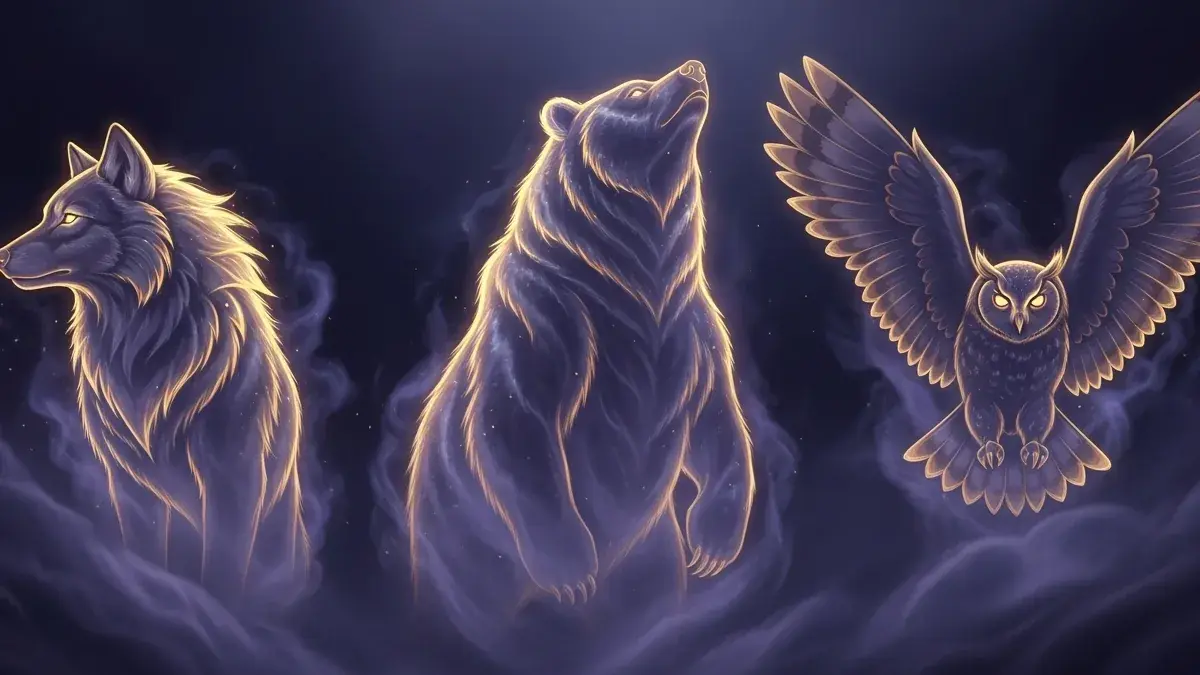
A spirit animal is a guide that shows up when you need support and moves on once its work is done. A totem animal reflects an ongoing part of your identity rather than something you call on. A power animal is an energy you actively invoke to draw out a particular quality in yourself. All three trace back to an animistic worldview, where everything, animals included, has its own spirit. They can appear through dreams, real-world sightings, meditation, repeated imagery, or even a lingering scent.
An almanac
- Spirit Animal
- A guide that appears when needed, then moves on
- Totem Animal
- Reflects identity; not chosen, revealed over time
- Power Animal
- An energy actively invoked for a quality or situation
- How They Appear
- Dreams, sightings, meditation, repeated imagery, scent
- Root Concept
- Animism — everything has its own spirit
- Totem Word Origin
- Ojibwe *-doodem* — "his kin, his family mark"
- Power Animal Term Origin
- Popularized via Michael Harner's core shamanism (1980s)
If you've ever wondered aloud, "what is a spirit animal, anyway?" you're in good company — it's one of the most common questions people ask. The easy answer, "it's the animal you're most like inside," isn't quite the full picture. This guide breaks down three related but distinct ideas: the spirit animal, the totem animal, and the power animal. There isn't one single "correct" way to think about these terms, so treat this as a toolkit: take what resonates and use it as you need it.
Spirit Animal, Totem Animal, and Power Animal: Three Related Ideas
These three terms get used almost interchangeably in everyday talk, and they do overlap. But separating them out makes them far easier to work with:
- Spirit Animal — a guide who shows up when you need love, strength, support, or direction, then moves on once its work is done.
- Totem Animal — less something you call on, more something you are. It reflects an ongoing part of your identity.
- Power Animal — an energy you actively call up from within, or invoke for help in a specific situation, either for life or only when needed.
This works because we're genuinely connected to the animal world; we share enormous amounts of biology with the creatures around us. So "calling up" an animal energy isn't borrowing something foreign — it's waking up a quiet or dormant part of yourself.
So What Exactly Is a Spirit Animal?
A spirit animal appears when you consciously reach out for it, and also when your conscious mind hasn't caught up with what your deeper self already knows you need.
Say a butterfly keeps turning up in odd places while you're stuck in a job or relationship you're scared to leave. Butterfly's teaching is that it's okay to sit in the dark, cocoon-like phase before you transform into something better — the discomfort of change is part of the process, not a sign you're doing it wrong.
A spirit animal might appear once, in a single dream, or repeatedly across dreams, art, and daily life. Either way, these guides tend to know exactly what you need, and when.
Can a Person Be a Spirit Animal?
Since humans are technically animals too, yes — a person can fill this role. Think of the stranger who stops to help you change a flat tire: a human spirit animal works the same way. It enters your life to fix, teach, encourage, or offer perspective, then moves on once that work is done.
These relationships are often short-lived, though for challenges that stretch on for months or years you may develop a deeper bond with that person.
Because life brings so many phases and transitions, it's normal to encounter more than one spirit animal — human or otherwise — in a lifetime. How many you notice depends on how open and attentive you are; these guides won't linger if you keep writing off their signals as coincidence.
How Does a Spirit Animal Make Itself Known?
- Dreams. The clearest signal. If the same animal keeps appearing night after night, jot down notes right after waking and compare the dream to your waking life.
- Real-world sightings. The same creature turning up in unusual settings more than once. Stick to plausible animals for your environment, and use common sense: a felt connection isn't an invitation to go looking for its wild, literal counterpart in the woods.
- Meditation. An animal image forming in your mind is a solid indicator, even if it's smoky or incomplete rather than sharp.
- Repeated imagery. The same animal turning up on TV, in an ad, and elsewhere within a short window is worth sitting with.
- Other senses. A distinctive scent that keeps lingering can point toward an associated animal. Don't dismiss smaller creatures either; insects carry plenty of meaning too.
Making Sense of Your Spirit Animal's Message
- Start with your first association. If lion makes you think of its roar, the message may be about finding your voice. If an animal feels like a negative omen, ask what's happening in your life that calls for extra awareness.
- Research if it's unfamiliar. Most guides carry one central theme plus secondary layers — shark centers on strength and survival, but also touches emotional depth, adaptability, and intuition.
- Go deeper if nothing clicks. Try mimicking the animal's movement, meditating on it, or reading more about its natural behavior.
What you do with the message is up to you. Some situations resolve quickly; others take time, and the meaning may shift as circumstances change.
A Few Things to Keep in Mind About Spirit Animals
- They can return more than once — a repeat visit often signals a deepening relationship.
- If a guide seems to vanish before things feel resolved, ask whether something happened that read as disrespectful or ungrateful, or whether its job was simply done and room was made for a different kind of help.
- Guides can follow the seasons. One animal energy might show up in spring and another later in the year, and not every visit is serious — sometimes a guide drops by just to mark a happy occasion.
- More than one guide can work together at once, each contributing part of a larger message. There's no rule limiting you to a single spirit animal guide at a time.
What Is a Totem Animal?
Totemic beliefs show up worldwide and generally split into two categories. Totemism isn't a religion on its own, and it isn't the same as ancestor worship.
The word totem itself comes from the Ojibwe language of the Great Lakes region — specifically from -doodem, found in odoodeman, meaning "his sibling kin, his group or family." English speakers picked the word up in the mid-1700s, and by the late 1800s anthropologists had borrowed it wholesale to describe similar animal-clan systems they found in cultures around the world. That's part of why the term feels so universal today, even though its root traces back to one specific people and place.
Group totemism centers on a family, clan, or tribe collectively recognizing an animal, plant, or phenomenon as significant to the whole group, sometimes viewed as an ancestral figure tied to the group's origin story. The totem is often credited with protective qualities and comes with its own symbols, taboos, and shared observances that reinforce the group's identity. Among the Indigenous nations of the Pacific Northwest Coast — including the Haida, Tlingit, Tsimshian, and Kwakwaka'wakw — this kind of group totem was carved directly into cedar and raised as a totem pole: not an idol to be worshipped, but a public record of lineage, legend, and clan history that anyone visiting the village could read.
Individual totemism is closer to what people usually mean by a personal totem animal today: a person feels a particular animal grants them a kind of power. That bond is woven into who they are rather than chosen — described across traditions as transmitted by a parent, revealed through a dream, reflected in physical resemblance, or discovered through a meaningful coincidence.
The idea that shows up again and again: you don't choose your totem — it reveals itself to you, in its own time. As your awareness of this relationship grows, so does that private bond with your own inner animal wisdom.
What Is a Power Animal?
The idea of a power animal is defined a little less consistently across cultures than spirit or totem animals, but common threads show up. In some traditions it functions as a protective guide, much like a spirit animal; in others it's a deep, ongoing connection that shapes character and personal power, closer to a totem.
Much of today's Western vocabulary around "power animal" traces back to one figure: anthropologist Michael Harner, who spent years learning directly from shamanic practitioners in the Americas. In 1979 he founded the Center for Shamanic Studies, reorganized in 1985 as the Foundation for Shamanic Studies, to teach what he called core shamanism — a distillation of practices and journeying techniques found across many shamanic traditions. That framework is largely where the specific practice of intentionally "retrieving" a power animal through a guided journey comes from, even though the older belief underneath it — that an animal ally can be called on for strength — shows up independently, and much further back, across many cultures.
A power animal's influence can come through dreams, meditation, or real-world encounters, and its gift usually flows directly from that animal's natural symbolism. If you need patience, you might draw on a creature known for stillness and precise timing. If you're wrestling with fear around a big decision, you might draw on an animal known for nurturing instinct.
One theme holds across traditions: gratitude matters. Take time to genuinely thank a power animal for its help, instead of moving on the moment the favor is done — that deepens your relationship with the energy over time.
Where These Ideas Come From: A Quick Look at the History
To understand spirit animals, it helps to look back at humanity's animistic roots. Animism, from a Latin root meaning "life breath," describes a worldview in which everything — rocks, trees, animals, insects, even stars — has its own spirit or soul. That's a sharp contrast to modern worldviews, which tend to treat humans as separate from, or in control of, nature.
Animism holds that everything we experience has some agency or force behind it, with no hard line between the physical and the spiritual. These ideas were carried forward through myth, folklore, and oral tradition across generations. From that foundation, the idea of animal guides follows naturally: if everything has spirit, then animal spirits can act as allies that show up when we need love, support, warning, protection, teaching, or inspiration.
Frequently Asked Questions
What's the simplest way to tell a spirit animal, a totem animal, and a power animal apart?
A spirit animal is a guide that shows up when you need support and moves on once its work is done. A totem animal is closer to identity — it reflects who you are rather than something you call on. A power animal is an energy you actively invoke, either for a specific situation or for life, to draw out a particular quality in yourself.
Can more than one spirit animal be present in my life at the same time?
Yes. There's no rule limiting you to a single guide at once. Multiple animal guides can appear together: sometimes they work together to deliver a combined message, and sometimes they simply show up in different seasons of your life.
How do I know if an animal sighting is actually meaningful or just a coincidence?
Look for repetition and pattern rather than a single sighting. Recurring dreams of the same animal, the same creature appearing across unrelated contexts in a short span, or a strong image forming during meditation are stronger signals than a one-off encounter. Trust your own sense of significance too — these messages are meant to be personal.
Is it okay to say "spirit animal" if I'm not part of an Indigenous or shamanic tradition?
It's worth knowing where the words come from: totem traces to the Ojibwe language, and the modern practice of formally "retrieving" a power animal grew out of core shamanism, a framework built from Indigenous and shamanic practices. That doesn't mean the underlying feeling — a real pull toward a particular animal — isn't valid for anyone. It just means it's respectful to hold the terms a little more loosely, learn where they came from, and avoid treating a living tradition as a costume or a punchline.
Can my spirit animal or power animal change as I go through life?
Yes, and for most people it does. A spirit animal is especially likely to shift, since it tends to show up for a specific chapter and step back once that chapter closes. A power animal can also change as the situation you're working through changes, though many people find one settles in as a longer-term ally. A totem animal is the one most likely to stay constant, since it's tied to identity rather than to a passing need.
Is there a wrong way to work with an animal guide?
The main misstep is treating the relationship as one-sided: you take the symbolism you like, ignore the rest, and never circle back with gratitude once the guide's message has landed. Learning a little about the animal's real behavior and habitat, not just its symbolic meaning, tends to deepen the connection rather than flatten it into a trend.
More from Spirit Guides

Sources
Claims on this page were checked against these published sources.
- Animism
The word originates from the Latin word anima, meaning 'life' or 'soul'.
Read the source → - Totemism
Early anthropologists mistakenly attributed Aboriginal totemism to beliefs about an 'ancestral spirit individual' causing pregnancy, but this theory has been criticised by other anthropologists, and totemism is treated in the anthropology of religion as a religious practice rather than a standalone religion, distinct from ancestor worship.
Read the source → - Totem - Etymology, Origin & Meaning
From "-doodem" in "odoodeman," which translates to "his sibling kin, his group or family," and by extension, "his family mark." ... Origin Date: 1760.
Read the source → - Totem pole
Totem poles are monumental sculptures carved from great trees, typically Western Redcedar, by a number of Indigenous cultures along the Pacific northwest coast of North America... Totem poles were never objects of worship; the association with 'idol worship' was an idea from local Christian missionaries.
Read the source → - Michael Harner
Core Shamanism consists of the universal, near-universal, and common features of shamanism, together with journeys to other worlds... In 1979 he founded the Center for Shamanic Studies in Norwalk, Connecticut, to facilitate the training. in 1985, the Center for Shamanic Studies was integrated into a new non-profit organization, the Foundation for Shamanic Studies.
Read the source →
Not sure which animal is yours?
Consult the quiz