Spirit Guides
North Symbolism & Spiritual Meaning
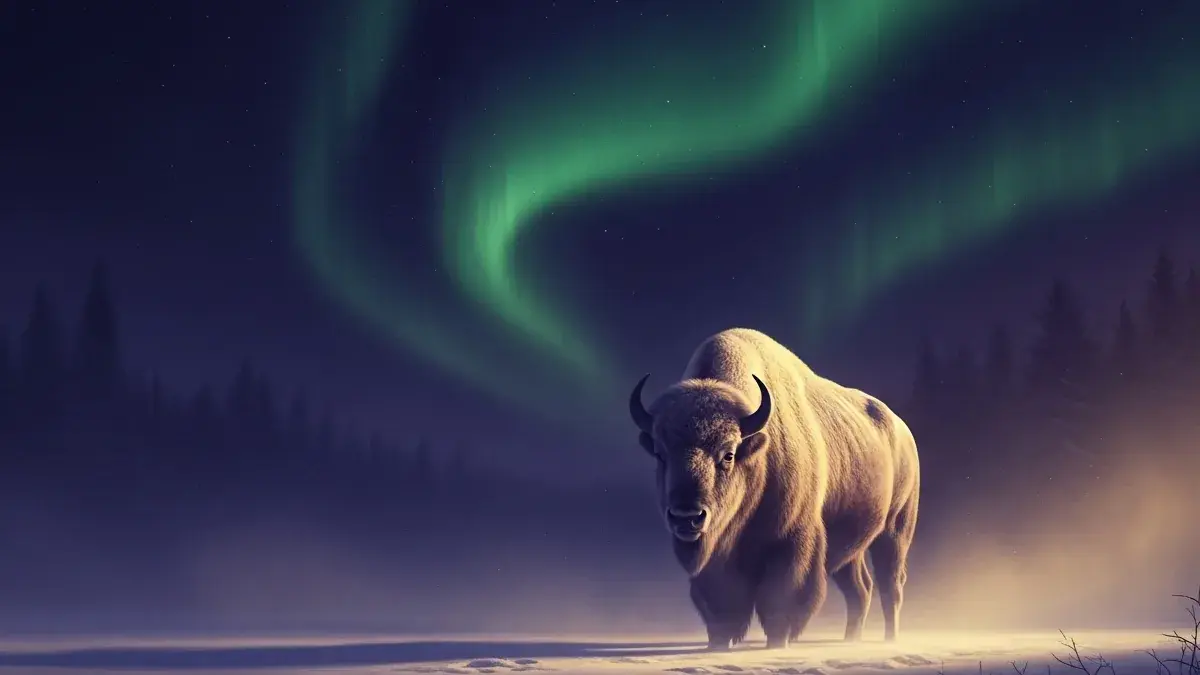
North represents completion and quiet wisdom — the point in the cycle of the seasons and of life where lessons finally settle into understanding. It corresponds to winter, midnight, the Earth element, and the ancestors and unseen guides said to watch over life's later chapters. Its totem animal is Buffalo, a symbol of gratitude and humility, and its closest crystals are Malachite and Moonstone.
An almanac
- Element
- Earth
- Season
- Winter
- Time of Day
- Midnight
- Spirit Animal
- Buffalo
- Crystals
- Malachite & Moonstone
- North Star
- Polaris
- Chinese Zodiac (due N)
- Rat
Of the four cardinal points, North is where the circle closes. If East is the spark of a new beginning, South is growth and West is the clarity that comes from experience, North is the quiet room at the end of the hall — the place where everything you've lived finally settles into wisdom. It corresponds to winter on the wheel of the seasons, midnight on the clock, and the later chapters of a life, when insight replaces ambition. Many traditions picture North as the seat of the ancestors and unseen guides, the threshold where the every-day world gives way to something older and less hurried — the realm some call the astral plane, or simply the afterlife.
Where the other directions keep you moving, North asks you to stop, go quiet, and listen. It's tied to careful use of resources — the same instinct that gets a household through a long winter — and to living out, in plain honest action, whatever truth you gained from the direction that came before it. Even the word carries that sense of orientation: Old Germanic speakers used it for the direction on their left hand as they faced a rising sun, one Mesoamerican language rendered it simply as "up," and in the Marshall Islands the word for North doubles as the phrase for the windy season.
North and the Element of Earth
North's ruling element is Earth, and cultures on opposite sides of the planet describe the same underlying relationship: not that people own land, but that the land holds us. Many Aboriginal Australian traditions frame identity itself as inseparable from country — you don't possess the ground, you belong to it.
A widely taught modern symbol popularized among Native American communities, the medicine wheel, echoes this: a circle marked by a cross, often read as a meeting point of the four directions and colors, and as a picture of home itself.
On a personal level, Earth energy is the steadying force — the one that pulls you back into your body when your thoughts have scattered. It governs the physical and the material: your health, your finances, the literal ground you stand on. If you feel ungrounded, going barefoot outdoors is a common, simple remedy.
If you're building a North-facing altar or ritual space, Earth's traditional palette leans dark and dense:
- Candles in black or deep brown
- Natural materials — coarse salt, tree bark, rich soil, fossils
- Stones with a heavy, grounding vibration — Agate, Hematite, Jet, Onyx, Black Tourmaline, and Obsidian
Crystals Linked to the Northern Direction
Two stones are most often named as North's own: Malachite and Moonstone.
Malachite is a stone of transformation. Its work is less about comfort and more about momentum: it loosens your grip on old patterns and helps you rebuild your foundations on purpose rather than by default. It's associated with heart-healing and chakra rebalancing, and many who work with it describe it as good company during a low mood, since it seems to help keep emotion on an even keel. Because it's said to absorb the heavier energy around you and convert it into something neutral, regular cleansing is considered essential.
Moonstone speaks to something quieter: the sense that your life has a shape and a timing you didn't fully choose, and that trusting the cycle is sometimes wiser than fighting it. It's linked to the Heart Chakra and to what's often called the sacred feminine — intuition, sensuality, and self-directed love. As a companion stone it's said to ease uncertainty and nudge creativity awake. There's a faint sense of wonder to it too, as if it keeps a little of the moon's light inside it.
Buffalo: The Animal of the North
In several Plains traditions, Buffalo is the totem of the Northern quarter. Its teaching is gratitude — the reminder that even in a paved, modern life, you're still walking on sacred ground. Buffalo is not a flashy animal; it's humble, and it will take the long, patient road if that's what integrity requires. It's also linked to providence: approach life gratefully, the teaching goes, and your needs will be met.
Those who feel a kinship with Buffalo energy tend to have an unusually steady bond with the natural world — people who treat abundance as something to notice and honor rather than take for granted.
White Buffalo Woman belongs at the center of any account of Buffalo symbolism: a sacred figure who, in Lakota tradition, brought the people the sacred pipe and seven sacred ceremonies along with a deeper lesson: that every choice we make ripples through the whole web of life.
To this day, the birth of a white buffalo is regarded as an especially auspicious sign, whether witnessed directly or received in a dream.
North in Native American Symbolism
In Lakota tradition specifically, North is described as a stern, purifying direction — the wind that strips the leaves from the trees and wraps the land in snow. It's a hard-times teacher, the direction through which a people learns endurance.
Three Earth-aligned animals fall under North's domain in this framework:
- Ox — steady, honorable, devoted to family and tradition, and slow to abandon a conviction
- Sheep — a lover of consistency who plans meticulously and, while warm and trustworthy, is slow to let people in close
- Dog — loyal and plainspoken, someone who takes duty seriously, sticks with one calling, and never strays in love
A modern, Native-inspired birth-date zodiac (not an ancient tribal system) places three more animal signs under North: those born October 23–November 22 carry Snake energy, with a natural feel for the unseen and a taste for mystery that dissolves once trust is earned; November 23–December 21 falls under Owl, an easygoing, adventurous, sharp-witted presence in any social circle; and December 22–January 19 belongs to Goose, driven and ambitious enough to sometimes work against their own success, though warm and playful once the guard comes down.
Celtic Symbolism and Meaning for North
In Celtic tradition, North carries the weight of wisdom, the warrior spirit, and the elder years of life, with Owl keeping watch under the winter sky. Historians note that early Celtic astronomers may have used the North Star itself to help orient the standing stones still found across the British Isles.
A modern, Celtic-inspired zodiac (not an ancient Druidic tradition) ties three animal signs to this quarter: the White Hound (October 28–November 24), unwavering in loyalty and nearly impossible to deceive, a natural mentor to teachers and healers; the Black Horse (November 25–December 23), an untiring, competitive presence suited to any pursuit with a rival to beat; and the Stag (December 24–January 20), a deeply Earth-rooted sign known for quick, practical thinking — often drawn toward technical fields like engineering or medicine.
North in Astrology and Feng Shui
In Western astrology, Earth governs Capricorn, Taurus, and Virgo. Capricorn tends to work quietly and let results speak, taking criticism in stride while quietly building respect. Taurus is the steadier, slower-moving counterpart — someone who weighs a decision carefully and, once settled, rarely reverses course; a dependable, homebody presence for anyone who needs one.
Feng Shui places North under the Water element, not Earth — it's the direction tied to career and the ease (or difficulty) with which opportunity flows into your life. The Earth element instead governs the Southwest and Northeast corners of the bagua, associated there with relationships and self-knowledge rather than with North.
The Chinese character for North relates to the idea of "the back" as opposed to the front — the shaded side, away from the sun, which is part of why light and shadow feature so heavily in how North is read.
In the Chinese zodiac, the Earth-aligned animals gathered under this direction include the tireless Ox, the attentive and provident Sheep, the larger-than-life Dragon, the graceful, sensitive Goat, and the devoted Dog — each bringing its own version of Earth's patient, grounded strength.
Worth noting: on the traditional twelve-point Chinese compass, the sign planted at true north isn't one of those Earth animals at all — it's the Rat, paired with the Water element and the midnight hour. It's a small but telling contradiction. Feng Shui's directional wheel and the Earth-totem traditions gathered elsewhere in this guide are simply answering different questions: one maps the compass, the other maps temperament, and North sits at the center of both without fully belonging to either.
Polaris: The North Star as a Symbol of Constancy
If North itself is the quiet room at the end of the hall, Polaris is the lamp left burning in the window. The North Star sits almost exactly above Earth's rotational axis, so while every other star wheels overhead through the night, Polaris barely seems to move — the one fixed point the rest of the sky turns around. That stillness is exactly why it became a symbol as much as a landmark: something to orient by when everything else is in motion.
Different peoples named that steadiness in their own way. Finnish tradition called it the naulatähti, the "nail-star," as though it were the pin holding the sky's fabric in place. The Lakota name for it, Wičháȟpi Owáŋžila, translates simply to "the star that sits still." Both point at the same intuition — that constancy itself is worth naming, even worshipping a little.
Its most storied use, in the United States, was as a literal path to freedom. Escaping slaves on the Underground Railroad were taught to find Polaris by first spotting the Big Dipper — nicknamed the Drinking Gourd — and following an imaginary line off the edge of its bowl roughly five times the distance between its two outer stars. For people who couldn't read or write, the National Park Service notes, "reading" the night sky this way carried the clues that could save a life. Whatever tradition you draw from, Polaris carries the same lesson North does at ground level: when you're lost, find the one thing that doesn't move, and let it hold your course.
North in the Bible and Ancient Near Eastern Myth
Long before it named a compass point, "north" in the Hebrew Bible was a place: Zaphon, a real mountain (known today as Jebel Aqra) on the northern edge of ancient Canaan. In Canaanite religion it was revered as the home of the storm god Baal and, in some accounts, the gathering place of the gods themselves — important enough that its name simply became the Hebrew word for the direction "north." That inheritance surfaces in Isaiah 14:13, where a proud king boasts he will ascend and sit enthroned "on the mount of assembly, in the far reaches of the north" — language scholars read as a direct echo of the Zaphon myth, cast here as an act of forbidden pride.
Elsewhere in scripture, North carries a double edge. It can signal majesty — Job 37:22 pairs it with "awesome majesty," and Job 26:7 pictures God stretching "the north over the void" — but it more often arrives as a warning. Jeremiah twice describes disaster "breaking forth out of the north," since the armies that historically threatened Israel and Judah, Assyria and Babylon among them, marched down from that direction. So in the biblical imagination, North holds both: it's where the sacred council is said to sit, and where trouble is said to come from — a fitting match for the direction's older reputation everywhere else, as the place that humbles you before it teaches you.
Frequently Asked Questions
What does North symbolize spiritually?
North represents completion and integration — the point in a cycle where lessons settle into real wisdom. It's linked to winter, midnight, the later years of life, and to the ancestors and guides said to watch over the quiet, in-between spaces, including the astral realm many associate with what comes after this life.
What is the spirit animal of the North?
Buffalo is widely regarded as the totem animal of the North. Its message is gratitude and humility: notice the abundance already present in daily life, and treat the natural world as sacred rather than something to use up.
Which element and crystals are associated with North?
North is tied to the Earth element, which governs grounding, physical health, and material stability. Its most closely associated healing stones are Malachite, valued for transformation and heart healing, and Moonstone, connected to intuition, life's natural cycles, and the sacred feminine.
What does the North Star symbolize?
Polaris, the North Star, is a near-universal symbol of constancy and guidance because it barely appears to move while the rest of the night sky rotates around it. Finnish tradition called it the "nail-star" for seeming to pin the sky in place, and Lakota tradition names it "the star that sits still." It's also remembered as a literal guide to freedom — escaping slaves on the Underground Railroad used the Big Dipper to locate it and steer north.
What does the Bible say about the north?
The Hebrew word for "north" traces back to Zaphon, a mountain the Canaanites considered the home of the god Baal and the gathering place of the gods — a myth Isaiah 14:13 echoes when a prideful king claims he will sit "in the far reaches of the north." Elsewhere North is linked to God's majesty (Job 26:7, 37:22), but more often to danger, since Jeremiah twice warns that disaster will "break forth out of the north," the direction from which Israel's historical invaders came.
Which Chinese zodiac animal is aligned with due north?
The Rat is the zodiac sign tied to true north on the traditional Chinese compass, along with the Water element and the midnight hour. That's a notable exception to North's usual Earth-element association elsewhere in this guide — a reminder that Feng Shui's compass system and the Earth-based medicine wheel and Western frameworks don't always agree on which element belongs to which point.
More from Spirit Guides

Sources
Claims on this page were checked against these published sources.
- North
The word north is related to the Old High German nord, descending from Proto-Indo-European *ner-, meaning 'left; below,' as north is to the left when facing the rising sun.
Read the source → - 北
Ideogrammic compound – two men back to back. Originally meaning 'back'; the character 背 refers to the original word.
Read the source → - Medicine wheel
the symbol was created by Hyemeyohsts Storm, described as a 'pretendian,' who first published his invention in 1972... has also been misappropriated by non-Indigenous people, usually those associated with New Age communities.
Read the source → - Celtic astrology
Various systems of astrology invented by enthusiasts of Robert Graves' Celtic Tree Alphabet ... Hypothetical astrological systems of the prehistoric Celts
Read the source → - Rat (zodiac)
Cardinal Point: North (N); Element: Water; Yin Yang: Yang
Read the source → - Polaris
Because Polaris lies nearly in a direct line with the Earth's rotational axis above the North Pole, it stands almost motionless in the sky, and all the stars of the northern sky appear to rotate around it.
Read the source → - North Star to Freedom
the North Star played a key role in helping slaves to find their way—a beacon to true north and freedom... Escaping slaves could find it by locating the Big Dipper... From the gourd's outline, the North Star could be found by extending a straight line five times the distance from the outermost star of the bowl.
Read the source → - Jebel Aqra
It appears in the Hebrew Scriptures as Mount Zaphon... from its importance and its position at the northern end of Canaan, it also became a metonym and then the word for the direction 'north' in the Hebrew language... Mount Sapan was sometimes accounted as the home of all the gods, not only Ba'al and his sister... considered the peak of Mount Sapan to house the lapis and silver palace of their storm god Ba'al... and his sister 'Anat.
Read the source → - Topical Bible: North
Job 26:7 - "He stretches out the north over empty space, and hangs the earth on nothing." Job 37:22 - "Out of the north comes golden splendor. With God is awesome majesty." Jeremiah 1:14 - "Then Yahweh said to me, Out of the north evil shall break forth on all the inhabitants of the land." Jeremiah 4:6 - "I will bring evil from the north, and a great destruction."
Read the source →
Not sure which animal is yours?
Consult the quiz