Animal Facts
Zebra Facts & Trivia: Stripes, Migration and the Quagga
A black animal in white stripes, and almost every explanation of why is wrong.
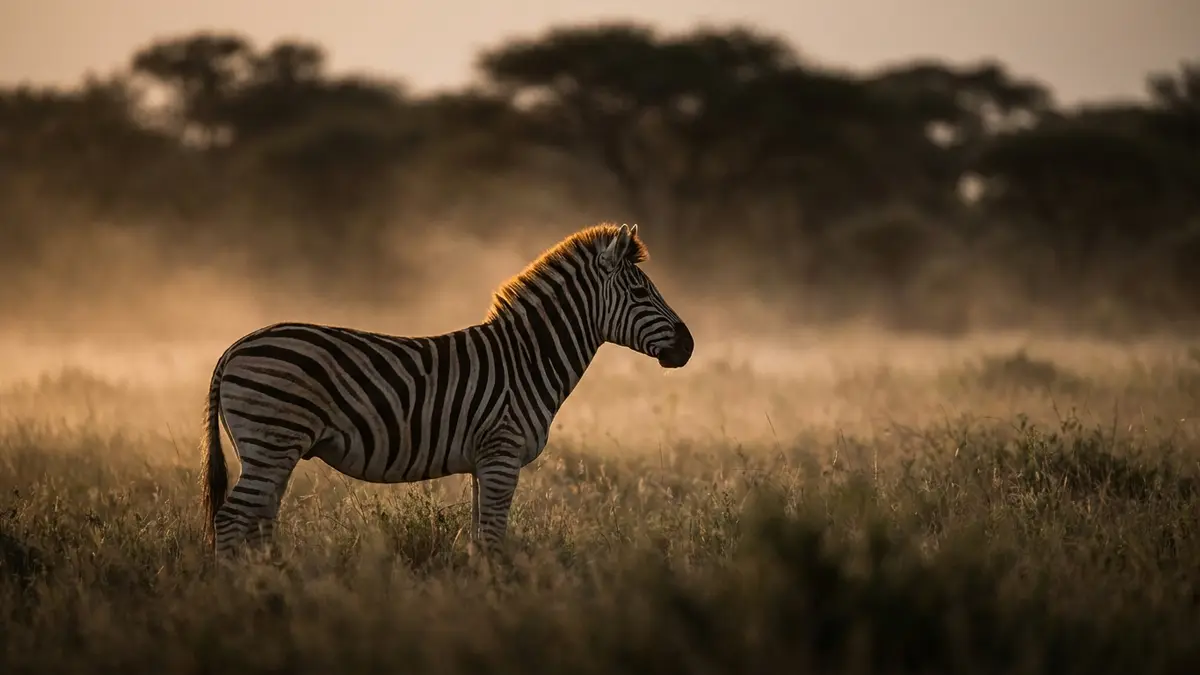
A zebra's skin is uniformly dark — the white bands are where pigment is switched off — so black with white stripes is the closer description. The stripes are not camouflage: filtered through lion and hyena eyesight, the pattern blurs to flat grey beyond about 50 metres in daylight. And the extinct quagga was not a separate species; its DNA places it inside the living plains zebra.
An almanac
- Species
- Three: plains, mountain and Grévy's zebra
- Gestation
- 390 days in Grévy's zebra — the longest of any equid
- Top speed
- More than 40 mph (64 km/h)
- Water
- Adult Grévy's can go three to five days without drinking; they forage up to 22 miles (35 km) from water
- Grévy's population
- Fewer than 2,500 left — under 100 in Ethiopia, under 2,400 in Kenya, down from as many as 15,000 in the 1970s
- Longest migration
- More than 300 miles (500 km) between Namibia and Botswana, found by satellite collar in 2012
Almost everything commonly said about zebra stripes has been tested, and most of it failed.
They are not camouflage — big cats cannot resolve them at any useful distance. They are not air conditioning — that was measured directly with water-filled barrels in the field, and striped ones ran no cooler than plain grey. Even the tidy story about zebras leading the Serengeti migration to clear grass for the wildebeest behind them turned out, in 2024, to be competition rather than cooperation.
What survives is more interesting than what does not. Below, with sources.
Zebra Facts Worth Knowing
- The longest pregnancy of any equid. A Grévy's zebra mare carries her single foal for 390 days.
- A foal is walking about twenty minutes after birth and can run within the hour.
- They reach more than 40 mph (64 km/h).
- Grévy's zebra has the largest ears of any zebra, set on a long, narrow, almost mule-like head.
- Adults can go three to five days without drinking — nursing mothers excepted — and will forage up to 22 miles (35 km) from the nearest water even in the dry season.
- Grévy's zebra is in serious trouble. Surveys in the 1970s put the population at as many as 15,000. Fewer than 2,500 remain: under 100 in Ethiopia and under 2,400 in Kenya.
- It is named after a French president. Jules Grévy was sent a live one in 1882 as a diplomatic gift from Emperor Menelik II of Abyssinia.
- They once ranged to Egypt, around 6,000 years ago in the Neolithic.
- The longest straight-line land migration documented in Africa is a zebra's: more than 300 miles (500 km) between Namibia and Botswana, discovered by satellite collar in 2012 and published in Oryx in 2014. It is the longest endpoint-to-endpoint journey, not the greatest total distance walked — the Serengeti migration covers more ground overall.
- The plains zebra is a hindgut fermenter, which lets it live on grass far too coarse and poor for the ruminants sharing the same savannah.
- Mountain zebras are identifiable from behind by a gridiron of narrow horizontal bars across the rump, and a dark stripe running the length of the white belly.
- The Cape mountain zebra fell to fewer than 50 animals in three surviving pockets by the 1950s, after a 90% collapse in its range.
- Ancient DNA as a field began with a zebra. In 1984 researchers recovered two short mitochondrial sequences from a museum specimen of the extinct quagga — the first time DNA had been retrieved from an extinct animal.
- The quagga's half-striped, brown-rumped coat evolved unusually fast, from a lineage that split from other plains zebras only about 120,000–290,000 years ago. Genetically the quagga sits inside the living plains zebra rather than beside it, so it was a lost population, not a lost species.
Five Zebra Facts That Are Not True
"White with black stripes." Under the coat the zebra is a dark animal: the skin is uniformly dark and the white bands are where pigment production is switched off in the hair. The argument is about which colour is the default, and the default is black.
"The stripes are camouflage." Researchers passed zebra photographs through digital filters mimicking lion and hyena vision. Big cats cannot resolve the stripes at any useful range — beyond roughly 50 m in daylight, 30 m at dusk and about 9 m on a moonless night the pattern collapses into flat grey. By the time a lion can see stripes it can see a zebra.
"The stripes are air conditioning." Tested directly: six water-filled metal barrels were covered with real horse, cattle and zebra hides, plus an artificial striped pattern, and measured in the field. The striped barrels ran no cooler. A 2019 study revived a narrower version of the idea, so it is not entirely closed — but the simple cooling-eddy story failed its test.
"Zebras were never tamed because they are vicious." That is Jared Diamond's checklist, and when domestication was modelled against ungulate phylogeny, temperament predicted nothing. What did predict it was capture myopathy — the fatal muscle and heart damage some animals suffer from panic and overexertion.
"Zebras lead the migration and mow the tall grass for the wildebeest behind." Grazing succession was taught for decades. A 2024 study combining camera traps, GPS collars, diet analysis and satellite data found the head of the procession is a competition for the same nutritious parts of the tall grass, not a relay of favours.
Zebras in Culture
The zebra crossing takes its name from the animal and dates to British road trials of 1949. DreamWorks put Marty the zebra at the centre of Madagascar (2005) and its sequels, and gave Racing Stripes (2005) a zebra that thinks it is a racehorse. In medicine, "zebra" is student slang for a rare diagnosis, from Theodore Woodward's aphorism that when you hear hoofbeats you should think horses, not zebras — which is why rare-disease campaigns have adopted the stripe as their symbol.
Famous Zebras
The best-known individual zebra is the one Jules Grévy received in 1882, a diplomatic gift from Emperor Menelik II of Abyssinia that ended up naming the species.
The most consequential, though, is a museum skin. The quagga specimen sampled in 1984 yielded the first DNA ever recovered from an extinct animal and effectively started the field of ancient DNA — the same discipline that has since rewritten the histories of the mammoth, the Neanderthal and, as it happens, the domestic cat.
Frequently Asked Questions
Are zebras black with white stripes or white with black stripes?
Black with white stripes is the closer description. The skin beneath the coat is uniformly dark, and the white bands are places where pigment production is switched off in the growing hair.
What are zebra stripes actually for?
The best-supported explanation is biting-fly deterrence. Camouflage has been tested and failed — filtered through lion and hyena vision the stripes blur into flat grey beyond about 50 metres in daylight. The cooling-eddy theory also failed a direct field test using hide-covered water barrels.
How fast can a zebra run?
More than 40 miles per hour, about 64 km/h. A newborn foal is on its feet in roughly twenty minutes and can run within an hour.
How many Grévy's zebras are left?
Fewer than 2,500 in the wild — under 100 in Ethiopia and under 2,400 in Kenya. Surveys in the 1970s put the population at as many as 15,000.
Was the quagga a separate species of zebra?
No. DNA recovered from museum specimens places the quagga inside the living plains zebra rather than as a sister species. Its distinctive half-striped coat evolved rapidly from a lineage that split only about 120,000–290,000 years ago.
Why were zebras never domesticated?
Not because of temperament, despite the popular claim. When domestication was modelled across ungulate phylogeny, aggression predicted nothing; capture myopathy — fatal muscle and heart damage brought on by panic and overexertion — did.
More about the Zebra
More from Animal Facts
Sources
Claims on this page were checked against these published sources.
- Grevy's zebra
Females will usually give birth to a single foal after a gestation period of 390 days, the longest of any equid.
Read the source → - Zebra
They can walk just 20 minutes after birth and can run after an hour!
Read the source → - Mpala Live! Field Guide: Grevy's Zebra
adult zebras—except nursing mothers—can go without drinking for three to five days
Read the source → - Grevy's zebra, facts and photos
He considered his local zebras to be regal creatures and, as a sign of respect, sent one to the president of France, Jules Grévy.
Read the source → - 7 Facts to Celebrate International Zebra Day!
During the Neolithic period (about 6,000 years ago), Grevy's zebras had a range that extended as far north as Egypt!
Read the source → - Longest Migration Among African Mammals Discovered
But the animals cover more than 300 miles (500 kilometers) in a straight-line, up-and-back journey across Namibia and Botswana.
Read the source → - Plains Zebra – Equus quagga
As the plains zebra is a hindgut fermenter it can survive on a much poorer diet than that of African ruminants like giraffe, antelope, and gazelles.
Read the source → - Learning Their Lines
There is a distinctive gridiron pattern on the rump, and a mountain zebra's white underside has a dark stripe that runs the length of the belly.
Read the source → - Lessons for conservation management: Monitoring temporal changes in genetic diversity of Cape mountain zebra (Equus zebra zebra)
by the 1950's, as a direct result of hunting pressure and habitat loss, CMZ experienced a 90% reduction in its geographic distribution and were reduced to less than 50 individuals
Read the source → - A rapid loss of stripes: the evolutionary history of the extinct quagga
Twenty years ago, the field of ancient DNA was launched with the publication of two short mitochondrial (mt) DNA sequences from a single quagga
Read the source →
Not sure which animal is yours?
Consult the quiz