Animal Facts
Cricket Facts & Trivia: Fascinating Things to Know
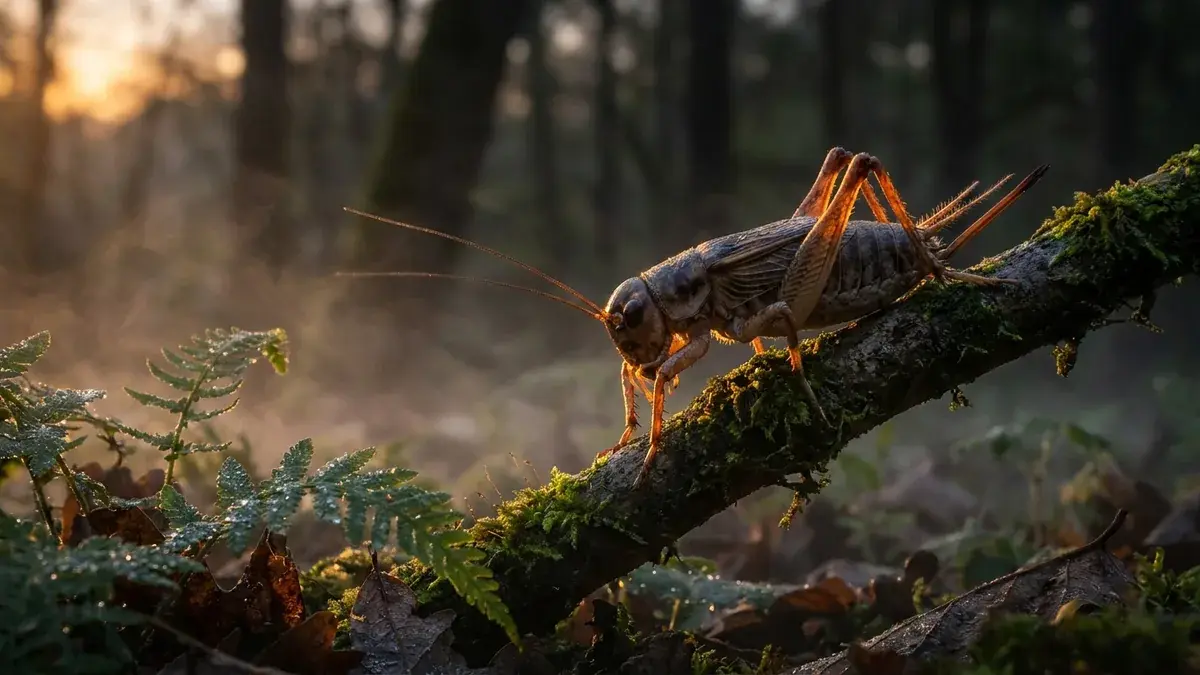
Crickets are nocturnal insects that hear through organs on their front legs instead of their heads. Only males chirp, and the sound speeds up as temperatures rise. Found on every continent except Antarctica, these 1-2 inch omnivores rarely fly despite having two pairs of wings. They've also worked their way into folklore as a symbol of good luck, and into pop culture through Disney's Jiminy Cricket.
An almanac
- Lifespan
- Less than a year in the wild
- Size
- 1-2 inches long
- Diet
- Omnivorous (plants, fungi, seedlings)
- Found in
- Every continent except Antarctica
- Species
- About 900 known species
- Fun fact
- Their ears are on their front legs
That familiar chirping in your backyard at dusk comes from one of the most common insects on the planet. Crickets show up in folklore, film, and music, and behind that simple song is some genuinely odd biology.
Fascinating Cricket Facts
Crickets belong to the insect order Orthoptera, a group that also includes grasshoppers and katydids, and scientists have catalogued roughly 900 different cricket species worldwide. Most run about 1 to 2 inches long and show up in shades of green, brown, black, or red depending on the species. Despite carrying two pairs of wings, the vast majority of crickets never actually take flight.
Their sensory setup is where things get really odd. A single pair of antennae helps them track down food and detect nearby prey, while compound eyes give them sharp vision for an insect. Stranger still, their hearing organs sit on their front legs rather than their heads — so a cricket essentially listens through its knees.
Only males produce the classic chirp, and that sound isn't random: it speeds up as the temperature rises and often follows a successful mating.
- Classified in the order Orthoptera, with about 900 known species
- Typically 1–2 inches long, in green, brown, black, or red
- Own two pairs of wings but rarely fly
- Use one pair of antennae to sense food and predators
- See well thanks to compound eyes
- Chirping comes only from males
- Active mainly at night (nocturnal)
- Omnivorous, feeding on decaying plants, fungi, and young seedlings
- Live less than a year in the wild
- Found on every continent except Antarctica
- Females can lay as many as 200 eggs in one go
- Have unusually sharp hearing
- Chirp speed shifts with the temperature
- Hearing organs are located on their front legs, not their head
- Molt repeatedly as they grow
- Mostly ground-dwellers, though some live underground, in trees, or in caves
- Regarded as a symbol of good luck in many cultures
- Were historically kept as pets in China
- Several species today are considered endangered
- Their chirp became a classic radio and film cue for signaling nighttime
Crickets in Movies & Music
Crickets have landed a few memorable on-screen roles, most notably as Jiminy Cricket in Disney's 1940 film Pinocchio and as the loyal, silent sidekick Cri-kee in the 1998 animated feature Mulan. They've turned up in children's music too, including "The Cricket Song" by Kathy Johnson and "Mr. Cricket in the Thicket" by Andy Z.
Famous Crickets
A handful of named crickets have earned their own following. Chester Cricket is the star of the classic children's book The Cricket in Times Square, and Cri-kee (from Mulan) and Jiminy Cricket (from Pinocchio) are two of the best-known insect characters in animation.
Even sports has a cricket namesake: the Lubbock Crickets, a baseball team named after Buddy Holly's Texas hometown.
Frequently Asked Questions
Can crickets fly even though they have wings?
Not really. Crickets have two pairs of wings, but most species use them to make sound or glide a short distance rather than fly any real distance.
Why do crickets chirp faster on hot nights?
A cricket's chirp rate is directly tied to temperature — warmer air lets them chirp more quickly, which is why the sound seems to speed up on hot summer evenings.
Do both male and female crickets chirp?
No, only male crickets chirp. They produce the sound to attract mates, and often chirp again after a successful mating.
More about the Cricket & Grasshopper
More from Animal Facts



Not sure which animal is yours?
Consult the quiz