Animal Facts
Crocodile Facts & Trivia: Bite, Brain and Survival
The hardest bite ever measured, on an animal that is far from unchanged.
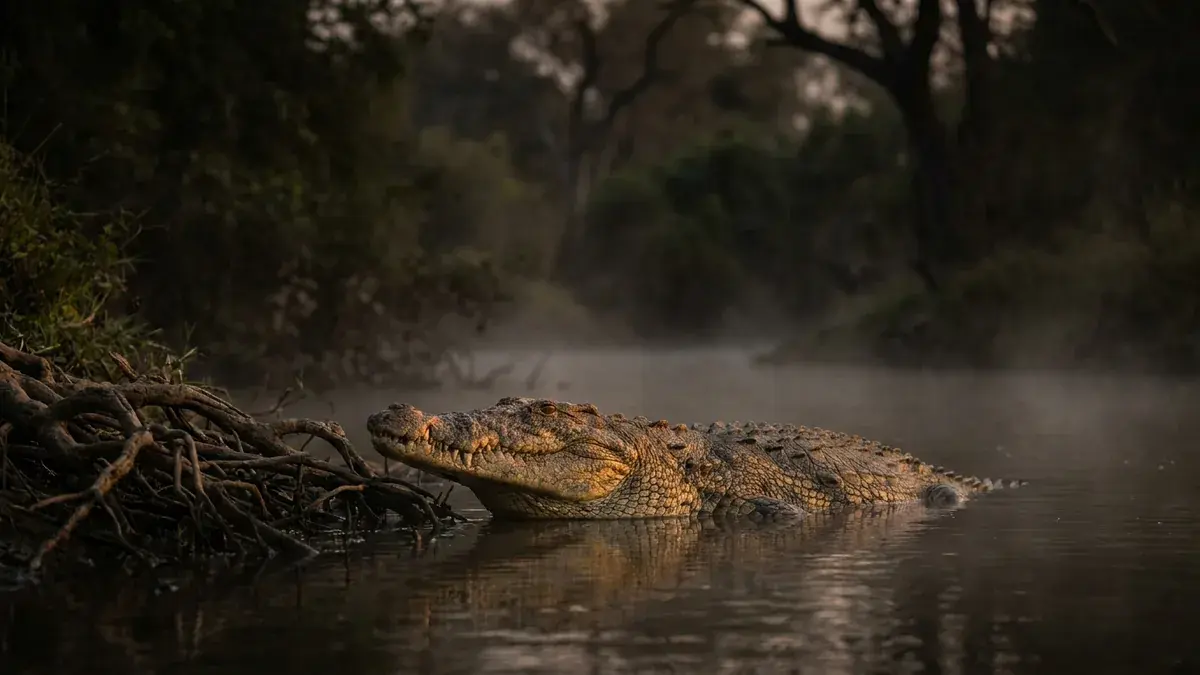
Crocodiles produce the strongest bite force ever measured in a living animal, and the sex of a hatchling is decided not by chromosomes but by the temperature of the nest. The line that they are unchanged living fossils that outlasted the dinosaurs is the part that does not hold up.
An almanac
- Lifespan
- 30 to 75 years, depending on the species; Cassius, the record captive saltwater crocodile, is believed to have lived over 110
- Size
- Adult saltwater crocodiles average 3–5 m; the largest reliably measured wild individual was 6.15 m (Mary River, NT, 1974)
- Species
- 26 living crocodilians recognised by the IUCN Crocodile Specialist Group, spanning crocodiles, alligators, caimans and gharials
- Range
- Tropics worldwide. In Australia, saltwater crocodiles run from Broome in Western Australia to Gladstone in southeastern Queensland
- Diet
- Carnivore — anything they can catch and overpower, from fish and crustaceans to waterbirds, sea turtles and mammals up to water buffalo
- Conservation status
- Saltwater crocodile: Least Concern (IUCN). The Cuban crocodile survives in the wild in just two places, Zapata Swamp and Isla de la Juventud
- Standout number
- 3,700 psi — the bite force measured in saltwater crocodiles, the strongest ever recorded in a living animal
Crocodiles get described in two contradictory ways at once: as mindless killing machines, and as unchanged living fossils. Neither survives contact with the research.
They are attentive parents that carry hatchlings in their jaws. The sex of those hatchlings is set by the temperature of the nest rather than by chromosomes. And crocodilians are not frozen in time — the group has diversified repeatedly, and the animals alive today are not the ones that watched the dinosaurs die.
What is true is the bite, which is the most powerful ever measured in a living animal.
Crocodile Facts Worth Knowing
- There are 26 living species of crocodilian recognised by the IUCN SSC Crocodile Specialist Group. That count covers all crocodilians — true crocodiles plus alligators, caimans and gharials. The number has moved recently: older sources say 23, because genetic work since 2011 has split several species (including the Nile crocodile) into two.
- Crocodiles excrete excess salt through specialised glands in their tongues — which is how a saltwater crocodile can live in the sea.
- A crocodile can stay underwater holding its breath for more than an hour.
- A single crocodilian may grow and shed roughly 8,000 teeth over its lifetime, replacing worn teeth continuously.
- Mother crocodiles carry their newly hatched young to the water inside their mouths, and some species call hatchlings in to shelter there.
- The pigmented domes covering a crocodile's jaws are more sensitive to touch than human fingertips, tested with the same calibrated hairs used on people.
- Tracked saltwater crocodiles ride surface currents to cross open sea: one tagged animal covered 590 km in 25 days down Cape York Peninsula.
- Crocodiles are the closest living relatives of birds, sharing a common ancestor about 240 million years ago that also gave rise to the dinosaurs.
- Crocodilian genomes change roughly ten times more slowly than mammal genomes — an order of magnitude slower rate of molecular evolution.
- Crocodilians can secrete stomach acid about ten times faster than the highest rate measured in any mammal, which is how they dissolve bone.
- A female saltwater crocodile lays up to 71 hard-shelled eggs in a single clutch, averaging around 50, and they hatch after two to three months.
- The Nile crocodile is actually two species, and DNA from 2,000-year-old Egyptian crocodile mummies showed every mummified animal was the smaller west-African one, Crocodylus suchus.
- South Florida is the only place on Earth where wild alligators and wild crocodiles live side by side.
- Crocodiles gallop and bound like a mammal, but in a study of 42 animals across 15 species, not one alligator or caiman ever did.
What People Get Wrong About Crocodiles
“"Crocodile tears" are pure invention — crocodiles don't produce tears at all, the phrase is just a metaphor for fake grief.” They genuinely weep while eating. When researchers videotaped seven captive crocodilians feeding on dry land, five of them visibly teared up, some so heavily the tears frothed around their eyes. The cause is plumbing, not emotion: air forced through the sinuses during the huffing and jaw work of feeding mixes with fluid in the tear glands. The medieval legend about false remorse is still wrong — but the tears are real.
“A crocodile can charge across land at 30 mph, so no human can outrun one.” Nobody has ever measured anything close to that. In the largest gait study yet — 42 animals, 15 species, on a runway with high-speed cameras — the fastest individuals hit 3.7 and 4.4 metres per second, roughly 13–16 km/h or 8–10 mph. That is quick for a sprint of a few dozen metres, but it is slower than a fit adult human, and no crocodile sustains it.
“Crocodiles are living fossils that have not changed since the age of the dinosaurs.” Today's semi-aquatic ambush predators are a narrow surviving sliver of a 230-million-year lineage that was once wildly varied — plant-eaters, fully marine forms with paddles and tail flukes, and small land runners built like greyhounds. Roughly 26 crocodilian species remain out of a fossil record containing hundreds. Modern crocodiles are specialists in their own right, not leftovers frozen in time.
“"Crocodile" and "alligator" are two words for the same animal.” They are different families with a visible tell. A crocodile's snout is narrow and triangular and the fourth tooth of the lower jaw stays exposed when the mouth is shut; an alligator's snout is broad and hides that tooth. Crocodiles are also paler — grayish-green above, white to yellowish below — against the alligator's darker hide. In the United States the two only overlap in south Florida.
In Culture
Disney's Peter Pan (1953) gave the world Tick-Tock, the crocodile whose swallowed alarm clock announces its arrival and terrifies Captain Hook — still the template for the comic movie croc. Elton John's "Crocodile Rock," released in late 1972, became his first US number one, reaching the top on 3 February 1973 and holding for three weeks. Crocodile Dundee (1986) put Paul Hogan and Linda Kozlowski in the Australian outback and New York, and made "croc" shorthand for outback swagger. Horror took the other route with Lake Placid (1999), whose giant man-eaters in fictional Black Lake, Maine spawned a franchise and tie-in games including Lake Placid: Croc Drop (1999) and Lake Placid 2: Croc Alley (2007). On television, The Crocodile Hunter premiered as a pilot on 25 October 1996 and ran from 1997 to 2004 with Steve and Terri Irwin, reshaping wildlife TV entirely. Most recently, Lyle, Lyle, Crocodile (2022, Columbia Pictures) adapted Bernard Waber's picture books with Shawn Mendes singing as Lyle opposite Javier Bardem, grossing $111 million.
Notable Individuals
Lolong, a saltwater crocodile caught in Bunawan township, Philippines, in September 2011, was measured at 6.17 m (20.24 ft) and certified in 2012 as the largest crocodile ever held in captivity, beating the previous 5.48 m record holder by more than two feet. He died in 2013. Cassius then took the title: 5.48 m and over a tonne, originally from the Finniss River south of Darwin, he lived at Marineland Melanesia on Green Island from 1987 until his death in 2024, believed to be over 110 years old. Gustave, a roughly 20-foot, one-tonne Nile crocodile of Burundi's Rusizi Delta and Lake Tanganyika, was tracked for years by naturalist Patrice Faye, with attack records dating to 1987. Sweetheart, a 5.1 m Northern Territory male notorious for attacking boats, drowned during his 1979 capture and remains on display at the Museum and Art Gallery of the Northern Territory.
Frequently Asked Questions
Are crocodiles living fossils that have not changed since the dinosaurs?
They genuinely weep while eating. When researchers videotaped seven captive crocodilians feeding on dry land, five of them visibly teared up, some so heavily the tears frothed around their eyes. The cause is plumbing, not emotion: air forced through the sinuses during the huffing and jaw work of feeding mixes with fluid in the tear glands. The medieval legend about false remorse is still wrong — but the tears are real.
Do crocodiles cry crocodile tears?
Nobody has ever measured anything close to that. In the largest gait study yet — 42 animals, 15 species, on a runway with high-speed cameras — the fastest individuals hit 3.7 and 4.4 metres per second, roughly 13–16 km/h or 8–10 mph. That is quick for a sprint of a few dozen metres, but it is slower than a fit adult human, and no crocodile sustains it.
What is the difference between a crocodile and an alligator?
Today's semi-aquatic ambush predators are a narrow surviving sliver of a 230-million-year lineage that was once wildly varied — plant-eaters, fully marine forms with paddles and tail flukes, and small land runners built like greyhounds. Roughly 26 crocodilian species remain out of a fossil record containing hundreds. Modern crocodiles are specialists in their own right, not leftovers frozen in time.
How is a baby crocodile's sex decided?
By the temperature of the nest rather than by chromosomes. Incubation temperature determines whether the hatchlings are male or female, which is why a warming climate is a genuine concern for crocodilian populations.
More about the Crocodile
More from Animal Facts
Sources
Claims on this page were checked against these published sources.
- Crocodilian Species
There are 26 species of crocodilian currently recognised (Vliet et al. 2024; Hekkala et al. 2011; Shirley et al. 2014, 2018; Eaton 2010).
Read the source → - Crocodilian
All crocodiles have special glands in their tongues that can get rid of excess salt
Read the source → - Croc Jaws More Sensitive Than Human Fingertips
the domes around the animals' teeth and jaws were even more touch sensitive than human finger-tips
Read the source → - Crocodiles ride ocean currents to travel the high seas
travelled 590 km over 25 days down the west coast of Cape York Peninsula
Read the source → - Scientists reconstruct genome of common ancestor of crocodiles, birds, dinosaurs
Crocodiles are the closest living relatives of the birds, sharing a common ancestor that lived around 240 million years ago and also gave rise to the dinosaurs.
Read the source → - How Gorged Gator Guts Digest Big, Bony Meals
This shunt enables crocodilians to secrete gastric acid at a rate that is approximately 10 times the highest rates measured in mammals.
Read the source → - Estuarine Crocodile
lays up to 71 hard-shelled eggs (average of around 50).
Read the source → - Nile Crocodile Found to Comprise Two Species
All of the mummies were of C. suchus, indicating that the ancient Egyptians had recognized the differences between the two reptiles.
Read the source → - American Crocodile: Species Profile
South Florida is the only place where both of these species coexist.
Read the source → - Divergent evolution of terrestrial locomotor abilities in extant Crocodylia
No Alligatoroidea ever galloped or bounded; thus our Hypothesis 1 (H1) was not supported
Read the source →
Not sure which animal is yours?
Consult the quiz