Animal Dream Symbol
Cricket Dream Meaning: Dreams About Crickets Explained
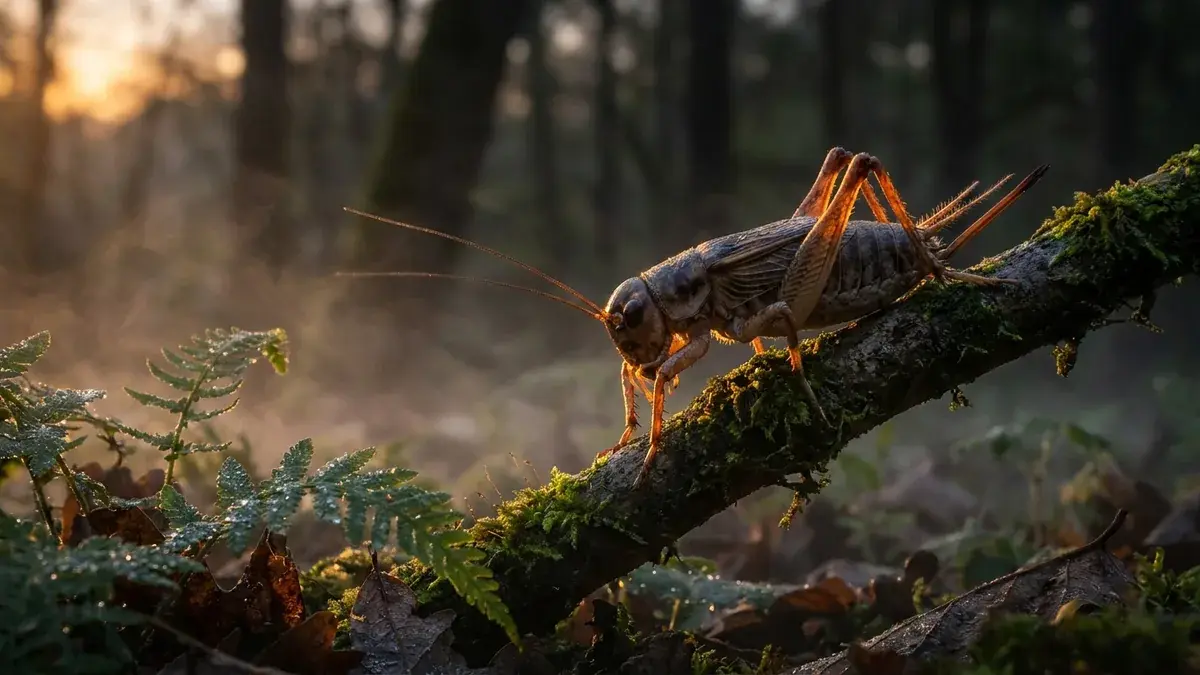
Some think its chirp is an omen of comfort, good luck, and silent confidence on your path through life. But a minority of traditions believe the call means trouble. It's probably best to go with your gut. If you feel peaceful when you hear the song, that's a good sign. If you're uneasy, keep on your toes.
If it's a cricket in your dreams, it could mean one or more things: trust your hunches, make way for romance, and go ahead and make noise if you need to.
An almanac
- Core message
- Good news and comfort are on the way
- In dreams
- Usually a sign of luck, rarely a warning of loss
- Best qualities
- Trusting instinct, patience, honest self-expression
- Watch for
- Emotional tone of the dream — soothing vs. unsettling
- Totem for
- Romance, connection, and inner guidance
- Cultural roots
- Echoes Jiminy Cricket's conscience symbolism from Pinocchio
- Real-world echo
- Chirp speed can reveal air temperature (Dolbear's Law)
- Ancient tradition
- Kept as luck charms & prized singers in China for ~1,000 years
A cricket's chirping through your dream can feel like the opening notes of a lullaby you used to listen to as a kid on summertime evenings. Traditional dreamers often see the cricket as a sign of good fortune, peace, and quiet self-knowledge, though some old folk tales don't agree. Whether it's good or bad usually comes down to how the dream feels and what's already going on in your waking life.
What It Means
In many dream dictionaries, a cricket is a sign of good things on the way. It might be something nice and simple, like a sunny day or a lucky break. But it could also mean something major, like a stretch of happy contentment.
The thing is, that's not true all the time. Some older cultural traditions say that if a cricket's singing at night, it means someone close to you may die soon.
Luckily, most modern people don't think the same way. They think what you feel when you see the cricket is more important. If you're sad or worried or hurt, the cricket might not mean anything good to you.
Common Cricket Dream Scenarios
When you're dreaming about crickets, the specific ways they show up matters a lot. Here's a quick run-through of some common cricket dream scenarios:
Hearing a chirping cricket without spotting it* Usually points toward an invitation to slow down and think, kind of like how the sound of crickets on a summer night makes you turn inward on your own. It's more of a nudge than an alarm, though.
Seeing a cricket up close or gently holding it.* This can mean that you've gotten in touch with your instincts and are relying on them rather than second-guessing yourself or relying too much on others for opinions.
Finding crickets in your house.* This hints at comfort or luck arriving faster than expected, often related to relationships or family issues.
Trying to find a hidden chirping sound (especially indoors).* This one's about low-level distractions that keep annoying you even when they're not really a threat. But they're definitely interrupting your peace!
A group of chirping crickets singing in harmony.* Often signals that romance is nearby (since their chirps are really meant for finding mates), although someone who isn't single might take it as hints of great connections or closeness.
A silent or injured cricket, or one that dies during the dream.* This can point toward losing your voice or confidence, especially around something important to you.
A cricket crawling on skin or clothing.* This mirrors nervousness creeping into situations where it isn't welcome.
A swarm of crickets, especially if they seem aggressive toward you.* Can signal feeling disengaged from important things, like how motivation might've scattered.
Symbolism & Message
Cricket dreams are often about luck or listening to yourself. Crickets come out at night, so dreamers who see them may be being encouraged to pay attention to their instincts in the stillness of the moment.
Crickets sing to attract mates, so this dream may point toward romance. If you're in a partnership, this dream might simply mean that you need to nurture your connection. A cricket doesn't lose its song if it's noticed, so seeing one in a dream may also be a message to not hold back things that you have to say or talents that you have.
Spiritual Meaning
In totem and spiritual traditions, crickets are seen as tough little teachers of fortitude and patience. The cricket's association with luck is less about passive waiting than it is about the idea that good things naturally come when people act with honesty and keep a clear conscience. If you see one in a dream, the message is that small, honest choices accumulate over time into real prosperity, and intuition can provide guidance that logic can't yet explain.
Crickets are also nocturnal: Your first sense of a cricket is likely to be its nighttime song rather than its presence, which spiritual readings interpret as a nudge to trust in invisible truths. Just because they're not easy to see doesn't mean your feelings aren't worth listening to.
If your dream of crickets left you with a sense of calm anticipation rather than dread, that's likely because your intuition was already guiding you on the right path; you just needed enough stillness to notice the guidance.
Cricket Folklore Around the World
Long before dream dictionaries existed, people were already trying to guess what a cricket's song meant, and that disagreement itself says something important about the way crickets appear in dreams.
In parts of Brazil, people think a cricket chirping inside a house means someone's going to die soon, so they kill the insect instead of leaving it be. But in places like Barbados, people think it's a good thing if you hear a loud cricket in your home — they're bringing money, and you should keep them and let them stay there. Those beliefs are different but not more or less right: they just show that hearing a particular sound might mean one thing to one person and the exact opposite to someone else.
China has had a very different relationship with crickets for many years. For more than 1000 years, many people kept them as pets — nice ones lived in special cages or hand-carved gourds. And that's probably why so many cultures see good fortune as one of the main ways crickets appear in dreams.
The Real Science Behind the Chirp
Crickets' chirps are more than just poetic sounds; they're also biological signals. The temperature around a cricket has a direct effect on its body temperature, and the warmer it is, the faster its wing muscles can fire. Biologists call this relationship Dolbear's law.
Of course, in a dream, there's something fitting about the sound of chirping crickets serving as a signal for temperature. Like the thermometer or barometer, the chirp of a cricket is a way to measure how much warmth is around you without having to touch or see anything; it's therefore no wonder that many dream interpreters view them as symbols of intuition. By counting them carefully instead of ignoring them as background noise, you might hear more about what you can't see than what's right in front of your face.
Frequently Asked Questions
Is dreaming about a cricket good luck?
Most dream traditions hold that a cricket means good things are coming your way: happiness, comfort, or success. Sometimes, though, older traditions say you need to watch out, because the insect could mean you're about to lose something important.
If you remember having a dream about crickets, ask yourself how you felt during the dream. That's probably the best clue to what it means.
What does it mean to dream about a cricket in your house?
A cricket inside your house in a dream is a good sign. It means good luck or emotional comfort or an unexpected breakthrough — in a relationship or family situation.
What does it mean when a cricket won't stop chirping in a dream?
Dreaming of a cricket who won't stop chirping can usually be interpreted as a sign that you want something. Since these sounds are basically a mating call, they might represent a desire for romance, love, or connection with another person. If it feels more like an annoyance than a pleasant sound, however, the chirping could mean you have a small worry or concern nagging at your mind in your waking life.
Is it true that crickets can tell you the temperature?
Cricket folklore has a solid scientific basis. Crickets are cold-blooded, so their chirps speed up as the air warms, as Dolbear discovered over a hundred years ago. In theory, you can count the chirps in 15 seconds and add 40 to get the temperature in Fahrenheit. The idea of treating a cricket's chirp as an important signal is similar to the way crickets are viewed in dreams.
Why do some cultures consider it bad luck to kill a cricket?
Some people think killing a cricket in their home can chase away their good luck. For example, in Barbados, a noisy cricket inside the house is taken as a sign that money is coming, so people will just leave it alone rather than kill or drive it out. Not all traditions agree on this, however. In parts of Brazil, for example, a cricket chirping in the home is instead thought to mean someone's about to die.
What does it mean to dream about a black cricket specifically?
Color isn't always important, but a black cricket often suggests introspection: the suggestion that you take time to sit with an emotion before sharing it, rather than jumping to a fearful conclusion about what the cricket means.
Sources
Claims on this page were checked against these published sources.
- Dolbear's law
T F = 40 + N 15 [simplified formula using chirps counted in 15 seconds]; published in 1897 in an article called 'The Cricket as a Thermometer.'
Read the source → - Cricket (insect)
Crickets chirp at different rates depending on their species and the temperature of their environment. Most species chirp at higher rates the higher the temperature is. The relationship between temperature and the rate of chirping is known as Dolbear's law.
Read the source → - Cricket fighting
Cricket fighting was nurtured by Tang dynasty emperors more than 1,000 years ago, and later popularized by commoners. ... Prized crickets have become famous, with funeral services on their death.
Read the source →