Mammals · Spirit animal
Sheep & Ram Spiritual Meaning & Symbolism
Gentle strength, sure-footed courage, and the quiet power of belonging to something larger than yourself.
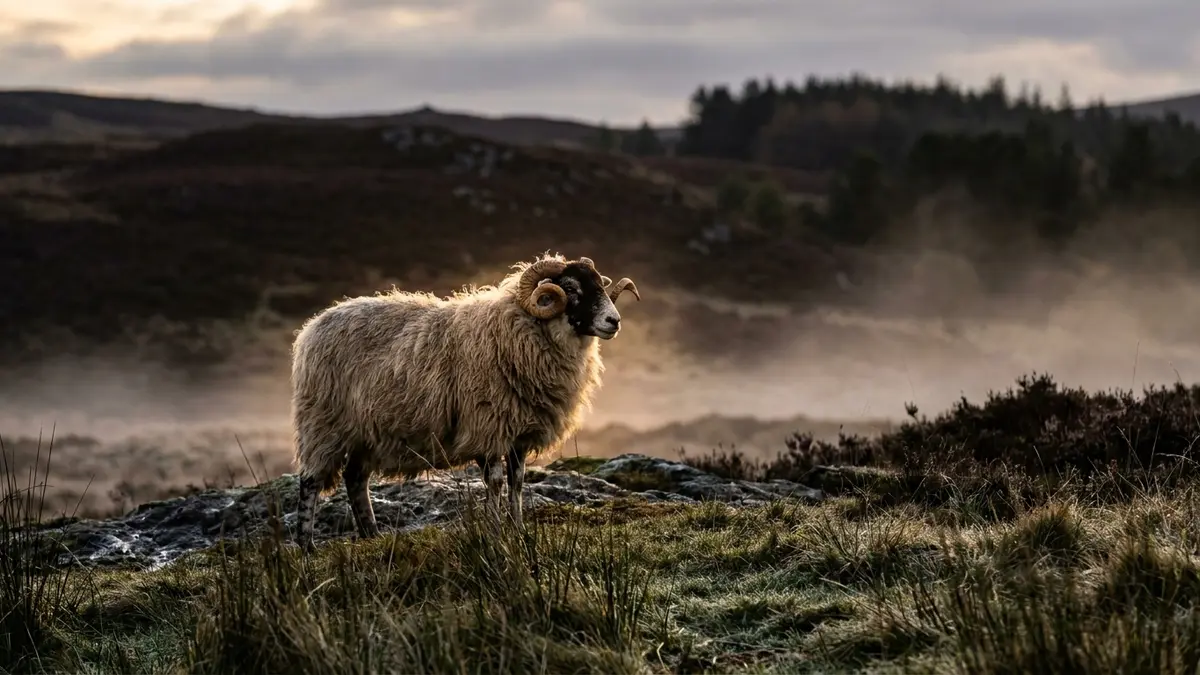
Sheep and Ram together symbolize gentle strength and sure-footed courage: the Ewe calls you back to community, tenderness, and forgiveness, while the Ram pushes you to confront a barrier head-on with committed will. Their spiral horns speak to endless renewal, and unblemished white Sheep have long stood for purity and devotion. In dreams, they usually warn that you're being too easily swayed by a confident or authoritative voice.
An almanac
- Core message
- Gentle strength paired with sure-footed courage
- Spirit animal
- Ewe brings tenderness; Ram brings bold, forceful drive
- Totem for
- Warm-hearted, modest, community-minded people (or bold, big-dreaming Rams)
- Power animal
- Return to community and shed what no longer serves you
- In dreams
- Warning against blindly following a persuasive voice
- Cultural roots
- Celtic goddess Brigit — healing, hearth, and nurturing continuity
- Chinese zodiac
- Sheep/Goat year — traditionally auspicious, signaling peace and prosperity
- Zodiac sign
- Aries (Mar 21–Apr 19), ruled by fiery Mars
Sheep are very soft and gentle animals. They move quietly, and almost never fight.
The two halves of this description are meant to teach people the same lesson: How can you stay gentle and sweet while also being strong and persistent? This is difficult to teach, but a person can learn from the sheep how to stay quiet and meek even under pressure.
Sheep & Ram Symbolism & Meaning
Few animals were welcomed into human life as early as the Sheep, and that long companionship shaped much of what they represent: calm cooperation, the willingness to be led, and an ease with communal living. The female, the Ewe, embodies tenderness and nurturing warmth, while the Ram carries a bolder, more headstrong charge.
Because of this pairing, Sheep imagery across cultures often speaks to spiritual devotion and belonging, most famously in Christian tradition, where the lamb becomes a stand-in for sacrifice made on behalf of others.
The Ram's coiled horns add a second layer of meaning entirely their own. That spiral shape has long stood for endlessness — the wheel of birth, death, and renewal turns without stopping. Even the Ram's link to spring, and to the astrological sign it rules, ties back to this same theme of fresh starts.
And don't overlook the Sheep's remarkable balance: wild mountain sheep, like bighorns, are built to scale steep, rocky cliffs where few predators can follow. Even the smallest foothold can carry you upward if you're brave enough to trust it.
There is a heavier thread too. Because Sheep supplied food, wool, and daily survival, they were frequently chosen for ritual offerings in the ancient world, with unblemished white ones prized as symbols of purity. Folk tales lean on this same gentle-but-wise character — Aesop's fable of the wolf and the lamb shows how an innocent, reasonable defense still can't save you from someone determined to find an excuse, while the phrase "a wolf in sheep's clothing" warns that disguises never hold forever.
Even our everyday language keeps these images alive: a "black sheep" marks the one who breaks from the group, and a "battering ram" is still how we describe brute force clearing a path.
The black sheep image runs deeper than the saying itself. Black wool is a genuine rarity in a white flock — it comes from a recessive gene — and for generations that fleece was considered commercially undesirable simply because it couldn't be dyed. In 18th- and 19th-century England, the black coloring took on a darker meaning still: many came to see it as a mark of the devil, which hardened the phrase into one about shame and exclusion. Modern usage has softened considerably, and plenty of people now wear "black sheep" as a badge of independence rather than a mark against them.
Sheep Spirit Animal
When sheep come to you as spirit guides, take note of what kind they are. The ewe tends to walk softly, and she's most likely to appear for people who've strayed from their own gentleness and lost touch with an inner innocence. If you're grappling with pressure to conform, being a little yielding isn't the same as losing yourself. The ewe also reminds you not to harden your heart when you're in a relationship or when someone in your circle feels frail.
The ram is more pushy. When it shows up, that's often a sign it's time to stop circling around problems and just push right through them. If you've been avoiding something because of your fears, the ram will show you where you can use more direct and committed pressure.
Diplomacy is usually the best approach, but sometimes a barrier will only yield if you have the courage to knock your head against it. The ram shows you where it's safe to do that.
Does Sheep & Ram fit you?
Tap the ones that sound like you — 6 traits, no right answer.
0 of 6 Nothing picked yet — start tapping.
Sheep & Ram Totem Animal
People who are drawn to sheep or ram totems tend to be warm-hearted and inclined toward quiet acts of invention, drawn more by modesty than by spectacle. Sheep or ram totems can be a reminder not to get carried away with one's ego, because they draw your attention back to your naturally kind and tender center. They also remind you to treasure small moments of happiness instead of running after excitement.
The guiding phrase of these two animals is "for the good of everyone," because they always look for ways to serve the needs of the whole rather than just their own. When someone mistreats you, a sheep or ram will remind you that holding a grudge never helps anyone and that forgiveness is better for the community.
Those born under a ram totem have another message: Not only are they built for expansive ideas and acts, they are also symbols of their endless creative possibilities. If your imagination feels constrained by your own limited outlook, the ram can remind you that you're capable of far more than you've ever realized.
Sheep & Ram Power Animal
Are you feeling disconnected from your community and your own values? The animal guides Sheep and Ram can help you get centered again. They're especially helpful if you've made a mistake you're ashamed of — their energy makes it clear that it's never too late to take corrective action.
If the world is too loud, Sheep will guide you to a quiet place where you can stop worrying about what other people think and instead focus on your own happiness. Ewes and Lambs provide softness when you feel worn down by life.
Sheep & Ram as Celtic Animal Symbols
Celtic people believed that Sheep represented Brigit, the goddess of healing, poetry, and protection for livestock. The pairing makes sense because both Sheep and Brigit represent continuity — the steady work of caring for home and community that doesn't get praised as much as it should but holds everything together.
Sheep & Ram in Dreams
Dreams about sheep often signal a tendency to let others dictate your direction, rather than pursuing the life course that suits you best. A flock of sheep following a leader reflects the risk of allowing persuasive personalities to take over; ideally, you should decide for yourself which steps forward are aligned with your values.
A white sheep often represents a longing to reclaim your innocence or purity, and may signal the end of an era where others largely determined what you'd do. Being separated from the flock can represent a distancing from community, and a dead or dying sheep may symbolize an old way of relying on others' views drawing to a close. A lone sheep could indicate that a specific female is having a disproportionate effect on your decisions right now.
A charging ram suggests that conflict needs to be resolved without delay, while butting heads between rams is typically understood as needing to take direct action.
Sheep & Ram Spiritual Meaning
The sheep is the gentlest. It may be physically weak but it's a beautiful metaphor for how power doesn't have to be cruel, and strength isn't always loud. And if you can accept yourself as you are –– if you surrender to community and trust others to care for you –– you will find your strength.
The ram pushes through barriers when it has to. It may fight its way toward what it wants.
In either case –– be gentle when you can be, but don't hold back when you must; trust that others will help you; accept yourself no matter what; know when to fight for your cause and when to rest. There is wisdom in this animal.
Ram Symbolism in Egyptian and Greek Mythology
Before the ram came to be included in astrology, it already played a special part in the lives of those who revered gods. In ancient Egypt, a Kushite ram god came under the control of the Egyptian god Amun, so images of Amun were shown wearing small curved horns called the Horns of Ammon. Those who prayed to Amun saw him as a representation of fertility and virility, not just raw power. The story of the Golden Fleece shows a similar pattern: in Greek myth, a golden fleece carried by a winged ram named Chrysomallos rescued two young people from danger. Later that fleece became an emblem of authority and rightful rulership.
The Zodiac sign Aries takes its name and symbolic ram horns. In both stories the ram's character offers positive qualities: energetic leadership and being in a hurry to be first.
If you're someone who feels attracted to Aries season, then perhaps Ram energy is calling to you in your own life.
Frequently Asked Questions
What does a Sheep symbolize spiritually?
In spiritual terms, a sheep represents gentleness, community, and willingness to trust wiser guidance. The sheep is also associated with purity, innocence.
What is the difference between Sheep and Ram symbolism?
Sheep, or Ewes, are nurturing, patient and cooperative animals. Rams are bolder and more forceful than sheep with their spiral horns, which are symbols of their endless drive to create and their courage to push through obstacles head-on.
What does it mean to dream about Sheep?
Dreaming of Sheep usually indicates that you feel like you're being led around like a sheep. Also, a white Sheep is a symbol of innocence and a new start.
What does the Chinese zodiac Sheep (Goat) year mean?
The Chinese zodiac has twelve signs in a repeating twelve-year cycle. Sheep, also called goat, is the eighth sign of this cycle. Historically, the Chinese have regarded sheep years to be auspicious and peaceful. People born under Sheep are often described as kind.
Why is the Ram connected to the zodiac sign Aries?
Aries was named after Chrysomallos, a golden-fleeced ram from Greek mythology. And it's ruled by the planet Mars, which has to do with motivation and conflict. So not surprisingly, March 21 to April 19, the season of Aries, is known for the same kind of "get it done" energy that Rams embody as spirit or totem animals.
Sheep & Ram also represents
- Other animals that represent love →Alongside Dove, Swan, Wolf, Seahorse
- Other animals that represent strength →Alongside Lion, Bear, Tiger, Elephant
- Other animals that represent rebirth and change →Alongside Butterfly, Snake, Dragonfly, Frog
- Other animals that represent loyalty →Alongside Dog, Wolf, Swan, Penguin
Sources
Claims on this page were checked against these published sources.
- Sheep
Sheep were among the earliest animals to be domesticated by humankind (along with dogs, which were domesticated 10 to 20 thousand years earlier); the date of domestication is estimated to fall between 11,000 and 9000 BC in Mesopotamia, from which it spread to Mehrgarh in the Indus Valley around 7000 BC.
Read the source → - Lamb of God
In Christian theology the Lamb of God is viewed as both foundational and integral to the message of Christianity... Christian doctrine holds that a divine Jesus chose to suffer crucifixion at Calvary to save the world from its sins.
Read the source → - Bighorn sheep
Bighorns are well adapted to climbing steep terrain, where they seek cover from predators.
Read the source → - Aries (astrology)
Aries (♈︎; Ancient Greek: Κριός, romanized: Kriós, Latin: Ariēs, lit. 'ram')... the Sun enters the sign of Aries when it reaches the March equinox, typically on March 21.
Read the source → - Notes on Leviticus
Every animal offered in sacrifice was to be perfect, without spot or blemish... Five animals are named in the Law as suitable for sacrifice, the ox, the sheep, the goat, the dove and the pigeon.
Read the source → - Wolf in sheep's clothing
Beware of false prophets, which come to you in sheep's clothing, but inwardly they are ravening wolves. (Matthew 7:15, KJV)
Read the source → - Black sheep
Black wool is considered commercially undesirable because it cannot be dyed. ... In 18th- and 19th-century England, the black color of the sheep was seen as the mark of the devil.
Read the source → - Golden Fleece
the fleece of the golden-woolled, winged ram, Chrysomallos, which rescued Phrixus and brought him to Colchis ... The ram had been sired by Poseidon ... The fleece is a symbol of authority and kingship.
Read the source → - Amun
This Kush deity was depicted as ram-headed, more specifically a woolly ram with curved horns. ... Amun thus became associated with the ram arising from the aged appearance of the Kush ram deity, and depictions related to Amun sometimes had small ram's horns, known as the Horns of Ammon.
Read the source → - Goat (zodiac)
The Chinese commonly regard sheep as an auspicious animal, and the year of the sheep, therefore, heralds a year of promise and prosperity. ... In Chinese astrology, Goats are described as peace-loving, kind, and popular.
Read the source →