Mammals · Spirit animal
Lemur Spiritual Meaning & Symbolism
A moonlit messenger of intuition, community, and clever adaptability.
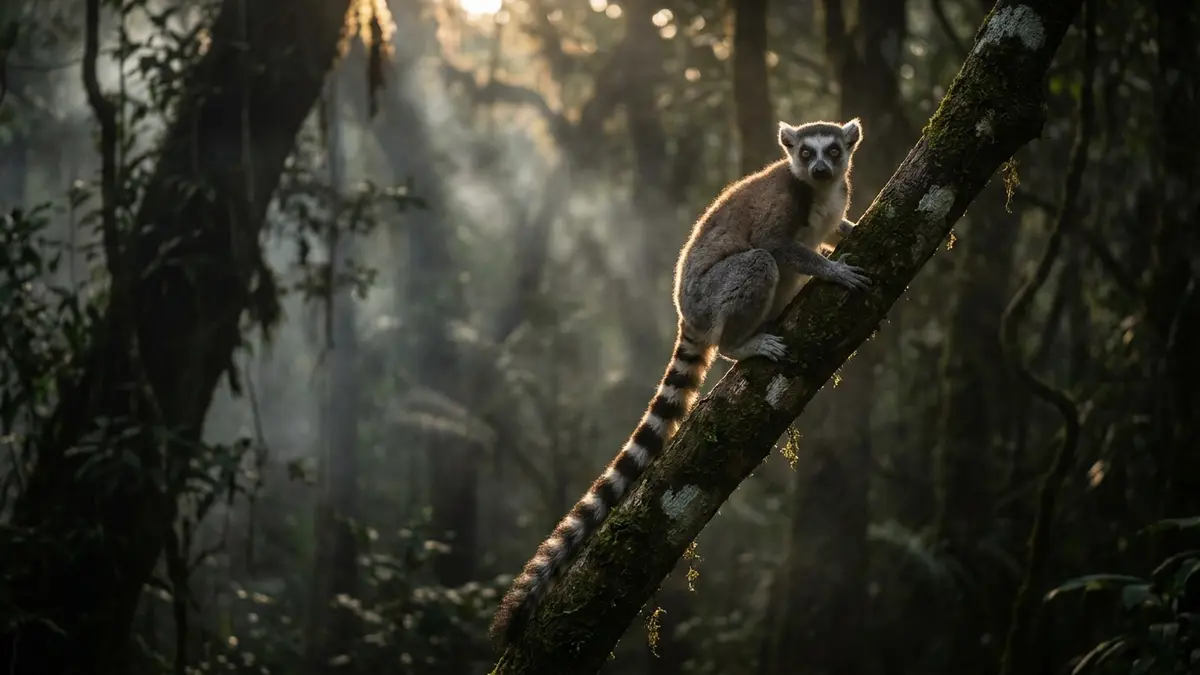
The lemur symbolizes the balance between masculine and feminine energies. It encourages people to trust their intuition and pay attention to their sense of smell rather than their sight. It's also a symbol of loyalty, both to family members and community at large.
The lemur is a playful animal with a habit of honest communication and resourceful problem-solving. It's nocturnal (active at night), ancestral.
An almanac
- Core message
- Trust intuition, protect your circle, stay playful
- Spirit animal
- Playfulness, sharper senses, honest communication
- Totem for
- High-standard, sociable communicators
- Power animal
- Finding direction, mending broken communication
- In dreams
- Warns someone may not wish you well
- Cultural roots
- Madagascar ancestral spirits & Roman lemures
- Social order
- Matriarchal — females outrank every male
- Conservation status
- Among the world's most endangered mammals
The Lemur is a primate that likes the dark. It has big eyes and a quiet, clever nature. Island folk and old empires wrote stories about the Lemur long before scientists figured out how it's related to other animals. Depending on who you ask, the Lemur is a guardian spirit or a wandering soul. Either way, what people think it means comes from the Lemur's own traits: both male and female lemurs look pretty much alike; they sense the world with their noses and not their eyes; they live in tight family groups; and they're surprisingly good at problem-solving. Those traits mean that if you see one, you can think of it as representing balance, sharper senses, and close bonds with the people around you.
Lemur Symbolism & Meaning
The Lemur is among the smallest primates alive; the mouse lemur weighs barely an ounce. Because males and females look almost identical, the animal has come to stand for balance between masculine and feminine energy rather than the dominance of one over the other. Its small size and closeness to the ground tie it to earthy, grounded influences.
Lemurs arrived on Madagascar from mainland Africa millions of years ago, and local communities there have long treated them as more than wildlife. Local fady (taboos) have helped protect lemurs and their forests for generations, and a popular belief holds that lemurs carry the souls of ancestors and bring misfortune to anyone who mistreats them, though historians note this specific belief isn't well documented and may owe as much to outside retellings as to confirmed tradition. That heritage is why the Lemur carries associations with generosity, humility, and reverence for family lines and mentors.
The animal's oversized eyes catch the eye, but lemurs actually rely on scent and smell far more than sight to find their way. That preference is often read as a lesson in trusting instinct over appearances. Because they're most active after dark, they've also picked up an otherworldly reputation, read as benevolent rather than frightening.
They live in tight social clusters with a recognized leader and huddle together for warmth, while males patrol the group's boundaries with scent signals and will fight if threatened. That territorial streak is why the Lemur is tied to protecting your space with confidence.
Despite a modest brain size, lemurs can sort objects, use simple tools, and grasp basic counting, evidence that ingenuity can outweigh raw power. Add their playful, fearless nature around people, and you get a symbol of joy taken seriously.
Lemur Spirit Animal
The lemur is happy and playful, curious and outgoing. Those who feel little playfulness in their lives are invited to borrow some of the animal's energy and to remind themselves that joy can be a primary form of nourishment.
The lemur can help you sense the energies around you; it nudges you to slow down enough to use your intuition. When the time comes to take a step in a new direction, this spirit animal helps you sense any obstacles ahead and keep moving smoothly despite them.
It also offers support for those struggling with self-expression: stand confidently in front of others, speak plainly, with a touch of humor, and the tension will evaporate.
Whether you need stamina or focus, this guide pushes you to use your time wisely. It will also give you a burst of energy when needed.
Does Lemur fit you?
Tap the ones that sound like you — 6 traits, no right answer.
0 of 6 Nothing picked yet — start tapping.
Lemur Totem Animal
People born under the lemur totem tend to set high standards. They want excellent in nearly everything they do. However, some of these standards can be unrealistic, which sometimes leads them to feel defeated when reality does not live up to their high expectations.
People with this totem are often very charming: affectionate, sociable and deeply attached to their families. They love traveling to scenic places that help them unwind and relax.
Most Lemur people enjoy living a joyful life. They are mostly night owls. They have been known to have an upbeat disposition and easily fit into any social situations. If a Lemur person speaks out, it is worth listening because this person usually has a gift for communication. Some of the career choices for this person include writers, event planners, negotiators, and public speakers.
Since most of the Lemur people have a good knowledge of language, they usually select jobs that make good use of their communication abilities.
One word of caution: Lemur people can hold on to grudges and wait until they find an opportune time when they are not happy or satisfied with another person’s behavior before they respond back sharply. By learning how to forgive others quickly this can be avoided as you become more mature.
Lemur Power Animal
The lemur power animal is a good choice if you're feeling adrift and you need fresh direction. A worthwhile project may be waiting for you to take it on.
This power animal is also helpful when you feel lonely. Typically this feeling comes from a misunderstanding. The lemur power animal helps you go back and uncover what happened and find your way back to balance.
Lemur Symbols in Madagascar
Early ancestors of the lemurs sailed to Madagascar some 60 million years ago. Early species evolved into many forms, including some giant lemurs that were much larger than today's animals.
The Western world became familiar with the animals in the early 1600s, but for generations before this, forest folk had held lemurs sacred and protected them as part of tradition. An old Malagasy story describes how a young father and son went searching for each other in the forest. But both disappeared — only to return transformed into the first Indri lemur.
The sad cry of another lemur species, called the Indri, lives on in Malagasy folklore. There are two tales.
In one version, an Indri gives a rare sign to someone below it in the trees (by pointing its long middle finger.) The gesture can bring a curse down on the viewer.
In another version: a little boy is gathering honey deep in a rainforest when he gets stuck in a tree with no way down. But a passing lemur gently guides him back to solid ground using its strong limbs to swing through the branches. The people thanked him with praise: "Babakoto," or "Koto's father."
Species of these incredible primates are endangered by encroaching civilization. Some varieties are now so rare that they qualify as Critically Endangered. The animals have long been sacred as ancestral guardians for Malagasy people.
Lemur Symbols in Rome
In the Roman Empire, the word "lemures" was used to mean wayward spirits of the dead. The writer Ovid described them as ghosts that move in silence from place to place. The ancients believed they were offended by improper burial, so each year at midnight, families commemorated the festival of Lemuria. Each family head would throw black beans behind him in ritual offerings, while clashing the pots and pans to drive the restless souls away.
Lemur Symbols in Sweden
Carl Linnaeus, the Swedish naturalist who revolutionized the system of classifying all of life on Earth in the mid-1700s, deserves the credit for this animal's formal scientific name. His famous text on the natural world listed a broad array of early varieties: slow-moving, cat-like, and gliding types.
Linnaeus had a classical education. He would have reached for Roman mythology. He named this new species for an ancient story about ghostly wandering spirits.
Lemur Dreams
People who see Lemurs in their dreams should generally be cautious of motives expressed by other people, especially regarding anything dangerous. Interactions involving Lemurs should then make you assess whether those involved are truly looking after your best interests. The scene in your dream can provide further clues:
- Lemurs hanging from trees symbolize the natural and child-like, and your ability to explore
- A Lemur screeching or agitated on a branch could warn of threats toward you or nearby predators
- Carrying or nurturing a Lemur may refer to the maternal influence in your life
- Seeing a Lemur with closed eyes can remind you of an unresolved situation in the past
- If the Lemur's eyes stand out in your dream, they're pointing to something important you're neglecting
- Seeing female Lemurs is associated with fertility and protecting someone vulnerable
- Male Lemurs can mean respecting the proper order of things and taking a correct approach
- Threatening Lemurs are cautioning about conflict that's coming and require proper preparation
- A Lemur floating around can hint at an exciting or transformative journey ahead
- A Lemur eating fruit suggests growth and abundance
- A group of Lemurs gathered together usually signifies your relationships with friends, family, etc.
Lemur Spiritual Meaning
For lemurs, the spiritual meaning comes down to trusting your senses beyond just what you see, staying close to the people you care about, and making do with what you have instead of forcing the issue. Their appearance, which looks like a mix of male and female, makes it clear that strength doesn't require dominance. Their sense of smell is stronger than their vision. That can mean that your intuition often knows more than just what you can learn by thinking about it.
If a lemur comes into your life as a spirit animal or as a totem animal, it asks you to stay playful, protect the people around you, and communicate honestly. If you feel lost or unsure about what's ahead, follow your curiosity and let it guide you.
Lemur Symbols of the Matriarch
Beyond the physical similarity between male and female Lemurs, something else is surprising: in most Lemur species, females rank higher than males. Queen Lemurs' daughters get their mothers' high standing, even above big strong males. Researchers who study this ranking talk about a peaceful system that needs only a poke or a quick shoving into a tree to keep harmony — dominance without cruelty.
The Lemur's balance of masculine and feminine power here is more than fifty-fifty. It shows people how to lead with confidence, instead of bullying: at home, on a team, or in your own life.
The Dancing Sifaka & the Spirit of Joy
In the lemur family, the sifaka is known for its playfulness. These lemurs are adapted to life in trees, spending much of their time clinging to branches and leaping between them. But one of the things that makes the sifaka special is its ability to leap more than 20 feet between trees without coming down on the ground. They do this by hopping from one tree to another, using their strong hind legs for propulsion and their arms for balance. This way of moving through the canopy is so rhythmic that it looks like they're dancing.
This behavior suggests that the sifaka's spirit connects joy and resourcefulness in a special way. These lemurs seem to say that they don't need special conditions or ideal circumstances to find joy. Even when branches are few and far between, these lemurs take advantage of gaps in the trees by hopping across them sideways.
Frequently Asked Questions
What does a Lemur symbolize spiritually?
Spiritually, the Lemur symbolizes a balanced blend of feminine and masculine energy. It also represents trust in intuition rather than relying on vision alone. Finally, its loyalties to family and community are strong. Some traditions see Lemurs as otherworldly or ancestral due to their nocturnal habits.
What does it mean when a Lemur is your spirit animal?
When you see a Lemur spirit animal, it's usually a sign to let yourself play more and to use your intuitive senses. A new venture might be on the horizon, so keep looking out for opportunities. Your Lemur spirit animal is telling you to be honest, open, and transparent, and not to give in to any urge you may have to fake it.
What does dreaming about a Lemur mean?
Dreaming of a lemur can mean someone doesn't wish you well. It may also mean good things—nurturing motherhood, a coming stretch of growth and change, or something else. The meaning depends on the rest of the dream.
Are female Lemurs really dominant over males?
Most species of Lemur have a social hierarchy where every female outranks every male, including the dominant breeding male. The hierarchy also applies to offspring; a daughter will automatically outrank her brothers even if they're older. Spiritually, this has implications about a Lemur's male-female balance. It's more about a calm and confident feminine authority, rather than a straight-up gender equality.
Why is the Lemur linked to guardianship and protection in Madagascar today?
Besides its original place in ancestral-spirit beliefs, Madagascar's lemurs are now among the most endangered mammals on Earth. The vast majority of them face a threat to their habitat and to hunting pressure. This vulnerability has deepened their symbolic role in people's minds to be seen as guardians who themselves need protection rather than protectors.
Lemur also represents
- Other animals that represent peace →Alongside Dove, Crane, Deer, Elephant
- Other animals that represent protection →Alongside Bear, Wolf, Dog, Elephant
- Other animals that represent intelligence →Alongside Crow, Raven, Dolphin, Fox
- Other animals that represent family →Alongside Elephant, Wolf, Penguin, Ant
Sources
Claims on this page were checked against these published sources.
- Lemur
Madame Berthe's mouse lemur weighs approximately 30 g (1.1 oz) and holds the title of world's smallest primate.
Read the source → - Ring-tailed lemur
Capacity to organize sequences in memory and retrieve ordered sequences without language; Understanding of basic arithmetic operations; Ability to select tools based on functional properties rather than appearance.
Read the source → - Indri
A legend tells of a man who went hunting in the forest and did not return. His absence worried his son, who went out looking for him... villagers discovered only two large lemurs sitting in the trees: the first indri. The boy and his father had transformed. In some versions, only the son transforms, and the wailing of the babakoto is analogous to the father's wailing for his lost son.
Read the source → - Lemuria (festival)
The householder would take a mouthful of black beans and spit them out behind him... 'I send these; with these beans I redeem me and mine' repeated nine times... the rest of the household clashes bronze pots while repeating, 'Ghosts of my fathers and ancestors, be gone!' ... at midnight.
Read the source → - For a glimpse of a world ruled by women, look at lemurs. (They keep the men in check.)
The majority of lemur species are female-dominant, and it's not just the queen who calls the shots. ... Liesl's privilege extends down her matriline, meaning her daughters also enjoy the ability to pull rank on all male relatives. Even female infants outrank Liesl's beleaguered mate Aracus.
Read the source → - Coquerel's Sifaka
These long, powerful legs can easily propel them distances of over 20 feet from tree to tree. ... On the ground, the animals cross treeless areas just as gracefully, by bipedal sideways hopping.
Read the source → - Almost a third of lemurs now Critically Endangered - IUCN Red List
Almost a third (31%) of all lemur species in Madagascar are now Critically Endangered... 98% of them threatened
Read the source → - The legend of Babakoto
A young boy traveling in the rainforests of eastern Madagascar climbed a high tree to gather honey. A passerby cut the vines so he couldn't come down. Just when it seemed the poor boy's fate was sealed, an indri lemur came swinging through the trees and helped him climb down from the canopy.
Read the source →