Mammals · Spirit animal
Antelope Spiritual Meaning & Symbolism
The watchful runner who trusts instinct over hesitation
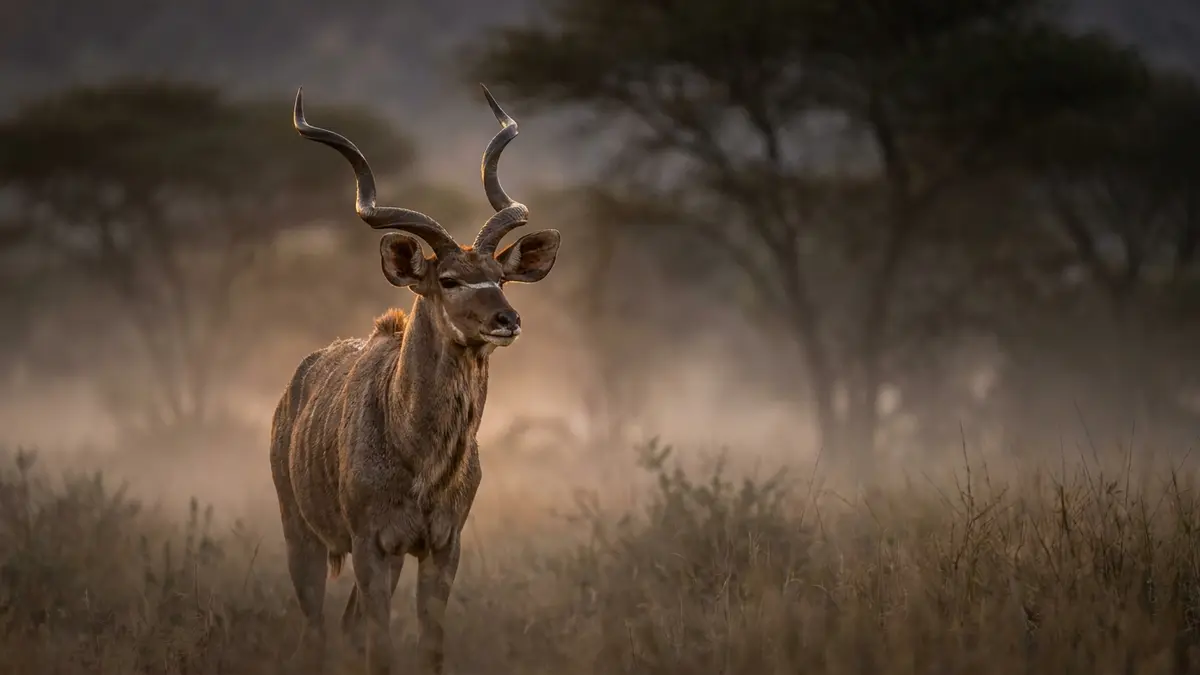
Antelope is an animal symbol of alertness, self-trust, and unclaimed freedom. It is a spirit animal that helps you widen your awareness of the situation so that you can act decisively without hesitation. Antelope shows up when opportunities call for action rather than further deliberation, especially in times when your energy is spread too thin or your perspective on things needs to be sharpened. As a totem and power animal, Antelope symbolizes independence, sharp perception, quick confidence, and decisive movement.
An almanac
- Core message
- Awareness paired with decisive action
- Spirit animal
- Stop deliberating and act
- Totem for
- Curious fast learners who need independence
- Power animal
- Momentum, sharper instincts, stronger boundaries
- In dreams
- Manage your energy, don't overanalyze
- Cultural roots
- African, Native American, Hindu, Egyptian, Far Eastern
- Biblical role
- Named among the 'clean' animals in Deuteronomy 14:5
- Sacred to the San
- Eland is the most revered animal in Bushmen rock art
Antelopes are one of few hoofed animals that coexist with humans but don't really submit. This independent streak, along with their speed and keen senses for spotting danger from every angle, has made antelopes symbols of alertness, self-trust, and unfettered freedom in both African and Asian traditions as well as Hindu myths. Below you'll find out what it means to have an Antelope spirit animal, totem, or power animal as well as some common interpretations of Antelope's meaning across cultures and possible messages if it showed up in your dreams.
Antelope Symbolism & Meaning
Antelope is a wild animal closely related to cattle, goats, and deer. It can be found in Africa and Asia. Even though people have been living with them, antelope has never been fully domesticated. This is one reason why they are so strongly associated with freedom.
The way the animals look varies widely: their fur might be brown or black or white. The smallest types — such as the royal antelope — weigh only six pounds and yet are thought to be very smart and fast.
It's believed that antelope horns hold power, and so they've been used in traditional medicine for a long time. They're also still used today by people living in China who think horn from Saiga antelope helps cure fever and makes them feel more amorous too.
The qualities linked to antelopes include: protection, quickness, attentiveness, endurance and sharp perception. It's easy to understand why these are part of its character when you know that it has excellent hearing, sight, and smell. And it can use all three senses at once because they're placed on the sides of its head. This lets antelopes see in every direction almost as if they had eyes around their entire heads instead.
Antelope Spirit Animal
Antelope usually enters our lives as a sign to stop overthinking. You've been deliberating about something for far too long — now Antelope arrives and urges you to make your move. Be sure that you are fully committed, though. Half-hearted effort isn't the spirit of Antelope.
It is saying to you that even when things seem overlooked, you are loved and cared for. Antelopes are very vigilant in nature; thus it might be a message from the universe asking you to widen your awareness on a particular issue before proceeding further.
If you're learning something new or studying for an exam, then Antelope shows up to sharpen focus, make you learn faster, and enhance comprehension skills. In business settings, this spirit guide assists one in being able to read situations clearly while quickly spotting dishonesty and deceit, responding with strategy and charm where necessary.
Does Antelope fit you?
Tap the ones that sound like you — 6 traits, no right answer.
0 of 6 Nothing picked yet — start tapping.
Antelope Totem Animal
If your birthday falls around the time of the antelope, you're likely a quick learner who loves questions. In fact, you might have been one of those kids who asked more than your parents could handle. One challenge for this birth totem is learning when not to do something just because someone wants you to.
The physical body of an animal with this symbol may be especially attuned to smell, sometimes in a literal sense (like being sensitive to perfume) or figuratively, as a way of sensing trouble early on. Also, there's often physical restlessness with a love of movement and possibly a natural talent for running.
There can also be a desire for elegance and beauty in everyday life, along with an unshakable need for independence — this animal just won't settle down even though it may get close to others.
Antelope Power Animal
Drawing on the Antelope energy sharpens communication. When you have stalled ideas or opportunities, calling up Antelope can help unblock your thinking and jumpstart a new course of action. It is especially helpful when heading into difficult conversations or negotiations because it enhances sensitivity to the subtle cues around you. Antelope can heighten accuracy in reading body language and deciphering other's intentions.
If you tend to override your instincts, calling up this power animal helps you reconnect with instinctive knowledge and trust that wisdom. It also strengthens boundaries and ensures others respect your personal space.
Across cultures
5 traditions — pick one to read its take.
Antelope in Native American Tradition
In some cultures among Plains tribes, antelopes are messengers from the spirits of ancestors. Several Pueblo communities have an "antelope clan", and Hopi people go further with an "Antelope Society" that is tied to their rain-and-crop ceremonies. The members of this society dance for rainfall and plant growth in the form of Antelope Katsina.
One Blackfoot origin story explains why antelopes are found on grasslands instead of mountains. In the story, creator first made bighorn sheep for the flat plains but they couldn't run properly and so were moved to cliffs where they could thrive. Then he made antelopes, who also struggled in the rocky terrain.
Creator recognized that this mismatch didn't make sense, so he put antelopes on the open prairie instead of mountains — which is why bighorn sheep remain in mountain ranges and antelope live in grasslands.
African Symbolic Meanings
The story goes that there once were three creatures — humans, Antelope, and Snake — whom a sky-god named Unumbotte had set to preparing a field before sowing seeds. They were instructed to smooth out the rocky soil first, but instead planted straight away in the fields they'd been given.
When crops began to grow, Unumbotte discovered that the plants had red fruit he reserved for himself alone. When humans reached for the forbidden fruit anyway, Unumbotte asked them if Antelope and Snake wanted to share it too. Antelope declined, saying that grasslands were enough to fill its belly — so they got a gift of their own, while Snake earned a special trait in exchange: venom. Humans were divided into separate tribes, who grew up speaking different languages.
In the Lower Congo Basin, meanwhile, a group of peoples including the Babwende, Basundi, Bakongo and Woyo carved Nsiba from antelope horns, turning them into small ornamented whistles made to transform their natural hollow cavities into musical instruments. The horns were chosen specifically because they could carry sound between the worlds of ordinary day-to-day life and those considered sacred.
Antelope in Hindu Mythology
In the Vedas, the antelope has powerful symbolic associations with divinity. The Moon God rides one as his mount, and so does Vayu, god of the winds. One of Shiva's many manifestations takes on an antelope form.
One story tells how Shiva walked through the forest in handsome human form but so irresistible that the hermitesses abandoned their devotions to pursue him. The furious hermits then hurled both tiger and antelope at him, but he caught the leaping antelope midair and held it motionless as a display of his mastery over the natural world.
Soma is also associated with the antelope; Soma is another moon god who is central in many of the Rig Veda hymns.
Antelope in Egyptian Mythology
Satis is a goddess associated with war who rules in Upper Egypt. Her symbol was an antelope. In a kind of family group, this triad includes Khnum, keeper of the source of the Nile River, and Anuket, protector of the Nile. Satis also wore the crown of Upper Egypt that had horns made from an antelope's head.
Far Eastern Antelope Symbolic Meanings
In Eastern mythology there's a horned creature like a unicorn but built from an antelope's body. It's said to appear only when the government is good at its job. Confucius mentioned it once in passing, lamenting the fact that a ducal hunt had killed one of these rare creatures.
The Serow was Japan's equivalent. This goat-antelope stood 32 inches tall on average and weighed about 70 pounds, with either black or white fur and backward-curving horns. It traveled with smaller herds to protect each other from danger, used scent glands for marking its territory, and is now protected through conservation zones in the nation's northern woodlands.
Antelope in Dreams
If you dream about an antelope, the dream is generally asking you to pay close attention to how you're using your energy. You may be spreading it out too thin and are being asked to put more focus on one task at a time. The dream could also suggest that your perspective on something minor has become distorted. Ask yourself whether you're over-analyzing the situation.
If an antelope is running away from you, this symbolizes taking a short break. It might help bring clarity back into the picture and restore balance. If it's lying down, this could be cautioning against complacency, reminding you that your window of opportunity won't stay open forever. Finally, seeing an antelope calm and watchful is signaling heightened perception. This suggests that what your instincts tell you are right and you shouldn't second-guess them.
Antelope in Astrology & Zodiac
Antelope isn't tied to any fixed zodiac sign. Yet because of its quickness, constant readiness, and heightened senses, it maps closely onto Mercury-ruled mental agility and Mars-driven initiative: the courage to act on information as soon as you get it without delay. Its traits echo those associated with earth or air placements that prize situational awareness.
If Antelope resonates in your chart, there's a good chance you read a room instantly, process a lot of information, and move quickly when the time is right — rather than waiting for permission.
Antelope Spiritual Meaning
An antelope teaches people to combine two things we sometimes treat as opposites: awareness and action. If this animal shows up for you, it might be trying to tell you to use its wide field of vision to survey your circumstances before committing to anything, but then take the hint and do something about it rather than sitting around waiting.
Let the energy of Antelope guide you toward trusting your instincts, protecting your boundaries, and moving through life with all the unclaimed vigor it carries into open country.
Antelope in San (Bushmen) Rock Art
Before anything was written down, members of the San (Bushmen) peoples painted Eland on rock shelters across southern Africa — especially in and around the Drakensberg. Eland fat was linked symbolically with abundance and fertility in San culture, so San artists paid particular attention to this large antelope when painting or carving other species; they also spoke of a trickster-creator figure who had his own pet Eland, which made the animal even more important as a part of their cosmology. The animal's most significant function, though, came from its role in the healing dance that formed the center of San spirituality.
Shamans entering trance were said to go through the process of dying in much the same way an Eland dies — legs folded beneath it. Rock artists sometimes painted Elands next to their drawings of shamans as a reminder of these things, and also because they knew that when shamans left on one of their healing dances, they carried with them some sort of special potency which could be used in the real world.
Antelope represented more than just swiftness and watchfulness — it served as a doorway between the spiritual and physical worlds.
Frequently Asked Questions
What does it mean when Antelope is your spirit animal?
Antelopes typically signal that opportunities require decisive actions instead of continued hesitation. This spirit animal also often appears in your life to boost focus, sharpen your perception so you can notice what has been missing from your awareness, and help remind you that you're not alone and being observed even when the people around you aren't paying attention to you.
What does an Antelope symbolize spiritually?
In spiritual terms, the antelope represents heightened awareness, independence, and rapidity of thought and action. Its wide peripheral vision and speed demonstrate the need to be aware of what is happening around you so you can react quickly if necessary.
What does it mean to dream about an Antelope?
If an antelope appears in your dream it can signify that you are spreading yourself too thinly and seeing things from an unrealistic viewpoint. An antelope running away may indicate that you have been overdoing things and would benefit from some relaxation. If an antelope is lying down, this shows that by staying still or ignoring something important you could miss a great chance to improve your situation.
Is Antelope mentioned in the Bible?
Antelopes, roe deer, wild goats, ibex and mountain sheep are included in Deuteronomy 14:5 (NIV), among the animals allowed under Israelite dietary law. They appear together with other cloven-hoofed, cud-chewing animals that were considered ceremonially clean – a list meant to represent permitted abundance rather than any single mystical meaning.
Can Antelope be a negative or warning sign?
If an antelope comes into view suddenly and feels overwhelming, then yes, it might be acting as a warning sign — your focus may be too scattered or you're hesitating past the point of usefulness, getting distracted by something you should have already noticed. In that case it can serve to correct you back onto the right path.
Antelope also represents
Sources
Claims on this page were checked against these published sources.
- Antelope
An antelope is any of the extant or recently extinct species of the ruminant artiodactyl family Bovidae... indigenous to most of Africa, India, the Middle East, Central Asia... Their eyes are placed on the sides of their heads, giving them a broad radius of vision with minimal binocular vision... acute senses of smell and hearing... Domestication of animals requires certain traits in the animal that antelope do not typically display.
Read the source → - Royal antelope
stands up to merely 25 cm (10 in) at the shoulder and weighs 2.5–3 kg (5.5–6.6 lb)... the smallest antelope and ruminant in the world
Read the source → - Saiga antelope horn suppresses febrile seizures in rats
Saiga antelope horn is a traditional Chinese medicine for treating febrile seizure with precise efficacy
Read the source → - Saiga Antelope
The horns are commonly believed to be effective at treating 'heatiness', reducing fevers, and detoxification.
Read the source → - Hopi
The most widely publicized of Hopi katsina rites is the 'Snake Dance', an annual event during which the performers danced while handling live snakes.
Read the source → - Unumbotte
Unumbotte creates a man, then the animals including an antelope and a snake, and later a woman... humans had cultivated plants, the antelope had grass, but the snake was given poison and a desire to attack humans.
Read the source → - Chandra
Chandra... also known as Soma... is the Hindu god of the Moon... Vahana: Chariot pulled by an antelope
Read the source → - Vayu
is the Hindu god of the winds as well as the divine messenger of the gods... Mount: Chariot drawn by Horses, Gazelle
Read the source → - Shiva
Axe (Parashu) and Deer are held in Shiva's hands in Odisha & south Indian icons.
Read the source → - Satet
an Upper Egyptian goddess who, along with Khnum and Anuket, formed part of the Elephantine Triad... usually pictured as a woman... wearing the hedjet, the conical crown of Upper Egypt, with antelope horns... As a war goddess, Satis protected Egypt's southern Nubian frontier
Read the source → - Qilin
The body is fully or partially scaled and often shaped like an ox, deer, or horse, or more commonly a goat... Spring and Autumn Annals mentioned that a lin (麟) was captured in the 14th year of Duke Ai of Lu (481 BCE); Zuo Zhuan credited Confucius with identifying the lin as such.
Read the source → - Japanese serow
a Japanese goat-antelope... stands about 81 centimetres (32 in) tall and weighs 30–45 kg (66–99 lb)... black to whitish... short, backwards-curving horns... found solitary, in pairs, or in small family groups... marks trees with sweet-sour-smelling preorbital gland secretions
Read the source → - Deuteronomy 14:5
the deer, the gazelle, the roe deer, the wild goat, the ibex, the antelope and the mountain sheep.
Read the source → - Rock Art
The Eland is a central symbol. Eland fat is associated with girls, as they are seen in that culture as fat and both, in turn, symbolise a 'good thing'. During the trance dance, the shaman 'dies' in the same way that an eland dies, with legs crossed. He also had a pet eland.
Read the source → - San rock art
eland bulls meant marriage, curing, or the trance dance
Read the source → - Nsiba
Nsiba are ornamented whistles that were used by tribes of the Congo Basin for spiritual practices... Nsiba are made of small antelope horns and wood... are associated to the Babwende, Basundi, Bakongo and Woyo tribes.
Read the source →