Birds · Spirit animal
Kestrel Spiritual Meaning & Symbolism
The patient, precise hunter who teaches you to strike only when the moment is right.
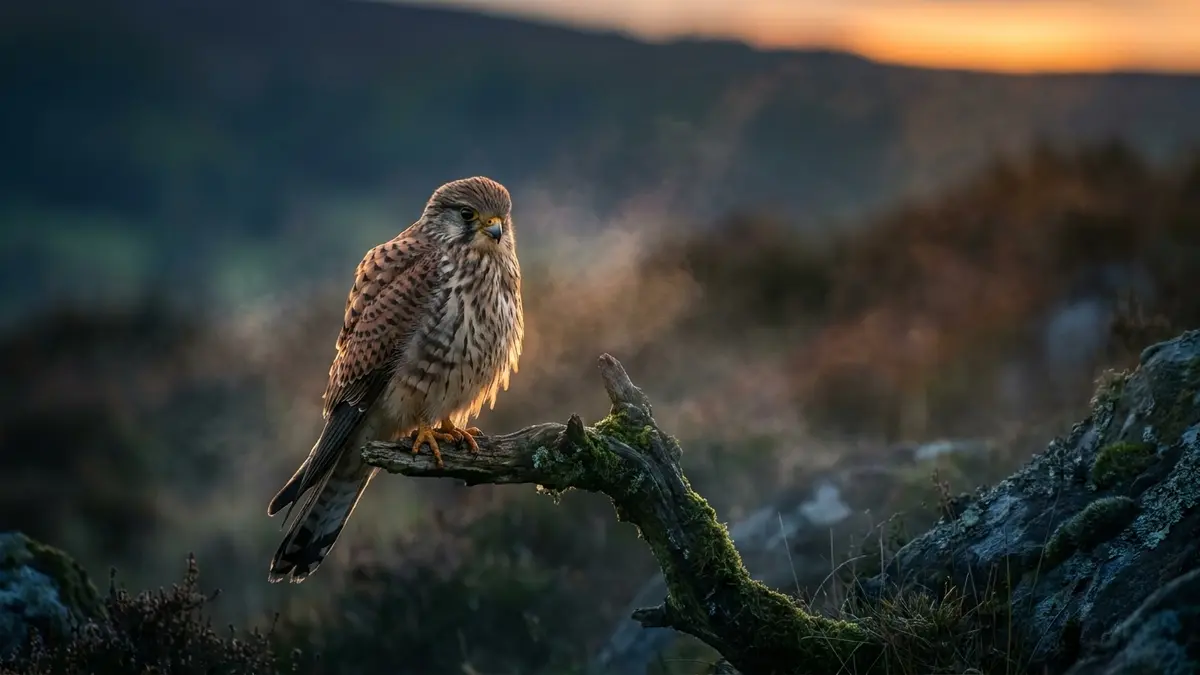
Kestrel spirit animal meaning: patience and decisive action. A kestrel hangs in the air, watching until it knows exactly when to strike. So if you're a kestrel in spirit animal form, that probably means you should step back and wait before acting. Watch for the perfect time to launch into action. As a power animal it carries the same meaning plus the qualities of loyalty and courage.
An almanac
- Core message
- Watch closely, then act without hesitation
- Spirit animal
- Slow your reflexes, then commit fully
- Totem for
- Quick-witted, composed, big-picture thinkers
- Power animal
- Courage and clear focus once you're ready
- In dreams
- A capable helper guides you past trouble
- Element
- Air
- Nickname
- The Windhover, for its still, wind-braced hover
- Irish name
- Pocaire Gaoithe — "wind frolicker"
You see the American Kestrel hovering above the treetops, its silhouette unmistakable even from a distance. It has all the falcon's grace but in a much smaller package. The kestrel waits, utterly still, until the break appears. Then it strikes with unstoppable accuracy.
If this bird comes to you as your guide, it's likely that it's challenging you to trust yourself more, reminding you that now's the time to act decisively instead of waiting for everything to be perfect, that now's the time to start seeing past the obvious and relying on those gut instincts.
Kestrel Symbolism & Meaning
Kestrels rarely dive into a single mystery without first investigating it. They'll hover for a bit, then dive once they're sure what they'll find. This is one of the most important parts of their symbolism: be careful before jumping right in.
They can dive down quickly. The birds can go fast, reaching around 60 miles per hour.
The kestrel's appearances often resemble tiny birds, like songbirds. It was once called a sparrow hawk by a lot of people because it looked like one. Their presence could therefore imply that what is strong and powerful may not always be evident to the eye.
Courting kestrels fly around and talk to each other in really interesting ways! The male will call from above while the female will respond by moving slowly with great control. There are kestrel pairs that stay together and come back to the same place to make a nest for years at a time. These behaviours and actions offer ideas of loyalty, companionship and regular everyday life.
While taking care of their babies, each parent handles their part: one of them stays on guard at the nest while the other finds some food and then they both work as one team, coming back and forth until it is time for the little ones to fly away alone. Even when their babies can already fly by themselves, they often keep doing this until they get pretty good at flying on their own!
Since kestrels can stay stable without moving much while they hover in the air, they have another name: windhover. A poet named Gerard Manley Hopkins wrote about them in a poem he named "The Windhover." But this bird's eyes see more: these birds use special abilities - with ultraviolet sight that enables them to follow footprints made out of pee; which are trails made by things such as voles...
Kestrel Spirit Animal
Kestrel shows up as a spirit animal when it's time to slow down and make full use of your senses. Kestrels are high-flying hunters, but they always spot their prey before they dive. Spirit animal kestrels ask you to look before you leap into decisions or a change in life direction.
Often, it's time to step into a position of greater responsibility. That can be an unwanted role that's suddenly on your shoulders or one you've been hoping for and working toward. The message then is to balance boldness and restraint — not to fall head over heels for either option.
Kestrel also carries associations of inner sight and symbolic insight, meaning that if this bird's joining you, it's time for you to become aware of unseen patterns in your life — echoes from earlier times.
Does Kestrel fit you?
Tap the ones that sound like you — 6 traits, no right answer.
0 of 6 Nothing picked yet — start tapping.
Kestrel Totem Animal
People born under the kestrel totem tend to think several moves ahead; they map out a plan while others are still reacting. You're quick-witted and composed, and you notice everything happening around you, literally: a kestrel person rarely sits with their back to an open room because they need the full view to feel settled.
Diplomacy comes naturally to you, and you likely gravitate toward work that rewards organization and big-picture vision. Your sunny, perceptive presence draws people in easily, and you tend to collect a wide circle of acquaintances without much effort. There's also a restless streak — an itch to travel and chase down life's puzzles — balanced by a homebody's loyalty to the place and people you've already chosen.
Kestrel Power Animal
Call on the kestrel when you're ready to let out your voice and take action after thinking things through. This animal spirit will give you courage and strengthen your conviction, helping you to move forward with confidence instead of hesitation.
The kestrel will help you focus when your thoughts are scattered, so it's a good companion when you need direction. This falcon has strong ties to the element of air and is connected with communication and cooperation..
If something doesn't feel right, trust the instincts the kestrel stirs up in you.
Kestrel in Native American Symbolism
The kestrel was considered to be closely related to hawks and falcons in many Native American traditions. This is because smaller raptors like the kestrel were often viewed as symbols of alertness, sharp perception, and vigilance.
Because hawks and falcons are linked to powers such as courage, protection, and the ability to ward off dangers, they have been a common clan symbol for various tribes such as the Chippewa, Hopi, Menominee, Huron, Iroquois. Specific descriptions of kestrels may be harder to find since sources often treat it as one with all hawks and falcons.
Kestrel in Dreams
If a kestrel appears in your dream, it may mean you'll have help from someone capable. Maybe they have some kind of authority and can get you out of a tricky spot without anyone having to lose face.
When the kestrel is flying freely above you, it might be a call to chill out, let go of your worries, and let your sense of humor come out to play.
When the kestrel is perched on a pole or post, it could be a signal that you should think about changing what you're doing before moving forward.
A kestrel hovering motionless might encourage you to watch a situation for just a little while longer before making any decisions.
A kestrel diving toward prey could mean that it's time to take some decisive action.
A feathery bundle of chicks cuddled under its wings might remind you to look after the people who depend on you at home.
A kestrel that attacks or flies at you could indicate restlessness, or the need to go for something you've been putting off.
A dead kestrel often means the cycle of watchfulness is coming to an end. This could make room for whatever is next.
Kestrel Spiritual Meaning
The kestrel waits and watches from on high. Its hover can be amazingly steady. It is looking for a moment to act, when its chance will come.
The kestrel is monogamous and faithful to its mate. It is a quiet bird.
If the kestrel shows up for you, it may be offering a little wisdom about becoming ready, timing and watching so you can know when it's time to move without delay or uncertainty.
Kestrel in Egyptian, Hungarian & Biblical Traditions
Move beyond Native American folklore, and the symbolism of the falcon family expands into the pages of history. In ancient Egypt, the falcon was the physical form of Horus, the sky god who watched over the heavens and the sun; his watchful gaze came to be called the Eye of Horus, a protective charm that was used as a talisman to ward off harm and as a sign of restored wholeness when broken.
In Hungary's founding legend, a similar story is told through the Turul. According to old chronicles, this mythical falcon-like bird appeared in a dream to a woman named Emese, foretelling that she would give birth to a great river of descendants — who would come from her son Álmos and grandson Árpád, and would lead to the founding of the country. Today you can still see Turuls on monuments across Hungary, perched there as guardians over destiny and lineage.
No nation has been entirely kind to birds of prey. Ancient scriptures like Deuteronomy list falcons alongside kites and other birds as animals forbidden for consumption — creatures set apart from other birds in a rather direct way. These are birds that stand somewhat separate from ordinary life, watching instead of blending in.
Frequently Asked Questions
What does it mean when a kestrel crosses your path?
A kestrel might urge you to slow down, look around and make decisions more carefully. Kestrels hunt by hovering and watching for small prey on the ground. Their appearance may be a reminder to be more patient and take the time to gather more information before acting.
Is the kestrel a good omen?
Overall, most traditions say good things about kestrels. Like the raptor family, kestrels are linked to sharp perception and concentration. They're also symbolized as loyal partners and wise guides. People say they see them as fortune that's coming your way.
What's the difference between a kestrel and a falcon spirit animal?
They're both in the same family, and they share many of the same themes around vision and precision. But because of the kestrel's small size and songbird-like camouflage, it also evokes a gentler image of hidden strength, which is something you don't get with a larger falcon.
Why is the kestrel nicknamed the windhover?
The name kestrel comes from the bird's habit of hovering on a current of air while hunting. Because of this peculiar manner, English poet Gerard Manley Hopkins wrote an entire sonnet to the bird, "The Windhover." In short, the kestrel lives out the idea that stillness held with skill is power.
Can a kestrel really see things humans can't?
Yes, kestrels can see UV light, which allows them to spot the glowing pee trails that voles and other tiny mammals leave behind in grass — basically a map invisible to human eyes.
Was the kestrel considered sacred or unclean in different cultures?
The falcon has been revered as sacred, as the form of Horus, an Egyptian god of kingship and protection, and in Hungarian legends as a guardian spirit. But it has also been considered unclean and thus forbidden as food in the Hebrew scriptures. As a result, falcons are rarely taken for granted.
Kestrel also represents
Sources
Claims on this page were checked against these published sources.
- American kestrel
the smallest and most common falcon in the Americas
Read the source → - American Kestrel
The male brings food for female, passes it to her in flight.
Read the source → - Horus
His symbols are the Eye of Horus (one of the most famous Egyptian symbols) and the falcon... Horus was given charge of the sky and, specifically, the sun.
Read the source → - Turul
a mythological bird of prey, mostly depicted as a falcon, in Hungarian tradition... a bird in the shape of a falcon appeared in his mother's dream when she was pregnant, a rushing stream sprang from her womb.
Read the source → - Deuteronomy 14:13
the red kite, the falcon, any kind of kite,
Read the source → - Kestrel
this behaviour is so characteristic that it led to the Kestrel's colloquial name of 'windhover'
Read the source → - The Windhover
"Windhover" is British dialect for a kestrel: a small falcon that hovers with rapidly beating wings while searching for prey on the ground.
Read the source → - Take on Nature: In celebration of the kestrel, our smallest and most widespread falcon
pocaire gaoithe meaning wind frolicker, and púicín gaoithe, meaning wind pooka (ghost)
Read the source →