Birds · Spirit animal
Dove Spiritual Meaning & Symbolism
The gentle messenger of peace, devotion, and quiet homecoming.
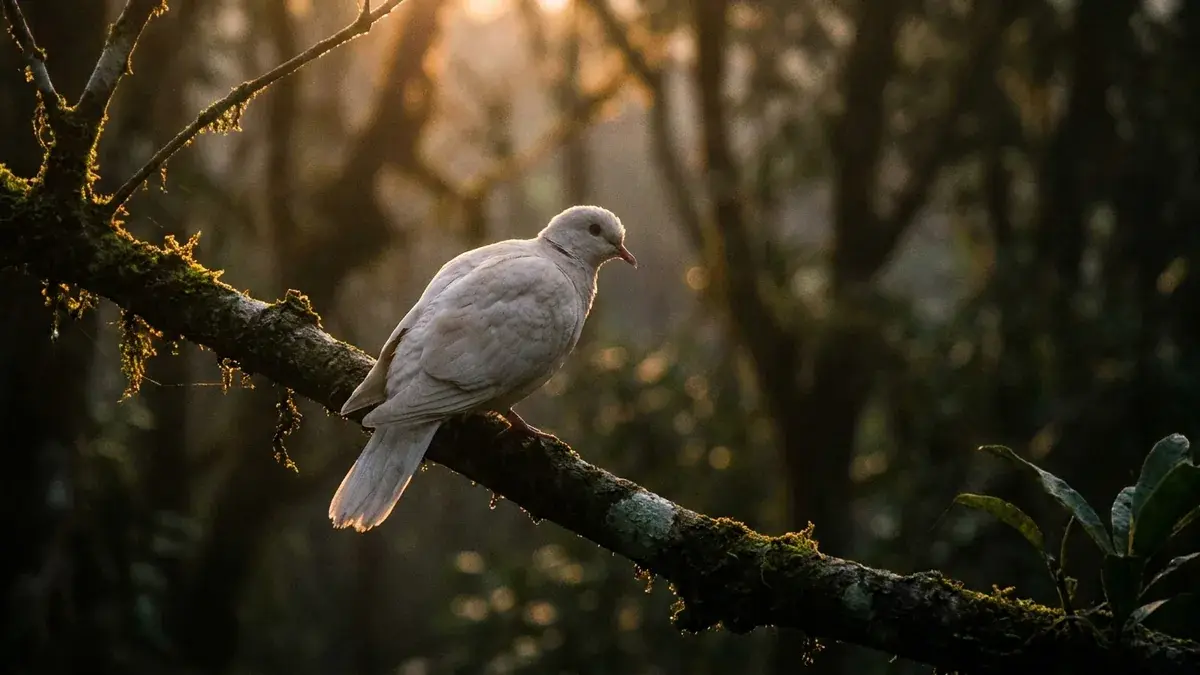
The Dove symbolizes peace, homecoming, and devotion. It shows you that gentleness is a form of strength, not weakness. As a spirit or totem animal, the Dove can show you the way to loving relationships and gentleness that has real strength. White Doves especially mean hope, purity, and renewal. If you dream of Doves, it usually means that harmony is coming your way, though if it's one Dove or a flock will change the meaning of your dream.
An almanac
- Core message
- Gentleness as strength
- Spirit animal
- Notice where you've drifted from peace
- Totem for
- Tender-hearted, diplomatic souls
- Power animal
- Restoring calm to strained bonds
- In dreams
- Harmony, loyal love, fading chaos
- Cultural roots
- Greek, Native American, biblical, Celtic
- Species worldwide
- 308, every continent but Antarctica
- As a number
- Two = partnership, flock = community
The dove has for a long time stood in for hope, homecoming, and the soft and comfortable feeling we have when we see someone dear to us. Its meaning shifts slightly depending on where you are or what culture you're from, but the dove is known all over the world for standing for gentleness as a form of strength, and never as a sign of weakness.
Dove Symbolism & Meaning
A snow-white Dove is a well-known symbol of holiness and hope. Other Dove colors mean other things, though: Red Doves suggest redemption. Speckled Doves suggest a variety of things. That's why people think of Doves as good messengers: Because when the time comes for you to go home, they can make it back there safely.
In Greek mythology, Zeus and Aphrodite are connected to the bird. That's why the Dove was chosen as the emblem of wedding rituals. Because Doves mate for life, that also helps explain why.
The Babylonians are said to have associated Doves with honor. Doves also played a role in two very famous books from ancient times, the first being Noah's Dove that signaled the end of a major flood and second being Christian scripture linking it to the Holy Spirit.
Some people say that something couldn't transform itself into a Dove without changing into something less pure than just that bird. Do not forget the term "dove" is used to describe smaller members of this group.
The meanings of Doves extend beyond this primary color palette. For instance, people consider gray Doves to be symbols of harmony between chapters in your life. Blue-tinted dove imagery is connected to communication and creativity; black ones signal good news about managing your fears.
Dove Spirit Animal
Doves remain alert even in the wild, and when Dove shows up as your spirit guide, it signals the presence of unease, perhaps an uneasy curiosity about your own comfort zone. If that's the case, try to trace the roots of the unease and reconcile them by finding genuine inner peace instead of relying on superficial safety. The guide also focuses on your close relationships and reflects on where there's been friction or friction's cause. It wants no bitterness or put-downs and wants to reconnect you with simple honesty in inner child. If someone's chipped away at your innocence, consider cutting them out and letting new doors open more quickly.
Does Dove fit you?
Tap the ones that sound like you — 6 traits, no right answer.
0 of 6 Nothing picked yet — start tapping.
Dove Totem Animal
You're a tender-hearted person who likes nurturing your friends and family. You're good at seeing what's coming next in most situations. That's why people like you a lot and are drawn into your easeful nature.
People born with this totem don't have much patience with unkind behavior. It's because you'd rather resolve conflict and build relationships than fight.
But since you're this way, some people may try to exploit your openness. So you need to know how to hold your ground even when you don't like confrontation.
Dove-born people like to make sure everyone has a safe place to go when they need it. In partnership, you want the person you love to feel good about what they have with you.
Dove Power Animal
A Dove is a bird associated with calm, affection, and simplicity. If you turn to a Dove for help, you can see a way to reconnect with the simple feelings of love and kindness that bring us together.
If your relationships with family and friends are strained, a Dove can help you overcome anger and find peace. The Dove is known for its wise words and gentle ways. It helps us talk about what's bothering us in the kindest way possible.
Dove's wisdom can also be used by new parents. It's the symbol of fertility, new life, and love. Those who work with the energy of the dove often think of amethyst as a tool to sharpen their intuition when they are ready to listen to their own inner voice.
Dove energy is often found in healing practices as well. Healers say that it can be used as a light on difficult days.
Across cultures
5 traditions — pick one to read its take.
Native American Dove Symbolism
Doves connect with the spiritual world. The whirring sound a dove makes is like a whispered message to Native Americans, telling them about paths they haven't yet chosen. When a dove appears, it might mean that you need to let go of something you've been hanging on to. Otherwise peace won't be able to come back.
In Blackfoot tradition, Doves helped warriors feel safe in battle. Among some Mexican tribes, doves were symbols of devoted love and often appeared in wedding ceremonies. Some Pueblo peoples consider doves clan animals.
Dove Symbolism in Ancient Greece
The dove had a special place in ancient Greek culture. It was linked to the goddess Aphrodite, the goddess of love and renewal. Aphrodite was often pictured surrounded by doves, and legend held that doves carried ambrosia to the gods. One Greek word for "dove" may come from a Semitic phrase meaning "bird of Ishtar," hinting at a connection between Ishtar and Aphrodite.
Doves were used as offerings in Greek temples and later connected to Venus and Fortuna by the Romans.
Dove as a Celtic Animal Symbol
In Celtic tradition, doves represented healers and were frequently pictured alongside them. Hearing a dove's call was seen as a sign that a person had passed on peacefully, and the bird represented prophecy and other forms of second sight.
Dove Meanings in China
The Chinese view of Doves is similar to that of much of the world.
In this tradition, Doves symbolize peace between people and peace between humans and nature. Because in the past people relied on Doves to deliver messages to distant friends, the bird also came to represent communication.
A pair of Doves symbolizes a long lasting love, not a fad of the moment. That's why it's so common in weddings and engagements.
Islamic Meaning and Symbolism for Doves
In Islam, Doves symbolize protection: when Muhammad was hiding from his enemies in a cave, a spider wove a web over the entrance and Doves nested on either side, so that it appeared no one was inside. Muhammad's enemies therefore thought the cave was empty and left without trying to discover whether anyone was there.
Dove in the Bible
Dove appears both in the Old and New Testaments. It's best known from Genesis 8, where Dove twice visits Noah after the flood, and returns the second time with an olive branch to signal the newly renewed earth. Later in history, in the Bible's Gospels of Matthew, Mark, Luke, and John, Dove appears in another setting, appearing as a visible sign that the Holy Spirit is present at Jesus's baptism.
Noah's story is not alone in the ancient flood stories that use a bird to confirm dry land has returned. Earlier than this biblical story, ancient records of the Epic of Gilgamesh recount Utnapishtim releasing three birds--a Dove, then a swallow, then a raven--to test whether land had returned. The raven was eventually released only after neither Dove nor swallow had found an acceptable place to rest. These messages ended up being shared in far older Near Eastern storytelling traditions.
Dove Symbolism in Japan
From ancient times, the dove has been an important symbol in Japan. The 3rd-century emperor Ojin was deified as Hachiman, the god of war and archery and agriculture. In legend, Hachiman's messengers were doves. So in art you'll often see a dove carrying a sword to show that after a conflict, peace has returned.
Dove in Feng Shui
Feng shui believes Dove imagery represents opportunity and invites positive energy to bring peace, love, and opportunity. For example, placing a Dove or dove imagery center-left in the home is said to support marriage and weathering hardships, and Sung Tzu Niang Niang, the fertility goddess whose headdress includes a Dove, is offered in the bedroom's southwest corner to those hoping to conceive.
Types of Doves and What They Mean
North America is home to at least 15 species of doves, each with its own shade of symbolism.
Brown-cuckoo Dove - We tend to see these birds in flocks. Their motion gives us the image of tenacity and reliability. Common ground-dove - These birds have a sparrow-like appearance, so they remind us that the important thing isn't size or strength, but instead the kind of trust you can get from a good friend. Emerald dove - This dove has green wings, so it's connected to images of fertility and new beginnings. Inca dove - This dove is able to tolerate quite cold weather. Its symbolic meanings are endurance and finding ways for people to get along even when things are difficult. Laughing dove - There are many birds whose sounds resemble human laughter. People who hear this sound need to laugh more often themselves. When these birds appear, laugh more often. Mourning dove - Mourning doves are able to travel fast. Their symbolism relates to focusing on your goal even when things are difficult for you right now. Turtle dove - Turtle doves are sometimes said to be partnered. When they appear together, we're encouraged think about balance in our lives and relationships.
Seeing a Dead Dove
Seeing a dead dove can be unsettling. As an omen, it warns that things are moving from peace to conflict, so be careful about choosing your battles.
It can be read as a sign of loss, telling you to pay attention so that misunderstandings don't grow bigger than they need to.
If you find a dove lying on the road, you will probably face turbulence but the situation will resolve quickly.
A dead dove after a death symbolizes an ending and lasting calm afterward.
If it's lying with its feet up, this signifies a big change in life.
Dove Superstitions & Folklore
- People thought Doves' songs thinned the boundary between different worlds.
- Seeing two Doves together meant joy and friendship, and three suggested that someone had good feelings toward you.
- Seeing a Dove during a relationship meant something good would happen to your relationship.
- Seeing a Dove right after someone was born predicted that the baby's life would be bright.
- The story was that if you saw white Doves nesting on your roof, they would protect your house.
- Doves carrying things in their beaks meant that you were getting a gift.
Dove Tattoo Meanings
A dove tattoo is usually a deeply personal choice. People who have it often find inner peace or find a resolution to a difficult situation, so the dove symbolizes that peace. Dove tattoos often appear on people who value diplomacy and who want to show others that they are committed to making peace. When you see the white dove tattoo, it is commonly used to show devotion to something greater than yourself.
Dove in Dreams
If you dream of a dove, it usually means that a peaceful time with your friends and family is just around the corner. You might even find some romance. If your dream doves are flying toward your home, that means there will be visits. If they're on the ground, you'd better expect some bad news. If you see doves standing together in pairs, that might mean that you're headed for matrimony. If you see a lone dove, then things might not be working out for you and your other half. If you catch one, get ready for the arrival of a new friend.
Dove in Art & Pop Culture
The Dove is a beloved symbol of peace, which the artist Pablo Picasso immortalized in an iconic lithograph. Picasso was an unlikely friend of Henri Matisse. The two had been rivals, but Matisse became a refuge during wartime—a haven. Conservation groups like BirdLife International monitor Dove populations so their breeding and migration can continue to be protected.
Spiritual Meaning of the Dove
With dove, the clearest way into their meaning is through a personal connection. Think about how you feel when you see this bird. It can mean different things to different people, but dove are often a symbol of hope in times of struggle.
In uncertain times, you may see dove as they fly overhead as a reminder that even when the path seems unclear, there's always a way home. Dove can also be a sign of love, either for someone single or as a deeper relationship between two committed partners.
Leaders and thinkers notice dove at times when they need to speak truthfully and honestly. If something isn't sitting right with you, it's possible this is the message your soul needs right now.
Dove arriving after loss — it means your loved one is still near you.
Dove Numbers: What One, Two, or a Flock Mean
A single Dove is often interpreted as an invitation to the inner strength necessary to stand on your own two feet and meet your current challenges. Solitude here means a chance to stop and become acquainted with oneself before depending on others for support.
Two Doves imply the lifelong union that pairs the bird in married life across Greece and China. Although two Doves are typically found together, seeing this number can signal the importance of investing your time in relationships that are already meaningful rather than searching for a new one.
As a small cluster of three or more, Doves suggest that blessings are coming your way, sometimes to signify goodwill or good luck. When seen together in a full flock, the message refers to community, unity of purpose, mutual support, and blessings that multiply through the power of coming together instead of isolation.
Doves as History's First Long-Distance Messengers
Even before there were telegraphs or mail routes, people counted on Doves and pigeons to take messages across distances that even the fastest runners would have taken a long time to cover. People have evidence that homing pigeons carried messages in Egypt, about 3,300 years ago. Homing pigeons come back to the same place no matter how far they've been carried away. Pigeons were used in Ancient Greece. For the Ancient Olympics, pigeons took messages letting a hometown crowd know about a victory before the winner got back. And by the time Greek and Roman trade and war networks were built, messaging birds had been used for about 3,000 years.
That inherited reputation of always finding its way home is why a Dove showing up usually gets taken as a message that has come just in time and was carried by something that never loses its way.
The Natural History Behind the Symbol
Although it's richly stocked with lore and mythology, the dove is, after all, a real bird. Alongside its human uses and veneration, it's important to remember the more basic facts about this charismatic species. Doves are part of a family, Columbidae, which includes more than three hundred birds. They are found throughout the world on every continent except Antarctica and the high Arctic. Many of these species have become endangered or threatened in recent times for reasons ranging from habitat loss to introduced species.
There is no denying that doves have captured the imagination of humans all over the globe. Their symbolism is well known: peace, innocence, love.
But beyond their popularity in popular art and literature, they're also worthy of discussion for their biology and natural history.
Frequently Asked Questions
What does a Dove symbolize spiritually?
Spiritually, Doves are associated with peace and purity. They convey a sense of spiritual presence and many people see them as messengers between the earthly realm and the sacred. These birds usually arrive as a sign that you're on the right path, or perhaps from someone who has passed on that they're watching over you.
What does it mean when you see a white Dove?
People who see a white dove often read it as a sign of hope and renewal, and believe that they will get spiritual protection. In Christian traditions, the dove is seen as a symbol of the Holy Spirit, and in folklore, as a guardian in homes and a promise of good luck for new parents or couples.
What does dreaming about Doves mean?
Dreaming of Doves usually suggests relationships that have a loyal and harmonious quality, possibly because they're stabilizing after a chaotic time. If the Dove is on its own, this might relate to loneliness. If a flock of Doves appears in your dream, it's probably strengthening community bonds. And if a Dove flies toward your house, someone will soon visit you.
Is it good luck or bad luck to see a Dove?
Seeing a Dove is generally thought of as good luck. Most cultures, in fact, associate it with peace. Seeing a Dove could mean your relationship with someone is getting stronger or that you'll hear some good news. The only time seeing a Dove might not be good luck is if you find a dead or sick Dove. Then it would be like getting a small warning that you should handle any current conflicts more carefully.
What does it mean when a Dove visits or nests near your home?
Doves are often thought to be a sign of blessing. This includes keeping you and those you live with safe, helping you all be kinder and more loving to each other, and helping you get through any hard times more easily. In folklore, a white Dove settling on or near your roof is taken as an especially strong sign of this.
Dove also represents
- Other animals that represent love →Alongside Swan, Wolf, Seahorse, Penguin
- Other animals that represent peace →Alongside Crane, Deer, Elephant, Turtle
- Other animals that represent rebirth and change →Alongside Butterfly, Snake, Dragonfly, Frog
- Other animals that represent loyalty →Alongside Dog, Wolf, Swan, Penguin
Sources
Claims on this page were checked against these published sources.
- Doves as symbols
In classical antiquity, doves were sacred to the Greek goddess Aphrodite ... Aphrodite's associations with doves influenced the Roman goddesses Venus and Fortuna, causing them to become associated with doves as well.
Read the source → - Mourning dove
The mourning dove is generally monogamous and forms strong pair bonds.
Read the source → - Hachiman
In Shinto, Hachiman is believed to be the divine spirit of the semi-legendary Emperor Ojin ... the syncretic divinity of archery and war ... His messenger is the dove, which symbolizes both the bow and arrow found in samurai banners.
Read the source → - La Colombe (Picasso) / Dove
The dove illustrated in the lithograph was actually a Milanese pigeon, which had been a gift to Picasso from his friend and fellow artist, Henri Matisse.
Read the source → - Native American Dove Mythology
The Blackfoot tribe associated the dove with protection and safe return from battle ... The Aztecs and other Mexican Indian tribes saw the dove as a symbol of love, associated with the goddess Xochiquetzal and often depicted on wedding ornaments.
Read the source → - peristera (Wiktionary, citing Beekes, Etymological Dictionary of Greek)
From Pre-Greek.
Read the source → - Jabal Thawr / Cave of Thawr
Muhammad took refuge from the Quraysh, during the migration to Medina ... Muhammad stayed here as a refugee with his companion Abu Bakr.
Read the source → - Homing pigeon
Evidence exists suggesting that homing pigeons were used for pigeon post in Ancient Egypt by 1350 BCE. ... They were used to proclaim the winner of the Ancient Olympics. ... The use of flying messenger pigeons was well-established as early as 3000 years ago.
Read the source → - The Motif of Releasing Birds in ANE Flood Stories
I put out and released a dove (summatu). The dove went; it came back, for no perching place was visible to it and it turned round. I put out and released a swallow (sinuntu). The swallow went; it came back... I put out and released a raven (aribu). The raven went, it saw the receding of the waters...eating, bobbing up and down, it did not return.
Read the source → - Columbidae (doves and pigeons)
Pigeons and doves are a cosmopolitan family (although they are not found in Antarctica or the high arctic). ... There are five subfamilies within Columbidae, 42 genera and 308 species. ... The IUCN lists 109 species of columbids in various categories from 'Extinct' to 'Near Threatened.'
Read the source →