Birds · Spirit animal
Catbird Spiritual Meaning & Symbolism
The clever mimic that turns everyday sound into a gift for connection and honest speech.
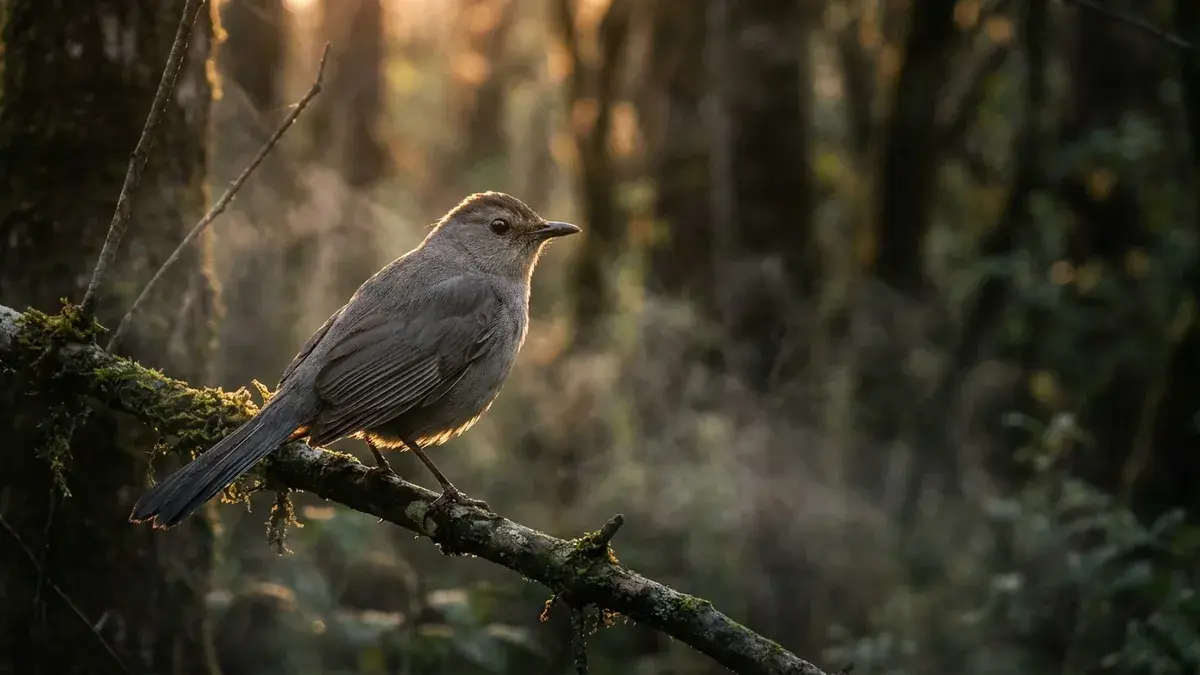
Honest, adaptable communication is the key to the Catbird's nature. If you look to a Catbird to guide you, you'll learn the importance of listening closely, speaking with intention, and staying curious without being nosy. Catbirds favor people with an ability to influence others, especially writers and speakers. They expect words to be spoken honestly and discourage exaggerated or manipulated language. The return of Catbirds to their nesting ground year after year also points to the importance of loyalty and feeling secure in familiar spaces.
An almanac
- Core message
- Treat your voice as something sacred
- Spirit animal
- Guides writers, speakers, and communicators
- Totem for
- Talkative, self-aware, welcoming homebodies
- Power animal
- Sharpens expression, cuts through gossip
- In dreams
- Joy and hope when singing; rising above troubles in flight
- Watch for
- Careless talk, exaggeration, or dishonesty
- Scientific name
- Dumetella carolinensis
- Folk expression
- "Catbird seat" = the seat of advantage
The Catbird has a cat-like cry, but it is actually plain and gray. It's a good communicator, even borrowing other birds' phrases to communicate. That's why it's a symbol of communication, adaptability, and curiosity.
Catbird Symbolism & Meaning
The catbird's odd, cat-like meow can give a false impression. What's more, unlike a feline meow, the catbird's meow is actually two sounds at once — a whistle over something else.
To see how this works, just listen closely. You'll probably hear the catbird layering its whistle over a chatter or a squeak or even over part of someone else's tune. (In addition to those distinct sounds all by itself, it can make up its own tunes by blending together bits of other birds' tunes.)
One reason why it likes to do that is its vocal organ (call it the syrinx if you want).
Catbirds build nests together each season with some staying through winter while others migrate to warmer climates — and always return to the same place year after year.
So you can say that loyalty and adaptability are important themes for the catbird.
Along with being very loyal and very adaptable, the catbird has developed several different skills that serve them well today: 1) keen perception; 2) quiet intelligence; 3) reflective habits; and 4) its knack for reading others
The name itself has interesting origins too: "Dumetella" is Latin meaning "small dweller of thorn bushes", which refers to where these birds live most often – inside thickets. The word “carolinensis” comes from Carolinas where this bird was first formally described
Catbird Spirit Animal
Catbird is a spirit animal for people who work with words. This might mean writers, speakers, singers, or anyone who influences others by the way they say things. Walking with this spirit animal, it's easy to see how people are listening to you more than they usually do. Be aware of the responsibility this might bring.
Catbird spirit has little patience for exaggeration or manipulation of the truth. It will withdraw if someone speaks carelessly.
One reason it may be calling to you now is that you've discovered a new way to express yourself. That could be in another language, or in a different mode of communication altogether.
When you're trying out something new, Catbird teaches attention and practice. Just get those basics right before you complicate things.
If you listen carefully, Catbird will also help keep your curiosity sharp. Be sure to ask questions — but don't cross into prying.
This spirit animal is there to remind us that we have many voices in our lives, bringing in different harmonies and song.
Does Catbird fit you?
Tap the ones that sound like you — 6 traits, no right answer.
0 of 6 Nothing picked yet — start tapping.
Catbird Totem Animal
People carrying catbird as a totem are often talkative, usually telling stories about themselves. These stories aren't filled with self-promotion; they're ways for the person to sort through their awareness and say it out loud, leaving room for others to reply. Catbird people also tend to have a gentle territorial side, especially when summer comes. They welcome friends and family in their homes but may react differently if a stranger knocks on the door. Women with this totem are often protective and watchful in cold weather.
For all catbird people, a meaningful step is finding a private mantra or inner song that unlocks something essential about who they are. This thing can be discovered through meditation or music or dreams. It's meant to stay private and is usually expressed through art, movement, or quiet rituals rather than through explanations to others.
In romantic relationships, those with catbird energy pursue partners who show off or put on a good show: bold gestures, playful displays, even outlandishness aimed at anyone willing to be entertained.
Catbird Power Animal
The Catbird is a great ally for increasing communication and language skills. Copying is part of learning, whether you're picking up a new skill or perfecting how you express yourself. The Catbird's talent for mimicking other animals' sounds promotes learning in this way.
The Catbird is also helpful when you want to get along with others, through humor or playful impressions.
When gossip or misinformation are muddling a situation, call on the Catbird's energy for separating fact from fiction, protecting against the harm that spreads when false stories take root.
Catbirds are especially valuable for newcomers who need to know your intentions right away as you welcome them into your circle.
Catbird Signs & Omens
A group of Catbirds means fruits are ready for picking.
A Catbird flying to your right means fortune is approaching. A Catbird flying to the left means you need to be careful starting anything new.
A calmed-down, singing catbird is a sign that good luck is coming. A quacking catbird instead means you should pay attention to where danger might be.
Catbird in Folklore
It's said that catbirds used to be ordinary gray cats that loved to hunt for small birds in low bushes. The birds grew tired of this and asked the gods for protection. As punishment, the cats were transformed into birds forevermore and were condemned to live their lives high in branches or amongst thickets. The only link they have left to their feline ancestors is the distinctive mewing call of the modern catbird.
Catbird in Dreams
Dreaming of a catbird has a range of potential meanings, but because the catbird isn't discussed often in dream lore, you can get good insight by interpreting bird dreams in general and using the catbird's specific behavior for extra detail. To fly in a dream is to soar above troubles.
Be careful if you're attacked in your dream; being attacked by birds indicates disappointment or people in your life pulling away from each other. A nest full of eggs suggests prosperity, while hatched eggs point to this same feeling just around the corner.
An empty nest or one that appears damaged or broken represents a need to reorganize and focus on security and stability. If you're hearing catbird songs from hidden places, it may be time to lower your own profile strategically.
Catbird Spiritual Meaning
Catbird teaches us that every sound carries its own meaning and that we should approach every utterance as something sacred and intended. This bird is highly loyal to its nesting ground season after season. It does this as a reminder that the path to true security lies in staying grounded in something simple and real. Catbirds greet new arrivals, including newcomers, with non-threatening curiosities. It's a reminder of a lesson we can all learn from the Catbird: speak with care and listen to people around us.
The Catbird Seat: An Old Idiom Rooted in This Bird's Habits
Long before we coined the term "spirit animal" to say it out loud, we had in our everyday language an expression that borrows directly from this bird's habits: to sit in the catbird seat means to hold the best possible position, the upper hand in a deal. The idiom's roots lie in this bird's behavior: When they're ready to sing, catbirds perch themselves on a high, secluded branch, and claim it as their own. This expression has been known since at least 1900, though it entered wider American vocabulary through the writings of humorist James Thurber and of baseball broadcaster Red Barber.
Spiritually speaking, the idiom fits neatly beside the rest of this bird's symbolism. Catbirds don't battle for supremacy; they merely perch themselves strategically. They perched atop the highest bough they could reach; or they chose a perch no one else was perching on. They're patient; they're attentive to timing; and they tend to know instinctively where those high points are. Carrying a catbird as a spirit animal can be a reminder that leading well comes from positioning yourself wisely.
Frequently Asked Questions
What does it mean when a Catbird visits your yard?
There are different ways to interpret a Catbird that visits your yard. One is to read it as a sign to pay attention to your own communication — to see if you're speaking honestly and listening carefully. Since Catbirds return to the same nesting spots yearly, repeated visits can be taken as a symbol of loyalty and stability, of finding comfort in familiar surroundings.
Is the Catbird a good or bad omen?
Most of the time a catbird is a good sign. A calm bird perched somewhere in view means something good is coming, but if it flies off to your left or makes the sound of a duck instead of its usual mew, be on your guard.
What is the spiritual meaning of a Catbird's call?
Its layered, mimicking call means flexibility, honesty, and the importance of your own voice. Because it can make two sounds at once and borrow from other birds' phrases, the call may remind you to communicate openly and honestly, and to listen to other people's views.
Why do people say someone is 'in the catbird seat'?
The idiom "in the catbird seat" means "in a position of great advantage or power." In fact, catbirds are used to singing from high and secluded perches. Red Barber brought the expression to life in his baseball broadcasts on the radio, and James Thurber made it famous with his story of the same name in 1942.
Is the Catbird related to mockingbirds?
Yes. The Catbird belongs to the Mimidae family of birds, along with mockingbirds and thrashers. All members of this family are known for weaving other animals' calls into their own songs. This hidden nature is reflected in the bird's scientific name, Dumetella carolinensis (from the Latin word for small dweller of thornbushes).
Catbird also represents
Sources
Claims on this page were checked against these published sources.
- Gray catbird
This species is named for its cat-like call.
Read the source → - Gray Catbird
Sometimes seems to mimic other birds.
Read the source → - Catbird seat
an enviable position, such as having the upper hand or greater advantage in any type of dealing among parties... it originated in the American South during the 20th century, with an early documented use appearing in the Columbia Daily Tribune on April 21, 1900... sitting in the catbird seat meant 'sitting pretty', like a batter with three balls and no strikes on him
Read the source →