Birds · Spirit animal
Starling Spiritual Meaning & Symbolism
Plain feathers that turn iridescent the moment the light is right: hidden brilliance, revealed.
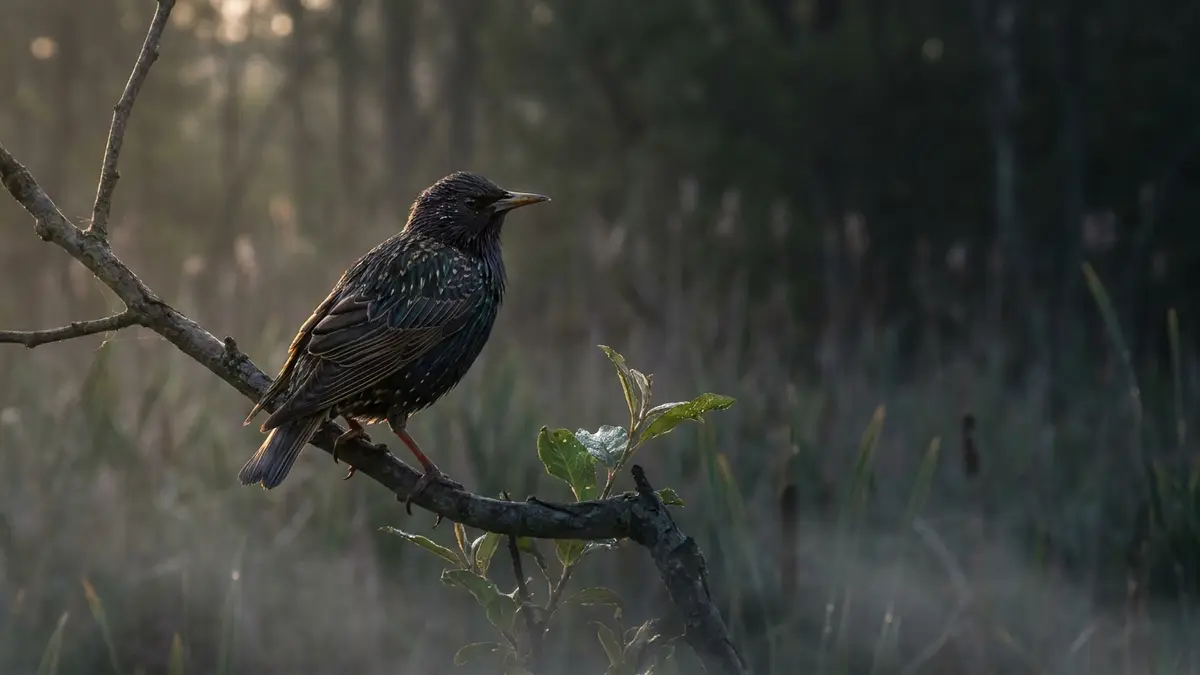
A Starling, appearing as a spirit animal, stands for hidden brilliance, flexibility, and the power of community: its plain dark feathers show iridescent shimmer when the light catches them just right. As a spirit animal, it urges you to uncover your true colors, speak candidly, and pick whom you let shape your thinking wisely. Most importantly, Starling makes it clear that belonging helps you come to terms with who you already are.
An almanac
- Core message
- Hidden radiance revealed through community
- Spirit animal
- Choose your circle, speak your truth
- Totem for
- Natural mediators and social connectors
- Power animal
- Finding your authentic voice
- In dreams
- Flight signals abundance; nesting alone warns of broken promises
- Cultural roots
- Celtic (Welsh "drudwen"), messenger in the Mabinogion
- Name origin
- Old English 'stær', echoing the bird's own call
A starling looks plain dark until sunlight catches its plumage, then it's splashed with shimmering greens and purples like another creature's entirely. Starlings were introduced to North America from Europe in 1890 by a Shakespeare fan, so the story goes. They spread across the continent because of their social ways, which symbolize belonging, voice, and hidden brilliance.
Starling Symbolism & Meaning
Starlings aren't native to the United States. As one story goes, someone released a few of them in New York's Central Park in 1890 so there would be a bird of every kind mentioned by Shakespeare. (Some scholars doubt this because the Shakespeare motive wasn't recorded until decades after the release.) Whatever the reason, the population exploded and spread from warm coasts.
That's already symbolic: a foreign creature thriving in new lands. And that's just the beginning.
Starlings are also an impressive symbol of collective strength. They migrate together in murmurations and roost together in huge numbers.
Starling Spirit Animal
When starlings land in your life, they're advising you to question who you're spending time with. Company is great, and you need other people in your life, but everyone in it doesn't deserve equal consideration.
Be selective about what you let influence you. Spend your time with people who bring you up, rather than pulling you down. Enjoy your social group, but don't let it shape your way of thinking.
Starlings teach the art of being firm but fair. This balance is necessary to create harmony in relationships. Be clear when talking to others about how you feel.
Take a moment to yourself before having important conversations. Sit quietly with starlings. Plan ahead so that you say what needs to be said and express yourself clearly.
Starlings are imitative. They won't warn you from becoming someone other than yourself as long as it's a natural extension of what they see in your natural disposition. When it goes too far, starlings will step in and remind you of who you are.
Does Starling fit you?
Tap the ones that sound like you — 6 traits, no right answer.
0 of 6 Nothing picked yet — start tapping.
Starling Totem Animal
Carrying Starling as a birth totem teaches you to be a natural mediator and guide. When you're with others, you're sensitive to the energy in the room. You read the current of what people feel and know instinctively what it means. You're good at sensing that, because people don't always express themselves well.
When you have a meeting or get together, adjust your delivery. This helps everyone understand you better. Sometimes, it might mean that you have to work on telling things in different ways until people understand.
Being Starling means you care about family bonds and social reputation. It's wise to pay attention to what you say and how you say things. If there's conflict, Starling medicine can push you towards confrontation. This might bring trouble later.
Solitude doesn't fit well with the Starling birth totem because Starlings enjoy company. They're meant for it! If you go without contact for too long, loneliness or low spirits can happen.
Starling Power Animal
Call on the starling when you feel lost or misunderstood, or when you are concerned about coming across as authentic. This bird medicine encourages you to step back from a situation, so that you can look at it from a fresh, distant perspective. Then, return to that perspective with renewed objectivity.
Starlings can also be allies in finding your true voice. Starling medicine helps you to find the energy at your core, which often takes the form of a quiet hum. Starlings encourage you to lean in towards this hum—only then will you be able to find the confidence and honesty needed to say what's true in your heart.
Starling as a Celtic Animal Symbol
In a fragmentary story in the Mabinogion, Branwen was given in marriage to a king of Ireland as part of a peace treaty. She soon found herself degraded in her husband's home and reduced to doing only kitchen labor.
Branwen sent the bird to her brother Bran with messages about her captivity. King Bran used the bird's flight to lead his armies over to Ireland, save his sister from humiliation, and bring her back home — a stirring little tale that makes Starling out to be rescuer.
Starling in Dreams
Any interpretation of a dream with starlings will depend on what the starlings are doing:
If you dream of starlings in flight, they may signal that you should be patient; things may not feel great in the present, but things are already looking up. Seeing a starling on its nest could be a sign to watch out for those who promise but don't deliver. This can be important for relationships, both romantic or personal, where you want to know that people are behaving as well as they say they do. If you dream of an injured or hurt starling, there is likely something in your life which is causing pain and isn't properly resolved. Seeing a bird on the roof means someone has solved a problem they've been having, which should provide good news for you and other people affected by the problem. If a starling visits your home it could mean new people will be arriving soon and new relationships developing with them. If a starling flies into your house this might mean someone new coming into your life - especially if it's romantic - and being interested in them.
Starling Spiritual Meaning
Plain feathers, luminous message — Starling's whole teaching is about hidden radiance. What looks unremarkable at a distance turns luminous the moment the right light finds it, and that's exactly the invitation this bird extends to you: reveal the color you've been keeping tucked away.
Its second, equally strong message is that belonging brings out more of who you already are. Speak honestly, choose your circle with care, and let the group carry you the way a flock carries every single bird within it, together, coordinated, and briefly luminous against the sky.
Starling & the Composer Who Loved One
Not everyone ignored the message Starling brought. In 1784, Wolfgang Amadeus Mozart bought a Starling from a shop in Vienna and recorded its cost in his expenses. He also made a transcription of the tune it repeated to him, a melody nearly identical to the opening of his Piano Concerto No. 17. Maybe the bird had heard him playing, or maybe Mozart cajoled it into singing that one phrase to him. Either way, their private music session lasted for three years.
When Starling died in June 1787, Mozart put together an extravagant funeral procession with veiled mourners chanting in step behind the tiny coffin. He even performed a reading of an elegy he'd composed for it, which was part heartfelt tribute and part joking sympathy.
If Starling finds you and stays awhile, remember that it's meant to be repeating the melody you didn't even know you had.
The Science Behind a Murmuration
Long before researchers studied murmurations, they looked like sorcery. Thousands of birds seemed to bend and pour through the sky like a single living creature, with no apparent leader. Scientists found out what was really happening: each bird watches the ones around it and reacts in an instant to their speed and direction. The birds' awareness of each other ripples across the whole flock with the result that the whole thing turns as one.
Groups of Starlings can be huge: more than a million have been seen over Denmark at once. One theory about this is that it's a way to make it harder for predators, like peregrine falcons, to catch them.
The birds don't just swoop in formation. They change shape and twist. It's so strange to see that it feels almost magic.
Frequently Asked Questions
What does Starling symbolize spiritually?
The starling has several symbolic associations, particularly with hidden brilliance, adaptability, and the strength that comes from community. This bird has highly colorful feathers that can change hues, suggesting that everyone has a vibrant side that only those closest to them might see.
What does it mean when Starling is your spirit animal?
If you often see starlings, it signals a need to assess the way other people think and the influence they have on you. It also suggests that you should make it clearer how you feel. Starlings can indicate that you are imitating others too much and losing your own identity as a result.
What does it mean to dream about a Starling?
A flying starling means something good is coming. By itself on a nest, it means a promise will be broken. A wounded starling may mean unresolved hurt. If a starling comes to your door or home, new visitors or romance is on the way.
What is a group of Starlings called?
A murmuration is a term used for a group of Starlings flying in formation. These birds often gather in massive groups that can exceed one million. The spring migration over Denmark provides some of the most spectacular displays, when the sky turns into one unified, shifting shape.
Why do Starlings gather in such enormous flocks?
The main reason why starlings form such huge flocks is protection. It's much harder for predators, like peregrine falcons, to pick out one single target from the middle of a moving crowd of birds. Spiritually, this teaches that strength comes from community, not from isolating yourself.
Starling also represents
Sources
Claims on this page were checked against these published sources.
- Common Starling
About 60 common starlings were released in 1890 into New York's Central Park by Eugene Schieffelin, president of the American Acclimatization Society. It has been widely reported that he had tried to introduce every bird species mentioned in the works of William Shakespeare into North America... [this] has been traced to an essay in 1948 by naturalist Edwin Way Teale, whose notes appear to indicate that it was speculation.
Read the source → - Branwen
She tames a starling and sends it across the Irish Sea with a message to her brother and Brân brings a force from Wales to Ireland to rescue her. ... Branwen is treated cruelly by her husband Matholwch... banished to work in the kitchens.
Read the source → - Mozart's starling
27 May 1784
Read the source →