Insects · Spirit animal
Cicada Spiritual Meaning & Symbolism
A patient underground dweller that spends years out of sight before its sudden, thunderous song announces rebirth, perfect timing, and a voice finally found.
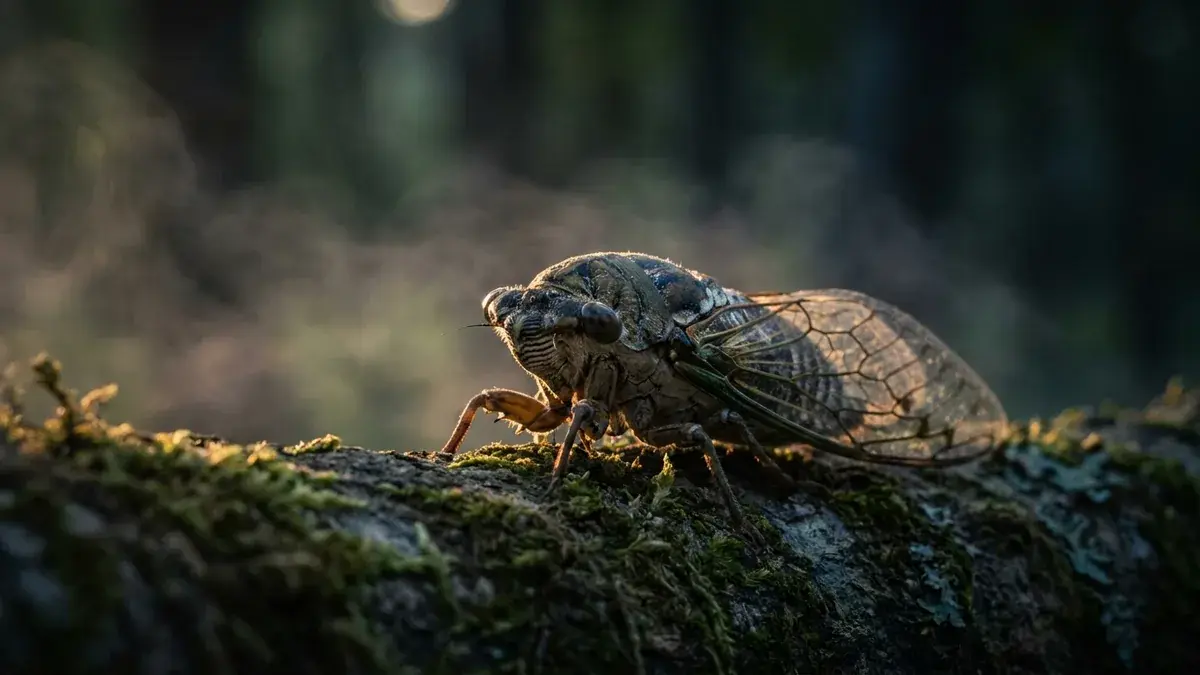
Cicada arrives as a sign that a time of change is over. If you've kept something hidden, a project, a truth, or your fullest self, it's time to make it known. Cicada stays underground for years before appearing with a loud song, and that history gives it themes of patience, good timing, and rebirth. Cicada suggests letting go of an old identity and finding your own voice.
An almanac
- Core message
- Trust your timing, shed the old, find your voice
- Spirit animal
- Molting an outdated identity
- Totem for
- Expressive, sound-sensitive, community-loving people
- Power animal
- Balancing caution with openness
- In dreams
- A challenge met with resourcefulness
- Cultural roots
- Greek myth, Hopi tradition, Chinese jade burial custom
- Biological clock
- Some broods (Magicicada) emerge every 13 or 17 years
- Greek myth
- Tithonus — immortal, but never young again
A cicada nymph spends many years buried underground before turning into a full-fledged insect and bursting out into the world with a loud, beautiful song. That makes cicadas a symbol of patience and the perfect timing you need to do something new. Their call comes from special membranes near their breathing organs. People all over the world have been fascinated by cicadas for a long time — even in the ancient Greek and Chinese civilizations. This page is about what it means to have a cicada as your spirit guide, totem, or power animal — and also about what it means in dreams and astrology.
Cicada Symbolism & Meaning
So why is the cicada a symbol of finding your true voice?
The cicada is a tiny insect that never gets to be much bigger than two inches long. Somehow that insect is able to make one of the loudest noises in the whole insect world by pushing air through membranes located near its breathing organs!
Cicada has been around for more than 200 million years. As a result it can be found anywhere on Earth that has seasons and where the weather will become tropical at some point. One of its most amazing talents is patience! The nymph remains underground for one year to nearly twenty years before it makes its way out. For this reason it is associated with immortality, resurrection, and perfect timing.
Aristotle called it one of his animals on display in History of Animals. In parts of Africa, instruments were created so they could replicate the song of Cicada.
Cicada Spirit Animal
If the cicada is a spirit animal for you, that means it’s time to let light in. Maybe there’s something you have been keeping in darkness, like a project or a truth or some part of yourself. Or maybe it’s time to let go of an old way of doing things and trust your gut as you find a new form for yourself.
Maybe you’re waking up to the kind of change that comes with transformation. That might make this change process tough and uncomfortable at first, because it requires you to be honest with yourself.
Meanwhile, this may be an invitation to use your voice. Maybe you’ve been living your life as if you’re playing to some other drummer’s beat instead of your own.
All of this might encourage you to listen inward and trust your inner guidance when making big decisions in your life. It may also ask you to follow more natural rhythms in your life.
Does Cicada fit you?
Tap the ones that sound like you — 6 traits, no right answer.
0 of 6 Nothing picked yet — start tapping.
Cicada Totem Animal
The Cicada is famous for being deafeningly loud. If you choose the Cicada as your totem animal, then you'll want to learn from this. It's a sign that you'll be making a lot of noise in your life, and it's fine for others to miss your cue sometimes. Sound matters to you: many people are different from you in that they tune out from their environment, or they tune out even their own inner voices. But not you! You'd rather not miss anything.
If you have a partner, the warmer months should be your high season. Romance and connection come easier in warm months. You love them; enjoy it! If you're not partnered but want to be, don't give up hope just because the weather's cold. Warm weather will usually make you feel happier overall than winter will.
Did you know that Cicadas spend a lot of their life underground? To recharge and come back better after "hibernating". The underground time doesn't mean they aren't alive: it just means they need personal growth before going back outside to spread their light.
Also remember: you love being part of groups — especially creative groups or any performance that works better with many people involved.
Cicada Power Animal
Working with Cicada can help you find the right balance between being cautious and being open. This ally teaches you the importance of protecting yourself, but also helps you to tell whether danger is real or just a fear in your mind.
Cicada's empathy lets you feel comfortable guarding yourself from danger while keeping your boundaries clear. The walls that we build often come from not understanding something, not true danger.
Cicada helps you to see that and take down some of these unnecessary walls. When this power animal is around, you know you're defending yourself from something real and what's safe to lower your guard about.
Across cultures
2 traditions — pick one to read its take.
Cicada in Native American Symbolism
The Hopi tribe of Oraibi, in Arizona, had a high opinion of the cicada: they saw it as an insect that re-emerged from the ground after a long underground wait. This is like the resurrection of humans who vanish in this world to return as something new and songful.
Other cultures thought the same way about the cicada, who sometimes seems to vanish but then comes back in a different form. For tribes with cycles of celebration and ritual, an insect whose whole existence depends on vanishing and reappearing is natural to use as a symbol in ceremonies and stories.
In other parts of North America, the Iroquois made their own kind of relationship with cicadas. One happens just once every seventeen years, when a whole group called a brood comes out from underground. Onondaga, a Haudenosaunee gave it their own name and ate it as a special treat at that time. The way Native people thought about cicadas was not all the same: some thought about how they disappeared but came back again, like resurrection; others just celebrated their arrival from time to time.
Cicada in Far Eastern Symbolism
In East Asia, especially in China, cicada carries rich symbolism. The image of this beautiful insect appeared in many traditional burial customs, meant to support the deceased on their journey into the next life. Cicada was often represented in a carving of jade and placed over the dead's tongue, an important part of a set of jade plugs that acted as protection against decay and would seal other body openings during the burial process. This protection was thought to be given through contact by the purity and immortality of jade and would secure the spirit's ability to rise out of the earth toward resurrection.
Cicada symbolism is connected to themes of rebirth, immortality, abundance, and nature's cycle of growth and death which also includes harvest and fertility themes. In daily life, jade carved cicadas were used as decorations or charms — clasps or toggles that might be worn on a robe or belt acting as a simple yet potent talisman against gossip and slander but also to invite a long healthy life.
The most significant impact comes from Feng Shui practice with images or figurines of Cicada placed throughout one's home as they guard against these things while invoking hope for long healthy years ahead.
Cicada in Dreams
If a cicada shows up in your dreams, it often signals that you'll need to apply resourcefulness rather than force to tackle the challenges ahead of you. If you or someone close to you has been ill lately, this dream may also mean that healing is on the way. And although you won't go back to being exactly the same person after the illness, at least you'll be on the road to recovery. You might see cicadas in these situations and others:
• A chorus of singing cicadas often means that someone will recognize your effort and offer praise for your accomplishments. • If a cicada is emerging from the ground, it probably signals a change in course — perhaps you've now found your footing, and now it's time to move forward. • You may see a cicada moving toward you as a sign that welcome news is on its way. • You're very likely to see a cicada if you're feeling under the weather and in need of recovery. It might mean that your illness has reached its turning point toward healing, and things are about to start getting better.
Cicada in Astrology & Zodiac
Cicada holds no fixed seat in traditional Western zodiac teachings, but its themes translate well into astrological language. The arrival of this insect during warm months links it to the energy of the sun, or fiery action; likewise, those with this spirit are typically bold on the stage like fire signs.
It's underground wait of years before a single, decisive appearance mirrors the patient approach of earth signs. Finally, Cicada's powerful song is in line with Air sign's spoken communication. Those who identify with Cicada find encouragement in learning to trust their timing. Some seasons call for quiet while others call for bigger steps into voice.
Cicada Spiritual Meaning
A cicada's song calls you to honor your own timing. It asks you to honor the very heart of who you are, even when you're not sure what that means. A long time spent dormant or out of sight isn't wasted time: it's a preparation for emergence and the song that makes the world listen.
The cicada reminds you to shed what doesn't serve you and to find that loud, strong voice that's always been there, waiting. And yes: it means shedding your old stories about who you are, and releasing any old fears of what you might be capable of.
When the cicada finds its way to you--when you hear its song--it's confirmation that your own season of dormancy is ending. It's a call: a call to step out into the light. To release any shame or fear of being seen. Because when cicadas emerge after years in the ground, nobody can ignore them.
Cicada in Greek Mythology: The Tithonus Myth
Long before Aristotle catalogued Cicada or Plato imagined it singing for the Muses, an older and darker Greek story explained where the insect came from. Eos, goddess of the dawn, fell for the mortal Tithonus and begged Zeus to make him immortal — but she forgot to ask for eternal youth alongside it. Tithonus aged and withered without ever being allowed to die, and in the version preserved through the Homeric Hymn to Aphrodite, he eventually shrank and shriveled until he became the very first cicada, forever singing but never released.
That myth reframes Cicada's immortality as a double-edged gift rather than a purely joyful state — a reminder that lasting doesn't always mean thriving, and that some cycles need an ending to stay meaningful. The Greeks softened the story elsewhere: a cicada perched on a harp became their emblem for music itself, linking the insect's endless call to art and devotion rather than decline.
If Tithonus's fate speaks to you, read it as Cicada's quieter warning alongside its usual message of rebirth: chase renewal, not endurance for its own sake.
The 13- and 17-Year Broods: Nature's Long Countdown
The eastern United States is home to periodical cicadas that live for exactly 13 or 17 years before bursting out en masse. Huge numbers emerge at once, living just four to six weeks and then dying. Scientists keep track of these synchronized populations by numbering them, and they estimate that one acre of land can be covered with a million or more cicadas in the same span.
These odd entomological facts give cicadas an apt symbolism of timing. Unlike many creatures that appear as soon as they're able, Magicicadas live according to a schedule: if a full cycle isn't complete, they'll wait patiently beneath the earth for the count to finish before finally rising together. Appropriately enough, this means borrowing from cicadas their discipline: certain transformations won't bear fruit if rushed, and the only reward worth waiting for is their communal chorus.
Frequently Asked Questions
What does it mean when a cicada shows up around you?
Cicadas usually show up when a season of waiting is ending, so you can think of it as a reminder that something you’ve kept hidden — a project, a truth, a change — is ready to surface.
Is Cicada considered a good omen or a bad one?
Cicada is an omen of rebirth and renewal in most traditions. For example, in the Hopi Oraibi, cicada is a protective presence instead of a warning. In Chinese custom, cicada was buried with jade for hope and protection.
What does it mean to dream about a cicada?
If you are having dreams with cicadas, it usually means you're facing a challenge that you can handle easily, especially one that will earn you gratitude. Cicadas also symbolize awakening, and possibly recovery, so if you were ill in your dream, it can mean a sudden turn toward better health.
Does cicada symbolism carry meaning in Japanese culture too?
Yes, cicadas also play an important role in Japanese symbolism.
Cicadas are strongly associated with summer. Depending on the species, different cicadas emerge to sing in spring or autumn. In this way, they can be thought of as a kind of seasonal harbinger. They're such a common symbol in poetry and everyday language.
Perhaps because their adult stage is such a loud and brief stage of life after years of hidden existence, many Japanese take cicadas to be a symbol of transience. Yet this reading doesn't completely replace the rebirth and voice symbolism of the Greeks and Chinese; instead, all these elements coexist as layers.
What does it mean to find an empty cicada shell?
It's generally a good sign. Most people think of cicadas as insects that molt from a softer skin, leaving a papery exoskeleton behind. That's what they do — and what it means if you find an intact, still-papery shell is that the cicada has fully transformed, moved on to the next phase of its life and become stronger. When people talk about this as the meaning of an empty cicada shell, they're typically thinking about their own lives. The point is to let go of something you've outgrown so that you too can move on in a stronger form.
What does a black cicada mean spiritually?
When you see a black or unusually dark cicada, it's often a message to do some shadow work. This means facing a fear, a secret, or an unresolved feeling that you've kept out of sight. This may be the opposite of what you expect from cicadas, which are often associated with a celebration or rebirth. But this particular type of cicada wants to invite you to sit with what you've been avoiding and then expect your own next emergence.
Cicada also represents
- Other animals that represent death →Alongside Raven, Crow, Buzzard & Vulture, Owl
- Other animals that represent rebirth and change →Alongside Butterfly, Snake, Dragonfly, Frog
- Other animals that represent patience →Alongside Turtle, Heron, Spider, Ant
- Other animals that represent intuition →Alongside Owl, Cat, Wolf, Raven
Sources
Claims on this page were checked against these published sources.
- Cicada
The 'singing' of male cicadas is produced principally...using a special structure called a tymbal ... The male abdomen in some species is largely hollow, and acts as a sound box. Sounds are among the loudest of all insect-produced sounds, up to 120 dB (SPL).
Read the source → - Phaedrus (Project Gutenberg / Jowett translation)
And the grasshoppers who are chirruping around may carry our words to the Muses, who are their patronesses; for the grasshoppers were human beings themselves in a world before the Muses, and when the Muses came they died of hunger for the love of song.
Read the source → - Tithonus
she forgot to ask that he be granted eternal youth ... he eventually became a cicada (tettix), eternally living, but begging for death to overcome him
Read the source → - Periodical cicadas
Magicicada species spend around 99.5% of their lives underground in an immature state called a nymph ... The adults are active for only about four to six weeks ... sometimes more than 1.5 million individuals per acre.
Read the source → - Cicada
Cicadas, like this light green piece, were the favored burial jade of the Han dynasty. These were placed on the tongue of the deceased ... The cicada was a symbol of transformation and resurrection because of its life cycle... By placing these pieces in the mouth or near the body, it may have been believed that they would confer the properties and virtues of permanence and purity to the deceased.
Read the source →