Animal Facts
Ferret Facts & Trivia: Not a Rodent, Long Domesticated
A carnivore domesticated for millennia, still mistaken for a rodent.
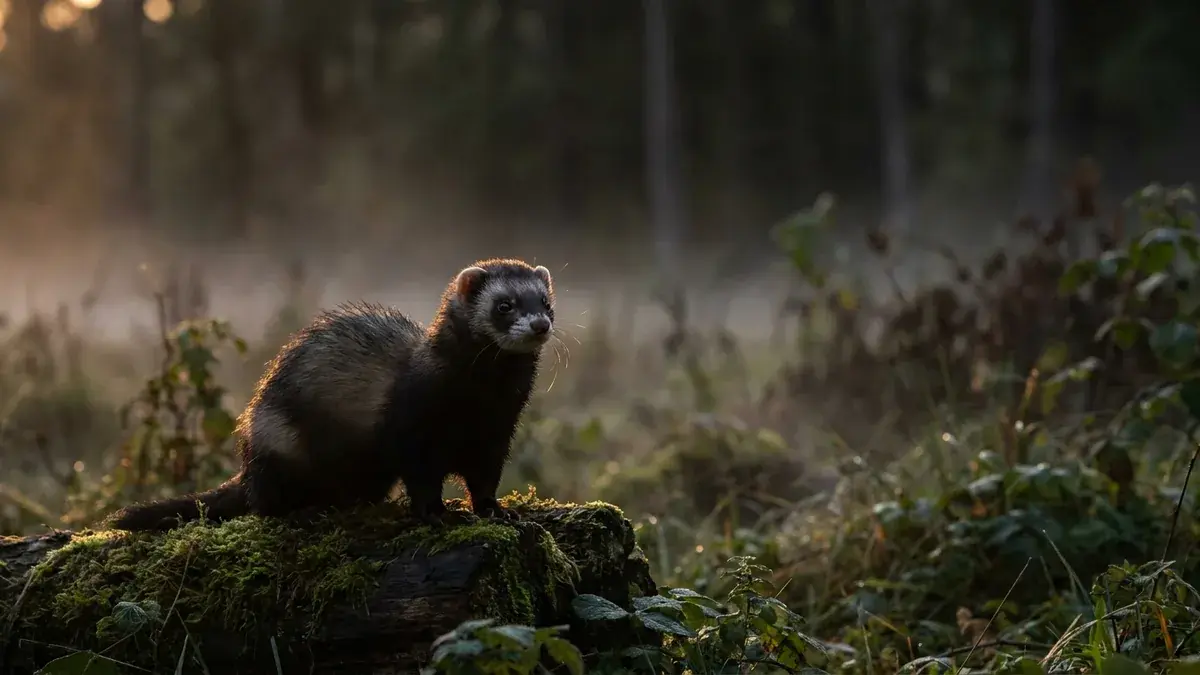
A ferret is not a rodent. It is a mustelid — a carnivore related to weasels, otters and badgers — and it has been domesticated for thousands of years, not tamed recently from wild polecats. It also is not colourblind.
An almanac
- Lifespan
- Pet ferret: typically 6-10 years (MSD Veterinary Manual). Wild black-footed ferret: few live beyond 3-4 years (Smithsonian's National Zoo).
- Size
- Pet ferret: hob (male) up to 2 kg / 4 lb, jill (female) up to 1.2 kg / 2.5 lb. Black-footed ferret: 46-61 cm (18-24 in) including a 13-15 cm tail, 0.7-1.1 kg.
- Diet
- Obligate carnivore - no caecum, no ileocolic valve, gut transit 3-4 hours, cannot digest fibre. Black-footed ferrets take 90% of their diet from prairie dogs.
- Range
- Domestic ferret: worldwide as a pet, banned only in California and Hawaii; invasive in New Zealand since the 1880s. Black-footed ferret: 28 reintroduction sites across Wyoming, South Dakota, Montana, Arizona, Colorado, Utah, Kansas, New Mexico, Canada and Mexico.
- Conservation status
- Domestic ferret: a domesticated animal, not assessed. Black-footed ferret: "widely considered the most endangered mammal in North America" (Colorado Parks and Wildlife).
- Sleep
- 18-20 hours a day for a healthy pet ferret; up to 21 hours a day for black-footed ferrets, which surface for only a few minutes daily.
- Standout number
- 8 - the number of wild individuals every black-footed ferret born before the cloning programme descends from.
The single most common thing said about ferrets is wrong: they are not rodents. A ferret is a mustelid, in the same family as weasels, otters, martens and badgers, and it is an obligate carnivore — as far from a hamster as a cat is.
The second most common claim is that pet ferrets are barely-tamed wild animals. They have in fact been domesticated for thousands of years, which is longer than some livestock.
Below, with sources — including what a ferret can actually see.
Ferret Facts Worth Knowing
- Domestic ferrets descend from the European polecat, and there is evidence of domestic ferrets in Europe more than 2,500 years ago. The 'ancient Egyptians kept ferrets' line gets repeated constantly. The documented evidence the University of Michigan's Animal Diversity Web actually cites is European and over 2,500 years old, and the wild ancestor named is the European polecat (Mustela putorius) - not an African or Egyptian animal.
- Food passes through a ferret from mouth to exit in about 3 to 4 hours.
- A female ferret that comes into heat and is neither bred nor spayed can die of estrogen-induced anaemia - her own hormones suppress her bone marrow.
- A healthy pet ferret sleeps 18 to 20 hours a day.
- The chuckling 'dook' noise ferrets make has been formally written into a scientific ethogram as a marker of positive welfare, published in Scientific Reports in 2024.
- Exactly two US states - California and Hawaii - ban importing or keeping a pet ferret.
- The virus that causes human influenza was first isolated in 1933, in ferrets, by Wilson Smith, Christopher Andrewes and Patrick Laidlaw in England.
- The ferret genome was published in Nature Biotechnology in 2014: a 2.41-gigabase draft assembly with 19,910 annotated protein-coding genes.
- Ferrets are susceptible to SARS-CoV-2, unlike dogs, pigs, chickens and ducks, according to a 2020 study in Science. The same study found airborne transmission between animals in cats, not ferrets. 'Ferrets catch COVID' is right; 'ferrets spread COVID through the air like cats' is not what the paper showed.
- The wild black-footed ferret of the American Great Plains gets 90 percent of its diet from a single prey animal: prairie dogs.
- One black-footed ferret eats roughly 100 prairie dogs a year.
- A black-footed ferret typically spends only a few minutes above ground per day, in the hours just after sunrise.
- The last 18 wild black-footed ferrets on Earth were caught between 1985 and 1987 to start a captive breeding centre in Wyoming.
- Every black-footed ferret alive before the cloning programme traced back to just 8 wild founders. The famous number is 18 - the animals physically captured. But not all of them bred, so the actual genetic base of the entire species is 8 individuals (some sources put the effective figure at 7). That bottleneck, not the head-count, is why cloning frozen 1980s tissue mattered.
- Ferrets were deliberately released into New Zealand in the 1880s to control rabbits, and now prey on kiwi, weka, penguins and albatross chicks.
- Between 2013 and 2015, 14 agencies field-tested a peanut-butter-flavoured oral plague vaccine bait across seven western US states to protect prairie dogs - and therefore black-footed ferrets.
What People Get Wrong About Ferrets
“Ferrets are rodents - basically a long rat, or a weasel-shaped hamster.” Ferrets are carnivorans in the family Mustelidae, alongside otters, badgers, stoats and mink. They are obligate carnivores with no caecum and no ileocolic valve, meaning they cannot ferment plant fibre at all - the opposite of rodent digestion. On the Animal Diversity Web classification, the domestic ferret sits in Order Carnivora, Family Mustelidae.
“Escaped pet ferrets go feral and wipe out native wildlife across the United States - which is why California outlaws them.” A 2022 review published in California's own state wildlife journal surveyed US state agencies and found no current feral ferret breeding population anywhere in the country. The only breeding population any agency reported was historic, on Washington's San Juan Islands. New Zealand really did suffer an ecological disaster from ferrets, but that followed a deliberate mass release of thousands of animals into rabbit country in the 1880s, not pets slipping out of a cage.
“Ferrets, like other mustelids, can pause a pregnancy - delayed implantation, or embryonic diapause.” They can't, and they don't. Diapause is famously common in mustelids (mink, stoats, badgers), but ferret pregnancy runs straight through at about 41 to 42 days. The weird part: ferret embryos transferred into a mink's uterus DO enter diapause. The machinery is there; the ferret simply never switches it on.
“Ferrets are colourblind and see the world in black and white.” Ferrets are dichromats - two working cone classes, not zero. Electroretinogram work published in Visual Neuroscience put the short-wavelength cone peak at 430 nm and the long-wavelength cone peak at 558 nm, with rods at 505 nm. Their colour world is narrower than ours, roughly like human red-green colourblindness, but it is not monochrome.
“A pet ferret is a semi-wild animal, only a generation or two removed from a wild polecat.” The domestic ferret has been under selective captive breeding for over two thousand years - a longer domestication record than the domestic cat's archaeological trail in Europe. It is a domesticated animal that happens to look wild, not a wild animal that happens to be tame.
In Culture
The most-watched ferret in cinema is not billed as one. In The Big Lebowski (1998) the nihilists drop what the Dude calls a "marmot" into his bathtub - the script did call for a marmot, but real marmots proved too big, a ferret was cast instead, and the line was left alone on the reasoning that the Dude wouldn't know the difference. The Beastmaster (1982) built its emotional core around Kodo and Podo, two ferret sidekicks played by a rotation of roughly twenty animals under American Humane supervision, and is widely credited with the ferret pet boom that followed. Along Came Polly (2004) gave Jennifer Aniston's character Rodolfo, a blind ferret who keeps walking into furniture. Harry Potter and the Goblet of Fire turned Draco Malfoy into "the amazing bouncing ferret" - a white ferret bounced through the air by a disguised Mad-Eye Moody (novel 2000, film 2005), and the nickname followed the character for the rest of the series. Games have Furret, the long-bodied Normal-type introduced with Pokemon Gold and Silver in Japan in November 1999 and still a fixture of Pokemon meme culture. And ferret-legging, the Yorkshire pub endurance contest in which men put live ferrets down their trousers, resurfaces online every few years to general disbelief.
Notable Individuals
Willa was a wild black-footed ferret from Meeteetse, Wyoming, who died in 1988; her cells were frozen at San Diego Zoo Wildlife Alliance's Frozen Zoo. From them came Elizabeth Ann, born 10 December 2020, the first US endangered species ever cloned, and then Antonia, born 2023 at the Smithsonian Conservation Biology Institute. In 2024 Antonia produced kits named Sibert and Red Cloud - the first offspring ever born to a cloned US endangered animal. Earlier and stranger: Felicia, a ferret bought for about $35 and put to work around 1971 at the National Accelerator Laboratory (now Fermilab), dragging cleaning swabs through the vacuum pipes of a particle accelerator. She wore a nappy on the job, went down the tube "without hesitation," and was eventually pensioned off as laboratory mascot when engineers built a mechanical replacement they nicknamed the "magnetic ferret."
Frequently Asked Questions
Are ferrets rodents?
Ferrets are carnivorans in the family Mustelidae, alongside otters, badgers, stoats and mink. They are obligate carnivores with no caecum and no ileocolic valve, meaning they cannot ferment plant fibre at all - the opposite of rodent digestion. On the Animal Diversity Web classification, the domestic ferret sits in Order Carnivora, Family Mustelidae.
Do escaped pet ferrets go feral and destroy wildlife?
A 2022 review published in California's own state wildlife journal surveyed US state agencies and found no current feral ferret breeding population anywhere in the country. The only breeding population any agency reported was historic, on Washington's San Juan Islands. New Zealand really did suffer an ecological disaster from ferrets, but that followed a deliberate mass release of thousands of animals into rabbit country in the 1880s, not pets slipping out of a cage.
Can a ferret pause its pregnancy?
They can't, and they don't. Diapause is famously common in mustelids (mink, stoats, badgers), but ferret pregnancy runs straight through at about 41 to 42 days. The weird part: ferret embryos transferred into a mink's uterus DO enter diapause. The machinery is there; the ferret simply never switches it on.
Are ferrets colourblind?
Ferrets are dichromats - two working cone classes, not zero. Electroretinogram work published in Visual Neuroscience put the short-wavelength cone peak at 430 nm and the long-wavelength cone peak at 558 nm, with rods at 505 nm. Their colour world is narrower than ours, roughly like human red-green colourblindness, but it is not monochrome.
Are pet ferrets basically wild polecats?
The domestic ferret has been under selective captive breeding for over two thousand years - a longer domestication record than the domestic cat's archaeological trail in Europe. It is a domesticated animal that happens to look wild, not a wild animal that happens to be tame.
More about the Ferret
More from Animal Facts
Sources
Claims on this page were checked against these published sources.
- Mustela putorius furo (domestic ferret)
There is evidence of domestic ferrets in Europe over 2500 years ago.
Read the source → - Ferret care and husbandry
The gastrointestinal (GI) transit time is rapid (3 to 4 hours)
Read the source → - Behavioral assessment of well-being in the naïve laboratory ferret (Mustela putorius furo)
the dook vocalization has been described as an indicator of elevated mood, excitement, and/or positive welfare state
Read the source → - Impacts of domesticated ferrets upon wildlife, agriculture, and human health in the USA
Only two states (California and Hawaii) ban importation and possession.
Read the source → - Animal models for influenza virus transmission studies: A historical perspective
Wilson Smith, Christoper H. Andrewes, and Patrick P. Laidlaw first isolated the virus causing human influenza during an epidemic in England in early 1933
Read the source → - The draft genome sequence of the ferret (Mustela putorius furo) facilitates study of human respiratory disease
Here we describe the 2.41 Gb draft genome assembly of the domestic ferret, constituting 2.28 Gb of sequence plus gaps.
Read the source → - Susceptibility of ferrets, cats, dogs, and other domesticated animals to SARS-coronavirus 2
We found that SARS-CoV-2 replicates poorly in dogs, pigs, chickens, and ducks, but ferrets and cats are permissive to infection.
Read the source → - Black-footed ferret
In the wild, 90 percent of black-footed ferrets' diet is prairie dogs.
Read the source → - Black-footed Ferret: Rebounding in the Badlands
One Black-Footed Ferret can easily eat around 100 prairie dogs a year
Read the source → - Black-Footed Ferret
8 - The number of wild black-footed ferrets that all ferrets were descended from prior to the cloning program
Read the source → - Ferrets: New Zealand animal pests
Ferrets were introduced to New Zealand from Europe in the 1880s, along with stoats and weasels, to control rabbits that were breeding out of control.
Read the source → - Plague vaccine helps reduce outbreaks in prairie dog colonies
From 2013 to 2015, a consortium of 14 federal, state, tribal and non-governmental agencies worked together to field test the plague vaccine in all four prairie dog species present across seven western states, including Arizona, Colorado, Montana, South Dakota, Texas, Utah and Wyoming.
Read the source →
Not sure which animal is yours?
Consult the quiz