Animal Facts
Flamingo Facts: Six Species, One Leg, Borrowed Pink
A flamingo cadaver holds the one-legged pose with no muscles; two legs, it can't.
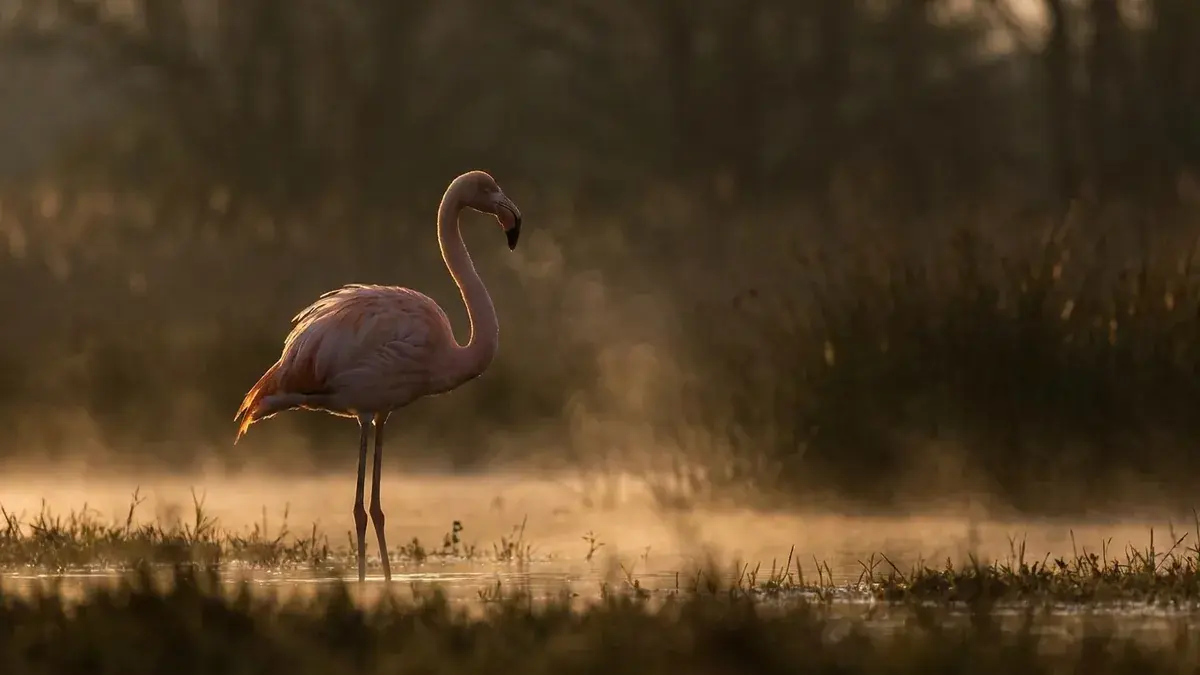
There are six flamingo species — greater, lesser, Chilean, American (Caribbean), Andean and James's — and none of them is born pink: chicks hatch grey or white and take two to three years to colour up on carotenoids from algae and brine shrimp. A pair lays one egg a season on a mud mound shaped like a miniature volcano and incubates it for about 28 days, and the Smithsonian's National Zoo gives American flamingos a lifespan of about 40-60 years. The joint that seems to bend backwards halfway up the leg is the ankle, not the knee.
An almanac
- Species
- 6 — greater, lesser, Chilean, American (Caribbean), Andean and James's
- Diet
- Algae and brine shrimp, filtered with the head upside down
- Source of pink
- Carotenoids taken from food; chicks hatch grey or white
- Neck
- 19 elongated cervical vertebrae
- Breeding
- One egg a season on a mud mound, incubated about 28 days
- Lifespan
- About 40-60 years (American flamingo)
- Rarest / most abundant
- Andean, fewer than 40,000 / lesser, over 2 million
Almost everything people repeat about flamingos is half right. The bird really is pink because of what it eats, but the shrimp are only the courier. It really does stand on one leg cheaply, though the evidence points at the skeleton rather than at body heat. And its knee does not bend backwards, because the joint everyone is looking at is not the knee.
There are six species, and they are not interchangeable. Fewer than 40,000 Andean flamingos remain, while lesser flamingos run past two million — and roughly three-quarters of those lesser flamingos depend on a single Tanzanian lake for breeding.
Everything below is tied to a named source: the Smithsonian's National Zoo, SeaWorld, Biology Letters, PNAS, BirdLife International and Audubon. Where the source hedges, so does this page, and where a popular version overstates the science, the overstatement is named.
Flamingo Facts
- Six species, and that is the whole list. There are exactly six flamingo species: greater, lesser, Chilean, American (Caribbean), Andean and James's (Puna).
- The pink is borrowed, not built. Flamingos are not born pink and do not make the pigment themselves — they metabolise carotenoids out of the algae and brine shrimp they eat.
- Feeding happens upside down. A feeding flamingo puts its head in the water upside down, bill pointed back toward its own feet, and sweeps side to side.
- The bill makes its own whirlpool. A 2025 PNAS study (Ortega-Jiménez et al.) filmed live flamingos generating underwater vortices, and in a separate bench experiment — a real flamingo beak driven by an actuator, with a pump standing in for the tongue — the rapid chattering of the lower beak drove roughly seven times more brine shrimp through the apparatus.
- What the one-leg experiment actually showed. Chang & Ting (Biology Letters, 2017) showed that flamingo cadavers can passively support body weight on one leg with no muscle activity, while a cadaver could not be held stably in a two-legged pose — which suggests one-legged standing needs far less active muscle force, and thus little energetic expenditure. The study inferred rather than measured the energy cost, and used two cadavers plus eight juvenile birds.
- Nineteen bones in the neck. SeaWorld counts 19 elongated cervical vertebrae in a flamingo's neck, which is what allows the range of movement and twisting. Humans and giraffes each have seven — a comparison from general anatomy, not from SeaWorld's page.
- Both parents produce red milk. Flamingo crop milk is coloured red by the pigment canthaxanthin and runs 8–9% protein and 15% fat, and the male and the female both make it.
- Chicks arrive grey and straight-billed. Newly hatched flamingos have grey or white down and a straight bill, and take two to three years to develop adult pink plumage.
- One egg a season, on a mud volcano. A pair lays exactly one egg per season on a mud mound shaped like a miniature volcano, and incubates it for about 28 days.
- Lifespan of roughly four to six decades. The Smithsonian's National Zoo gives American flamingos "a lifespan of about 40-60 years."
- Salt glands, and water that would scald you. Flamingos excrete excess salt through glands in their nostrils, and they are capable of drinking water at temperatures that approach the boiling point.
- Long flights after dark. SeaWorld reports flamingos flying 500–600 km (311–373 mi) each night between habitats, with flock flight speed reaching 50–60 kph (31–37 mph).
- One lake carries three-quarters of the lesser flamingos. Lake Natron in Tanzania, a Ramsar site since 2001, is East Africa's only regular breeding site for lesser flamingos, sustaining nearly 1.5–2.5 million birds — about 75% of the species' global population.
- They keep the same friends for years. A five-year study of four flamingo species at WWT Slimbridge found stable non-breeding friendships: male-male and female-female pairs, plus mixed-sex trios and quartets that stayed tight through the years.
- Feathers are worn as makeup. Both male and female greater flamingos spread carotenoid-pigmented oil from the preen gland over their plumage, which makes the feathers redder. In one experiment, feathers exposed to direct solar radiation were significantly duller after 40 days, fading 57.8% in redness — though control feathers kept in darkness still faded 11.4%, and the test ran on feathers, not on birds that had stopped preening.
- One species came back from the dead. The James's flamingo went unobserved by ornithologists after 1924 and was presumed extinct, until it was found breeding in Bolivia in 1957.
- Rarest and commonest. The Andean flamingo is the rarest of the six, at fewer than 40,000 birds; the lesser flamingo is the most abundant, at over 2 million.
- "A flamboyance" is folklore, not terminology. The word is real, but it is not the only one and it is not an ornithological term — the Smithsonian lists stand, colony and pat alongside it. Like most bird collective nouns, it is a piece of whimsical English tradition rather than scientific vocabulary.
What People Get Wrong
"A flamingo's knees bend backwards." Flamingo legs bend exactly the way yours do. The joint you can see halfway up the leg is the ankle; the actual knee sits high on the body, hidden under feathers. A flamingo is effectively standing on tiptoe, the way a bird's foot always does.
"Flamingos stand on one leg to keep warm — that's the answer." Heat conservation is one plausible contributor, but it is not the whole explanation. When Chang and Ting tested the posture (Biology Letters, 2017), flamingo cadavers held the one-legged pose passively, with no muscle activity, while a cadaver could not be held stably in a two-legged pose — which suggests one-legged standing needs far less active muscle force. The limits matter: two cadavers plus eight juvenile birds, and the energy cost was inferred rather than measured.
"Flamingos are pink because they eat shrimp." Shrimp are only the delivery van. The pigments are carotenoids that originate in microscopic algae; brine shrimp eat the algae, flamingos eat the shrimp and the algae, and the bird's own metabolism converts the pigment and deposits it in feathers and skin. A flamingo denied carotenoids goes white.
"The flamingos people see in Florida are escaped zoo birds." A study in The Condor: Ornithological Applications concluded the species probably originated and nested in Florida until the turn of the last century, and was hunted to near-extinction. Some Florida flamingos genuinely are escapees — notably from Hialeah Park Race Track — but the researchers found too many sightings to be explained by escaped captives alone, and two birds banded in Yucatán, Mexico were later seen in Everglades National Park.
"Flamingos can't really fly." They fly well and routinely — migrating between wetlands and moving to warmer, lower-altitude areas for winter, usually after dark. Taking off requires a running start (SeaWorld).
The Flamingo in Culture
The flamingo's cultural career began well before the lawn ornament. In Lewis Carroll's Alice's Adventures in Wonderland (1865), the Queen's croquet chapter has Alice swinging a live flamingo as a mallet at hedgehogs used as balls. For generations of English readers, that was their first flamingo.
The plastic version arrived in 1957, when Don Featherstone, a designer at Union Products in Leominster, Massachusetts, sculpted one using photographs from National Geographic. It became shorthand first for suburban kitsch, then for deliberate camp: John Waters titled his 1972 underground film Pink Flamingos, and in 1996 Featherstone's ornament earned him an Ig Nobel Prize for art.
The living birds staged their own media moment in late August 2023, when Hurricane Idalia pushed American flamingos out of the Caribbean and scattered them across Virginia, Ohio, South Carolina, North Carolina, Tennessee, Alabama, Texas, Kentucky and Pennsylvania. Birders drove for hours to see them. Two turned up at Caesars Creek State Park in Ohio, roughly a thousand miles from anywhere a flamingo belongs.
Famous Flamingos
Greater — named simply for his species, the greater flamingo — arrived at Adelaide Zoo in the 1930s and died in January 2014 at an estimated age of 83, the oldest flamingo on record anywhere. The bird's sex was never determined. Chile, a Chilean flamingo and the last flamingo living in Australia, died in 2018. The South Australian Museum had both birds taxidermied, and they made their public debut together on Friday 12 November 2021.
Two unnamed birds matter more scientifically. Banded in Yucatán, Mexico, they were later resighted in Everglades National Park, and they form part of the evidence behind the 2018 conclusion that Florida's flamingo sightings cannot be accounted for by escaped captives alone.
On the human side, Don Featherstone (1936–2015) designed the plastic lawn flamingo in 1957 and collected an Ig Nobel Prize for it in 1996.
Frequently Asked Questions
Why are flamingos pink?
They eat the colour. Carotenoid pigments originate in microscopic algae; brine shrimp eat the algae, flamingos eat both the shrimp and the algae, and the bird's own metabolism converts the pigment and deposits it in feathers and skin. A flamingo denied carotenoids goes white, and chicks hatch grey or white, taking two to three years to develop adult pink plumage.
Why do flamingos stand on one leg?
The strongest evidence is mechanical rather than thermal. Chang and Ting (Biology Letters, 2017) found that flamingo cadavers could passively support body weight on one leg with no muscle activity, while a cadaver could not be held stably in a two-legged pose — which suggests one-legged standing needs far less active muscle force. Keeping warm is a plausible contributor, not the whole explanation, and the study inferred the energy cost rather than measuring it.
How many species of flamingo are there?
Six: greater, lesser, Chilean, American (Caribbean), Andean and James's (Puna). The Andean is the rarest, at fewer than 40,000 birds, and the lesser is the most abundant, at over 2 million.
Do flamingo knees bend backwards?
No. The joint that appears to bend the wrong way halfway up the leg is the ankle. The knee sits high on the body, hidden under feathers, and it bends exactly the way a human knee does. The bird is effectively standing on tiptoe.
Can flamingos fly?
Yes, and they cover ground. SeaWorld reports flamingos flying 500–600 km (311–373 mi) each night between habitats, with flock flight speed reaching 50–60 kph (31–37 mph). They migrate between wetlands and move to warmer, lower-altitude areas for winter, usually after dark, and taking off requires a running start.
What is a group of flamingos called?
A flamboyance is the popular answer, but it is not the only one and it is not an ornithological term — the Smithsonian also lists stand, colony and pat. Like most bird collective nouns, it belongs to whimsical English tradition rather than to scientific vocabulary.
More about the Flamingo
More from Animal Facts

Sources
Claims on this page were checked against these published sources.
- 10 Things You Didn't Know About Flamingos
In addition to Caribbean flamingos, there are lesser, greater, James's (or Puna), Chilean and Andean flamingos.
Read the source → - All About Flamingos — Care of Young
"Milk" is red in color due to the pigment canthaxanthin.
Read the source → - American Flamingo
They lay a single egg that they then incubate for about 28 days.
Read the source → - All About Flamingos — Adaptations
Flamingos are capable of drinking water at temperatures that approach the boiling point.
Read the source → - Controversial mining project in Tanzania's Lake Natron halted
Designated as a Ramsar site in 2001, it is East Africa's only regular breeding site for the species, sustaining nearly 1.5 – 2.5 million flamingos, representing 75% of the species global population.
Read the source → - Flamingos Can Forge Long-Lasting Friendships—and Rivalries
male-male or female-female friendships, and mixed-sex trios and quartets, too, that remained 'tight' through the years.
Read the source → - The color of greater flamingo feathers fades when no cosmetics are applied
Both male and female greater flamingos apply over their plumage, as makeup, uropygial secretions pigmented with carotenoids that make their feathers redder.
Read the source → - James's Flamingo
was thought to be extinct for several decades, with no observations by ornithologists after 1924.
Read the source →
Not sure which animal is yours?
Consult the quiz