Spirit Guides
Full Moon Symbolism & Spiritual Meaning
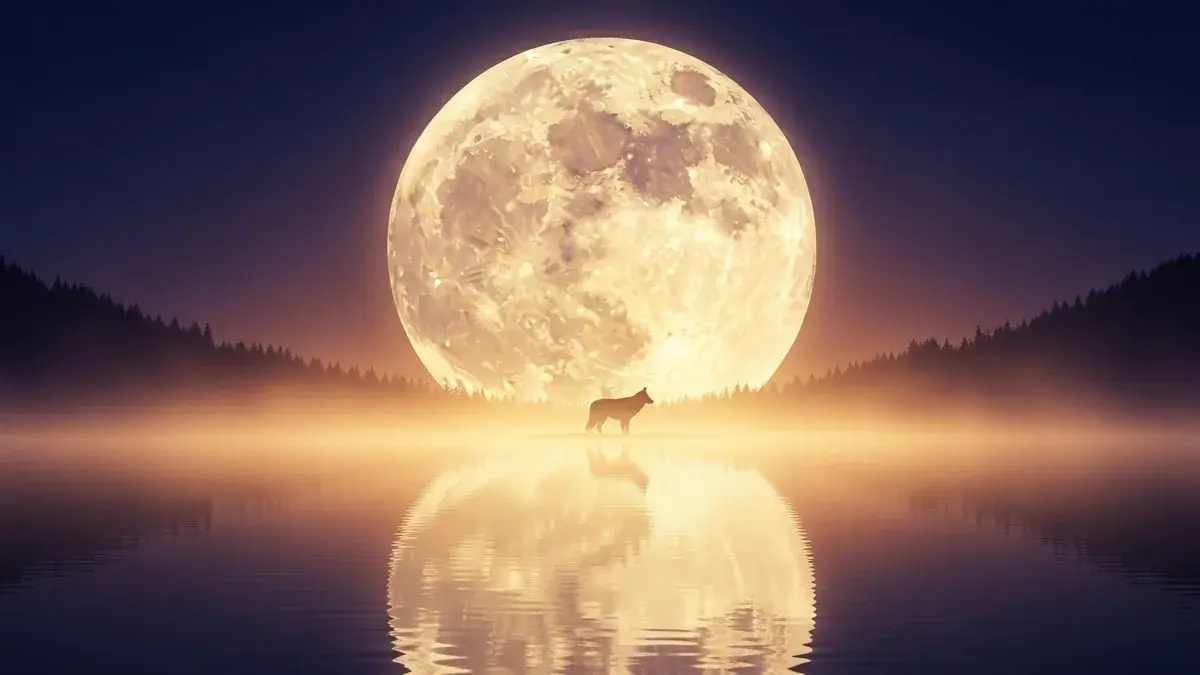
The Full Moon symbolizes culmination and clarity — the peak moment when something that quietly grew during the New Moon comes fully into view, right before the waning phase starts letting it go again. It's linked to duality (conscious vs. unconscious, logic vs. intuition), feminine power and fertility, and hidden knowledge. Lunar goddesses, nocturnal animals, and numerology all point back to that same idea: things reaching full visibility before they release.
An almanac
- Core Meaning
- Culmination, clarity, cycle's peak
- Element
- Water (emotion, intuition, subconscious)
- Feminine Link
- Mother phase of the Triple Goddess
- Tarot Cards
- The Moon & The High Priestess
- Sacred Animals
- Owl, wolf, turtle, dolphin, rabbit
- Monthly Moon Names
- 12, from Wolf Moon (Jan) to Cold Moon (Dec)
- Supermoon Frequency
- 3–4 times a year, always consecutive
There's a reason so many of us glance up when the Moon looks full and heavy in the sky. Across centuries and continents, people have paused at this exact moment in the lunar cycle to ask what it means, and every culture has answered a little differently. What ties those answers together is the sense that this is a peak: a point where something quiet has grown all the way into visibility. The Moon doesn't generate its own glow, of course; it's simply catching and returning the Sun's light back to us. Maybe that's fitting: so much of what we project onto the Full Moon, our beliefs, our fears, our longing for meaning, is really just our own reflection bouncing back at us from the night sky.
What the Full Moon Represents
The Full Moon marks completion. Whatever was planted or set in motion during the dark, quiet phase of the New Moon has now ripened; the waxing weeks built toward this crest, and the coming waning weeks will slowly let it go again.
That rhythm, rise, peak, release, renewal, is why the Moon has long stood in for cycles themselves: time, seasons, the turning of a life.
The lunar body shows a bright face and a hidden one, and that split makes it a natural symbol of duality: conscious and unconscious, the self we show and the self we keep private, plain logic and the kind of knowing that doesn't come from logic at all.
The Sun tends to represent open, daytime understanding; the Moon is linked instead to hidden and intuitive knowledge: dreams, visions, gut feelings, and the pull of the psychic senses.
- The Moon's gravity drives the tides, so it's tied closely to the Water element and everything associated with water: emotion, intuition, the subconscious.
- Its glow can feel mysterious, even a little deceptive, since it appears to shine on its own power.
- When Sun and Moon align their pull together, tides swell even higher, an event sometimes called a spring tide or king tide.
The Full Moon and the Feminine
Few symbols are as tightly bound to womanhood as the Full Moon. The very words "menstrual" and "month" trace back to old words for the Moon itself, and it's not just etymology: an average menstrual cycle and an average lunar month run almost the same length, close to 28 and 29.5 days.
Some research has explored whether the New and Full Moon phases influence ovulation timing, though the findings are mixed rather than settled.
In many Pagan traditions, this monthly rhythm is honored through the image of a Triple Goddess — Maiden, Mother, and Crone — with each aspect mapped onto a lunar phase. The waxing Moon belongs to the Maiden, the Full Moon to the Mother, and the waning Moon to the Crone, with a hidden fourth face sometimes assigned to the dark of the New Moon.
In this framework, the Full Moon represents adulthood, fertility, nurturing, and feminine power at its peak.
Full Moon Wisdom in Native Traditions
Many Native American nations gave each month's Full Moon its own name, usually drawn straight from what was happening in the natural world at that time of year. A midwinter Moon tied to the sound of hungry wolves became the Wolf Moon; a springtime Moon coinciding with the bloom of wild phlox became the Pink Moon. These names varied from nation to nation, since each community was reading its own local landscape.
The Moon also holds a place in the Medicine Wheel, the circular framework used across many Native traditions for self-reflection, healing, and spiritual growth. The wheel is divided into four quadrants aligned with the cardinal directions, and traditions differ on exactly how lunar phases map onto it — some assign three Moon phases to each of the four directions across the year, while others link the Moon specifically to the western quadrant, where the Water element already resides.
There's no single correct system here; it comes down to which framework feels right to the person working with it.
Full Moon Deities Across Cultures
Nearly every ancient culture personified the Moon, and the gender of that deity varies widely by region. The Akkadians honored the Moon god Sīn, while the Sumerians called him Nanna, "Lord of Wisdom." In Egypt, the early Moon god Iah eventually gave way to Khonsu, whose name means "traveler," a nod to how the Moon was used to navigate the night.
Iah's identity later merged into Djehuty, better known as Thoth, god of writing and knowledge; the cat-headed goddess Bastet also carried lunar associations alongside her ties to love and fertility.
Goddess traditions are just as rich. The Welsh Arianrhod — her name meaning "silver wheel" — ruled the sky, the stars, and the Moon. Irish lore gives us Aine, a Full Moon goddess of love and healing, while Cerridwen, keeper of arcane knowledge and her cauldron, is linked instead to the New Moon.
In West Africa, the Fon people revere Gleti, mother of the stars and mistress of light and love. Ancient Greece and Rome gave the Moon huntress faces in Artemis and Diana. In Japan, Chup Kamui watches over purity and humility, while Chinese tradition honors Changxi, mother of the year's twelve moons.
The Aztec goddess Coyolxauhqui, "Golden Bells," earned her lunar status through a myth of decapitation and rebirth among the stars — a striking image of the Moon's link to feminine wisdom won through hardship.
Full Moon Numerology
Numbers carry their own layer of lunar meaning:
- Two — the Moon is often called second only to the Sun in influence, and two carries vibrations of balance, partnership, and duality (fittingly, Monday, "Moon-day," is the second day of the week in many calendars).
- Three — a Blue Moon is the second Full Moon within one calendar month, making it the third full lunar appearance in that stretch; three also resonates with completion, feminine energy, and creative vision, and a Blue Moon is considered an especially potent window for intention-setting.
- Four — in years with thirteen Full Moons, the digits reduce to four (1+3=4), a number tied to stability, structure, and dependability.
- Eight — counting every phase from New through Waning gives eight distinct lunar stages, a number associated with karma, interconnection, and cycles of return.
Full Moon in Tarot and Astrology
In tarot, two cards carry lunar weight. The Moon shows two dogs howling at a crossroads beneath both the Moon and Sun sharing the sky, a picture of mystery, intuition, and the winding path toward emotional clarity; reversed, it points instead toward hard logic crowding out deeper insight. The High Priestess, robed like flowing water and crowned with a waxing-full-waning diadem, represents hidden knowledge and psychic perception; reversed, she suggests a mind pulled too far into material concerns.
In Western astrology, the Moon rules the water sign Cancer, lending that placement its tender, nurturing, home-loving character. As the Full Moon moves through each zodiac sign over the course of a year, it tends to color collective moods differently — sharpening focus in earthy or logical signs, stirring restlessness in more mutable ones — though the details shift depending on which astrological tradition you follow.
Animals Linked to the Full Moon
Because the Moon governs water and tides, many aquatic and nocturnal creatures carry lunar symbolism:
- Crab — ruled by both Water and Cancer, and some species, like the horseshoe crab, actually intensify spawning activity around the Full and New Moon.
- Owl — certain species grow more active under a full Moon's light, using it to signal to other owls; symbolically, they stand for wisdom and hidden knowledge.
- Turtle — some species time their egg-laying to the Full Moon's high tides, making them a symbol of patience, protection, and steadiness.
- Dolphin — nocturnal hunters that forage more actively by moonlight, associated with compassion and inner wisdom.
- Wolf, bat, and black cat — all creatures of the night, long linked to mystery, the unseen, and lunar magic.
- Rabbit or hare — a widespread fertility symbol, sometimes said to be visible as a shape on the Moon's own surface.
The Twelve Full Moon Names
Beyond the Wolf Moon and Pink Moon already mentioned, every month's Full Moon carries its own name, a tradition rooted in Native American observation of the natural world and later folded into European colonial almanacs. Each name is really a small piece of seasonal folklore, a note about what was happening on the land or in the sky at that point in the year.
- January — Wolf Moon. Named for the howling of hungry wolves through the coldest stretch of winter; also called the Old Moon or Ice Moon.
- February — Snow Moon. Marks the heaviest snowfall of the year across much of North America; also known as the Storm Moon or Hunger Moon.
- March — Worm Moon. Named for the worm trails that appear as thawing ground softens; also called the Chaste Moon or Sap Moon.
- April — Pink Moon. Honors an early blooming wildflower, not the Moon's actual color; also the Sprouting Grass Moon or Egg Moon.
- May — Flower Moon. Marks the season's abundant blooming; also the Hare Moon or Corn Planting Moon.
- June — Strawberry Moon. Named for the strawberry harvest; Europeans sometimes call it the Rose Moon.
- July — Buck Moon. Marks the month when male deer regrow their antlers; also the Thunder Moon or Hay Moon.
- August — Sturgeon Moon. Named by fishing nations for the sturgeon that appeared in number this month; also the Grain Moon or Red Moon.
- September — Full Corn Moon. Named for the end-of-summer harvest; called the Harvest Moon instead when it falls nearest the autumn equinox.
- October — Hunter's Moon. The traditional month for hunting deer and fox before winter; also the Travel Moon.
- November — Beaver Moon. Tied either to the setting of beaver traps or to beavers' own heavy dam-building activity; also the Frost Moon.
- December — Cold Moon. Named simply for winter's arrival; also the Long Night Moon or Oak Moon.
A supermoon occurs when a Full Moon coincides with perigee, the Moon's closest approach to Earth in its orbit, roughly 226,000 miles out rather than the more distant 251,000-mile apogee. At that distance the Moon can look up to 14% bigger and about 30% brighter than the year's smallest, faintest Full Moon, and the extra pull brings noticeably higher tides. It happens only three or four times a year, always in a row, which is part of why each one feels like an event.
What the Science Actually Says
Long before spiritual traditions gave the Full Moon its meaning, people already suspected it changed how they slept and felt, and modern sleep science has taken that old suspicion seriously enough to test it. A well-known 2013 study by Christian Cajochen's team found that around the Full Moon, participants took about five minutes longer to fall asleep, slept roughly 20 minutes less overall, took longer to reach REM sleep, and showed a 30% drop in deep sleep compared to other lunar phases, even in a windowless lab with no view of the sky. A larger 2021 study of both indigenous Argentinian communities and American college students found the same pattern: people tended to go to bed later and sleep less in the days leading up to the Full Moon, regardless of artificial light exposure.
What researchers have NOT found is reliable evidence that the Full Moon drives spikes in aggression, psychiatric crises, or hospital admissions; large studies looking for a lunar effect on mental health crises have mostly turned up weak or inconsistent patterns. The tides-and-gravity explanation doesn't hold up either, since the Moon's pull on a human body is far too weak to register. The more likely culprit is simply light: a brightly lit night sky, even filtered through curtains or city glow, nudging the body's internal clock later.
Long before anyone measured EEG waves, the old traditions already treated the Full Moon as a restless night, one that stirs something up and makes it harder to settle down. The science hasn't explained why the old traditions believed that, but it does back up the restlessness itself.
Frequently Asked Questions
What does the Full Moon symbolize spiritually?
The Full Moon is usually read as a symbol of culmination and clarity, the point where something that's been quietly building finally comes into full view. It's tied to intuition, emotional release, and feminine energy, and marks the completion of a cycle right before the pull toward letting go begins again.
Why is the Full Moon associated with women and femininity?
The link partly comes from timing: an average lunar month and an average menstrual cycle last almost the same length. Many spiritual traditions also frame the Full Moon as the 'Mother' phase within a three-part Maiden-Mother-Crone goddess cycle, representing fertility, nurturing, and feminine power at its peak.
Which animals are considered symbols of the Full Moon?
Nocturnal and water-linked creatures top the list: owls, dolphins, turtles, crabs, wolves, bats, black cats, and rabbits or hares. Many of them shift their behavior around the Full Moon's light and tides, feeding, breeding, or simply becoming more active.
Do full moons actually affect sleep or mood?
There's real research behind the sleep piece: studies have found people fall asleep more slowly, sleep for less total time, and get less deep sleep around the Full Moon, even in light-controlled lab settings. What hasn't held up under scrutiny is the idea that the Full Moon triggers spikes in aggression or psychiatric crises; large studies looking for that pattern mostly come up empty, and the sleep disruption itself is most likely driven by extra moonlight rather than any mystical force.
What does it mean to dream about a full moon?
A Full Moon appearing in a dream is often read as a sign of completion, clarity, or a truth finally coming into view, echoing its waking-life symbolism. A bright, clear Full Moon in a dream tends to suggest emotional clarity or a situation resolving itself, while one that's obscured, blood-colored, or unsettling may point to feelings you haven't fully faced yet. As with most dream symbolism, the tone of the dream and what's happening in your life matter more than any fixed rulebook.
What is a supermoon and is it different from a regular Full Moon spiritually?
A supermoon is simply a Full Moon that lines up with perigee, the Moon's closest point to Earth in its orbit, making it appear up to 14% larger and about 30% brighter than the year's smallest Full Moon. It happens just three or four times a year. Astronomically it's a distance effect, not a different kind of Moon, but many people treat its extra visual intensity as an amplifier, a good night to lean harder into whatever intention-setting or release work they'd already planned.
More from Spirit Guides

Sources
Claims on this page were checked against these published sources.
- Sin (mythology)
The precise etymology of the name Nanna is unknown, though it is agreed that it is not a genitive construction.
Read the source → - Khonsu
His name means 'traveller', and this may relate to the perceived nightly travel of the Moon across the sky.
Read the source → - Iah
As time went on, Iah also became Iah-Djehuty, meaning 'god of the new moon'. In this role, he assumed the lunar aspect of Thoth (also known as Djehuty), who was the god of knowledge, writing and calculation.
Read the source → - Arianrhod
The name 'Arianrhod' (from the Welsh arian, 'silver,' and rhod, 'wheel') may be cognate with Proto-Celtic *Arganto-rotā, meaning 'silver wheel.'
Read the source → - menstrual (etymology)
from PIE *me(n)ses- 'moon, month' ... in reference to the moon's phases as an ancient and universal measure of time.
Read the source → - Horseshoe crab
Nesting typically happens at high tides around full or new moons.
Read the source → - Moon rabbit
The Moon rabbit, Moon hare or Jade rabbit is a mythical figure in both East Asian and indigenous American folklore, based on interpretations that identify the dark markings on the near side of the Moon as a rabbit or hare.
Read the source → - What are the names of full moons throughout the year?
Named after the howling of hungry wolves lamenting the scarcity of food in midwinter.
Read the source → - Supermoons
a full Moon coincides with the Moon's closest approach to Earth in its elliptical orbit, a point known as perigee... Supermoons only happen three to four times a year, and always appear consecutively.
Read the source → - Do Moon Phases Affect Your Sleep?
During this lunar phase, participants took five minutes longer to fall asleep, slept for 20 minutes less, took longer to reach REM sleep, experienced a 30% reduction in deep sleep, and reported reduced sleep quality.
Read the source → - Does the full moon make us sleepless? A neurologist explains the science behind sleep, mood and lunar myths
the evidence that lunar phases trigger psychiatric crises is weak, with no reliable pattern found between the Moon and hospital admissions, discharges or lengths of stay
Read the source →
Not sure which animal is yours?
Consult the quiz