Spirit Guides
East Symbolism & Spiritual Meaning
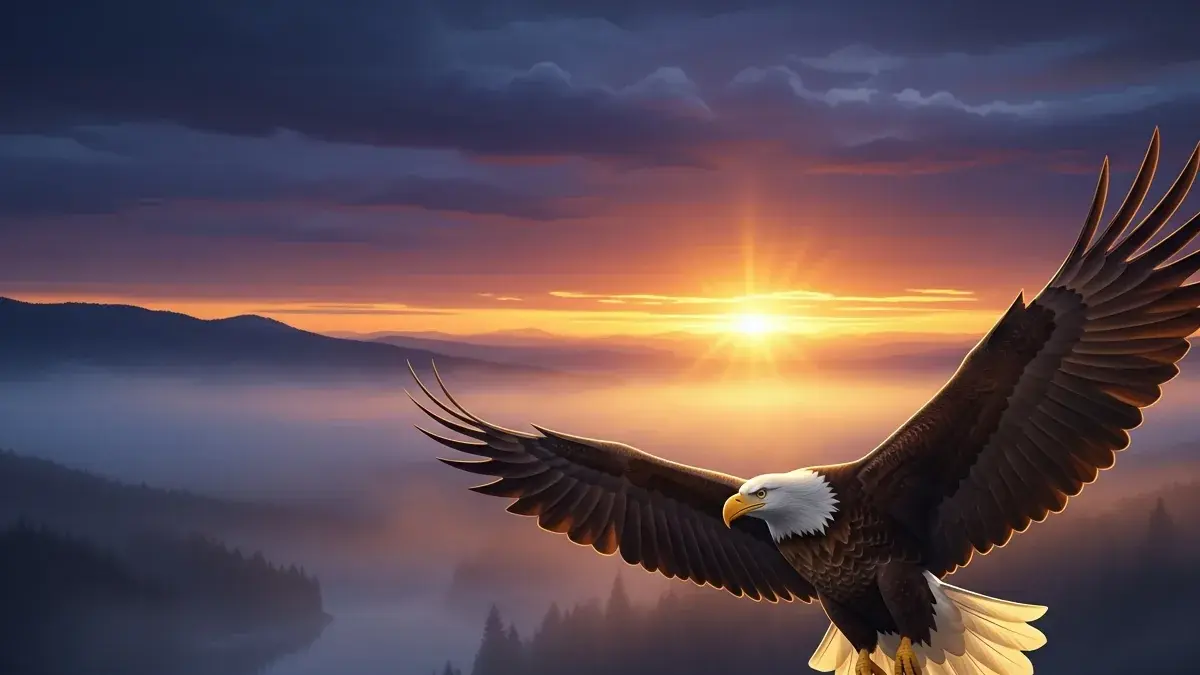
East is the direction of first light — the point spiritual traditions return to when they talk about new beginnings, awakening, and clarity, tied to the Air element and the season of spring. Its animal is Eagle, valued for sharp sight and its job carrying prayers to the divine; medicine-wheel and Celtic year-wheels add Otter, Wolf, Falcon, Green Dragon, Seahorse, and Hawk to this quarter. In Feng Shui, East belongs to the Azure Dragon and the household's eldest son, and its element there is Wood.
An almanac
- Element
- Air
- Season
- Spring
- Primary animal
- Eagle
- Astrology signs
- Gemini, Libra, Aquarius
- Feng Shui guardian
- Azure Dragon
- Hindu guardian
- Indra
- Buddhist guardian
- Akshobhya
Long before clocks and calendars, people oriented their sense of time around the point on the horizon where the sun first appears. East is the direction of first light — the place spiritual traditions return to when they talk about waking up, starting over, or seeing clearly for the first time. If East keeps catching your attention, it may be arriving at a moment when something in you is stirring awake.\n\nElders who kept the old ways would turn to face the sunrise and offer thanks before the day's first task; dawn itself was the teacher. One well-known Native American dawn prayer asks the spirit of the East — imagined as an eagle — to lend the one praying eyes sharp enough to see truth on the road ahead, and the courage to walk it honestly.\n\nOn the medicine wheel, East holds the first position, the same way the number one works in numerology: a starting point that already holds the whole journey in seed form. Seasonally, East belongs to spring, when everything buried through winter pushes back into the light — a young soul walking into an unfamiliar world without yet knowing what it's capable of.\n\nEven language carries this forward. In Old English, the root behind \"east\" ties to the verb \"to shine.\" Biblical Hebrew takes a related turn: its word for east also doubles as the word for \"the past,\" because in that worldview a person faces what has already happened, with the future understood as being at their back. Either way, East sits at the threshold between what has ended and what hasn't started yet.
Eagle: The Animal Voice of the East
Among Native nations, eagle carries a reputation few other creatures share: courage, sharp-eyed wisdom, and a direct line to the divine. Eagle was trusted as a go-between, able to lift a person's prayers high enough to reach the Creator and bring back guidance in return.
That's why an eagle feather held such weight in council — holding one while speaking was a pledge that only truth would follow.
Eagle is also said to move easily between the waking world and the world of dream and vision. One old story claims the sun itself only shines because Eagle keeps his wings spread; when he folds them at dusk, night falls.
Whatever the literal reading, the symbolism holds: eagle is the creature that carries East's gift of clear sight.
East and the Element of Air
Nearly every tradition that maps directions onto elements gives East to Air. In the wild, air is information — a shift in scent on the breeze warns of a predator or signals a mate. Many Native traditions treat wind itself as alive, a carrier of omens a skilled reader could interpret on the community's behalf; one Inuit tradition names a wind-spirit, Sila, whose weather moods were believed to shift depending on whether people honored traditional customs.
Air governs the mind: clarity, foresight, and the flashes of insight that seem to arrive out of nowhere. Simple ways to work with it:
- Place feathers or a fan on the eastern side of a home altar
- Face East during a quiet ritual and welcome in whatever is newly beginning
- Light a pale or golden candle at sunrise and speak your intention into the moving air
- Sit with a flying creature you feel drawn to and let its image fill your awareness
Air asks you to stay in the present tense — no yesterday, no tomorrow, only this breath.
Stones Aligned With the East
Two stones are commonly reached for when working with East's dawn energy.
Celestite, pale sky-blue and gentle in feel, is associated with restful guidance and lifting a heavy mood. Healers use it to restore harmony and everyday clarity. Its higher vibration is often paired with meditation aimed at psychic awareness, and it resonates with the crown, throat, and third-eye centers.
Citrine, glowing yellow and orange like the sun breaking the horizon, has long been worn as a charm for good fortune — ancient Egyptians shaped it into talismans. It's most reached for today when manifesting success earned through real effort. It resonates with the root, sacral, and solar plexus centers, which is part of why some also turn to it around fertility.
East on the Medicine Wheel
The details shift from nation to nation, but a common thread runs through Native teachings about the East: it's the quarter of Air, spring, dawn, and the sense of smell. It governs birth, the first spark of an idea, and the opening chapter of a life path. The focus is on inception, on taking the first real step rather than circling an idea forever.
A modern birth-based wheel, styled after western astrology rather than an ancient tribal calendar, assigns three creatures here. Otter (roughly Jan 20–Feb 18) brings humor and an unconventional streak, a knack for fresh angles on old problems, and real skill at listening. Wolf (Feb 19–Mar 20) carries deep passion for life paired with a fierce independence — the "lone wolf" instinct toward solitude that lets a person recharge before returning to the pack with genuine affection. Falcon closes the quarter with decisive leadership: little patience for stalling, quick and often accurate opinions, and a need to keep ego in check once those opinions start landing.
East in Divination
When a diviner sets East as a marker on the wheel or spread, it typically points to the future: the goals, wishes, and dreams a person is moving toward. But the teaching is practical, not passive. The future you're hoping for gets built today, through ordinary effort, not a stroke of luck — it still has to be planted and tended, not just foreseen.
East in Celtic Symbolism
Celtic communities read the land and sky closely for guidance on farming and the turning seasons, and their sense of East lines up with the modern picture: Air, growth, birth, communication, fresh life. Three creatures open this modern, zodiac-style year-wheel from this direction.
Green Dragon (Jan 21–Feb 17) is tied to spiritual growth and the ability to see straight through to what's genuinely in someone's heart — a teacher of wisdom and the soul's hidden treasures. Seahorse (Feb 19–Mar 27) carries a whimsical, mystical quality that fits Air; people drawn to it tend to be adaptable, warm, family-minded, and patient. Hawk (Mar 18–Apr 24) brings heightened alertness, eyes and senses engaged, along with a naturally wide view of how life's pieces connect and a drive to keep reaching higher.
East in Western Astrology
Western astrology links the eastern direction to the Air signs — Gemini, Libra, and Aquarius — though none carry an animal image the way other traditions do. What they share is a way of thinking: sharp, adaptable, able to move between concrete detail and big-picture abstraction, with a love of puzzles and real skill at communication.
The catch is that Air's moods shift like the wind — sometimes a gentle breeze, sometimes a full gale.
East in Chinese and Japanese Tradition
In Feng Shui, the eastern sector of a home is tied to the health of the household and, specifically, to the eldest son — reason enough to keep that corner's energy uncluttered. Living plants and dragon imagery are the traditional way to support it, because in Chinese and Japanese cosmology the East is watched over by the Azure Dragon, a guardian deity whose blue-green coloring echoes the cool, water-touched soil of eastern lands.
This dragon carries spring's energy and the Wood element, which Feng Shui also assigns to the East, so the dragon imagery fits doubly well. Some practitioners will even bring an unwell family member — or pet — into this part of the home for healing work.
East in Christian Tradition
Long before medicine wheels and Feng Shui compasses, Christian worship had its own compass point, and it was East. Genesis places the first paradise there directly: "the Lord God planted a garden in Eden, in the east, and there he put the man whom he had formed" — so before East became a symbol of anything else in this tradition, it was the location of the garden humanity was made for and then lost.
That loss is part of why early Christians turned to face the sunrise to pray, a custom old enough that Church writers like Tertullian and Origen already treated it as standard practice. Later theologians read three things into it at once: Christ as "the Light of the world" met by facing the literal light of dawn, the ache for the Eden that was planted in the east, and the belief that Christ's Second Coming would likewise approach from the east. The Latin name for this custom, still used by some churches today, is ad orientem — literally, "to the east."
Native and Celtic traditions read East as the doorway a new day walks through. Historic Christian practice reads the same direction differently: as the doorway paradise was planted in, and the doorway it's expected to return through.
East in Hindu and Buddhist Tradition
South and East Asian traditions assign East its own named guardians, distinct from the Azure Dragon of Chinese Feng Shui.
In the Hindu system of Dikpala — guardian deities set over the eight directions — the East belongs to Indra, king of the heavens and god of storms, rain, and thunder. Placing the sky's own king at the point where the sun rises fits the same pattern found elsewhere on this page: East as the seat of highest, most active power, where a day's authority begins again.
Vajrayana Buddhism draws its own map of the compass through the Five Wisdom Buddhas, and the East belongs to Akshobhya, whose name means "the Immovable One." Blue in color and seated in his own eastern paradise called Abhirati, Akshobhya stands for a wisdom that cannot be provoked into anger or knocked off center — a stillness so complete it turns aggression itself into clarity. Paired with Eagle's sharp sight and Air's restless clarity elsewhere in this quarter, Akshobhya adds something the other traditions here emphasize less: East as the place clarity is born, and also the place it becomes unshakable.
Frequently Asked Questions
What does East symbolize spiritually?
East stands for new beginnings, awakening, and clarity. It's tied to sunrise, the Air element, and the season of spring across many traditions, and it marks the start of a cycle rather than its middle or end.
What animal represents the East?
Eagle is the animal most widely tied to the East, valued for its sharp sight, its role as a messenger to the divine, and its comfort moving between the waking and dream worlds. Native medicine-wheel traditions also place Otter, Wolf, and Falcon in this quarter, and Celtic tradition places Green Dragon, Seahorse, and Hawk there.
Which element and season belong to East?
East is consistently linked to the element of Air and the season of spring. Both point to the same themes: fresh ideas, mental clarity, and life returning after winter's dormancy.
What does the Bible say about the east?
Genesis places the Garden of Eden "in the east," and for centuries many Christians prayed facing that direction — a custom called ad orientem — both to greet Christ as "the Light of the world" at sunrise and in hope of his Second Coming, which was likewise expected to approach from the east.
Which gods or deities are said to guard the East?
Traditions differ but tend to place their highest or most active figure in the eastern seat: Hindu Dikpala tradition assigns the East to Indra, king of the heavens; Vajrayana Buddhism assigns it to Akshobhya, the immovable Buddha of unshakable clarity; and Chinese and Japanese cosmology give it to the Azure Dragon.
What does it mean to dream about the East?
Dreaming of heading toward the East, or of a sunrise on that horizon, is generally read as a hopeful sign. It points to new opportunities, a fresh chapter, or a period of clearer thinking on its way in. As with the waking symbolism, the emphasis is on beginnings rather than endings: something is about to start, not wrap up.
More from Spirit Guides


Sources
Claims on this page were checked against these published sources.
- east | Etymology, origin and meaning of east
from PIE root *aus- (1) "to shine," especially of the dawn. The east is the direction in which dawn breaks.
Read the source → - The East, Time, Eternity, the Universe and the Origin of All Things
He sees the past as before him (qedem); the future is behind his back (aharit).
Read the source → - Azure Dragon
The Azure Dragon represents the east and the spring season. ... His cardinal direction's epithet is "Blue Dragon of the East."
Read the source → - Bagua
震; Zhèn ☳ Thunder, 1st Son ... 長男 Eldest Son
Read the source → - Citrine
Citrine and other quartzes are believed to have been used by the ancient Egyptians to make talismans, by the ancient Greeks for carving symbols, and by Roman priests as rings.
Read the source → - Silap Inua
Silla is a spirit of the sky, the wind, and the weather. ... Silap Inua was capable of controlling whether people paid attention to customs and traditions.
Read the source → - Genesis 2:8 (NRSVUE)
And the Lord God planted a garden in Eden, in the east, and there he put the man whom he had formed.
Read the source → - Ad orientem
Ad orientem, meaning 'to the east' in Ecclesiastical Latin, is a phrase used to describe the eastward orientation of Christian prayer and Christian worship... Christians prayed facing east because 'the Garden of Eden was planted in the east (Genesis 2:8) and that at the end of time, at the second coming, the Messiah would approach Jerusalem from the east.'
Read the source → - Guardians of the directions
Indra, Lord of Heaven and God of the Weather, Sky, Rain, and Storms
Read the source → - Akshobhya
Akshobhya... located in the east of the Diamond Realm... the lord of the Eastern Pure Land Abhirati... His color is blue-black.
Read the source →
Not sure which animal is yours?
Consult the quiz