Mammals · Spirit animal
Coyote Spiritual Meaning & Symbolism
The trickster-sage who turns chaos into wisdom and laughter into medicine.
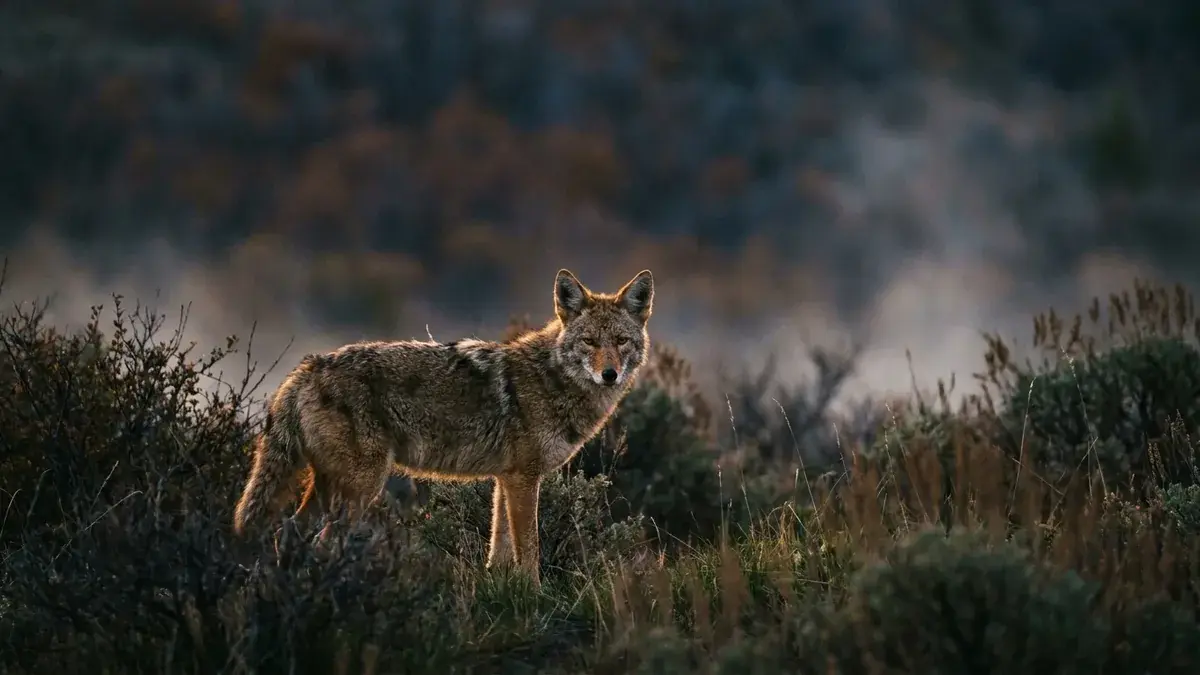
The coyote symbolizes playing with opposites and teaching through trickery. It can be both creative and cunning, but also mischievous and unpredictable. As a spirit, totem, or power animal it encourages you to open up to uncertainty, laugh at your own mistakes, and try new ways of thinking.
In dreams, an easygoing coyote asks you to lighten up. A sneaky one warns that there's dishonesty around.
An almanac
- Core message
- Loosen your grip, laugh, and adapt
- Spirit animal
- Drop rigidity; laugh at your mistakes
- Totem for
- Clever, loyal, easygoing people
- Power animal
- Turning negativity into playfulness
- In dreams
- Warns of deception, or urges you to relax
- Cultural roots
- Native American creator-trickster; Japanese/Chinese fox-shapeshifter parallels
- Real-life bond
- Genetically monogamous; mates for life
The coyote walks a strange line between wisdom and mischief, and that's exactly the point. Coyote symbolism teaches that insight doesn't always arrive wrapped in solemn ceremony — sometimes it comes disguised as a joke, a stumble, or a wink. Whether coyote turns up in your dreams, your totem lineage, or as a power animal you call on deliberately, the message stays consistent: loosen your grip, laugh at the absurd, and let unpredictability teach you something.
Coyote Symbolism & Meaning
The meaning of coyote is hard to sum up, because this spirit animal won't hand you advice without a joke. Coyote has a dual nature. It can cause trouble in one moment and teach you something useful in the next. It shows up when you need to take whatever has happened seriously or lighten the mood with a joke. You might not know if something is trouble or helpful until it's over.
More than anything, coyote teaches you that humor is good for you. It's not just distraction from doing things. It's part of healing. You'll know the wisdom that comes from coyote by its style of humor — which isn't just laughing at jokes. It's seeing deeper into what a situation means. The truth comes in ways that we don't expect.
Coyote also helps us with a great gift: it leads us to release what we're holding onto, for better or worse, instead of holding onto it forever. Facing how we've been affected — even if it's difficult to do — is the path toward wholeness.
Coyote Spirit Animal
When coyote appears in your life, it might mean you need to either drop a mask you've been wearing or wear a different one for a while, to protect yourself. It often shows up when people have gotten too rigid and serious and stop laughing at their mistakes — coyote thinks finding humor in failure is a useful skill. A coyote spirit may be telling you that it's time to weigh the risk against the reward: some situations call for caution, others reward boldness and clever thinking.
It's possible that you're standing at the edge of some sort of change that will require flexibility on your part. Or maybe coyote is trying to help you pay attention to someone back home who needs more care and attention, and you're sidestepping some uncomfortable topics.
Does Coyote fit you?
Tap the ones that sound like you — 6 traits, no right answer.
0 of 6 Nothing picked yet — start tapping.
Coyote Totem Animal
Those whose totem animal is coyote tend to be clever, easygoing, and quick to find the funny side of life, including their own blunders. Many were the class clown growing up, and as adults they keep attracting odd, almost comedic coincidences.
Coyote totem-holders prefer an uncomplicated way of living, which makes them naturally good at rolling with change. Loyalty matters enormously to you, along with the close circle of family and friends you consider your pack. You hold both the sacred and the silly at once, and your sharp wit occasionally tempts you toward pranks — the trick is keeping those jokes kind rather than mean-spirited, since coyote's underlying code is fairness.
In relationships you're deeply committed: like the animal itself, you tend to pair for the long haul and look after your loved ones fiercely. That instinct isn't just poetic license, either — coyotes are among the small percentage of mammals that practice genetic monogamy. A 2012 study tracking wild coyote pairs found zero evidence of infidelity across dozens of litters, and researchers have since documented coyotes showing grief-like behavior — long mournful howls, lost appetite — after a mate dies. If coyote is your totem, that fierce, one-partner loyalty isn't just a feeling you carry; it's written into the species itself.
Coyote Power Animal
Coyote is a good power animal to have around when you're in a slump and need a change of perspective. Obsessing over what's going wrong and ignoring everything else isn't healthy — it makes the things that are bad for you seem even bigger and more overwhelming. A coyote can help you shake off that negativity and get back in touch with your inner playfulness. The coyote can also help when you find yourself staring down some new, uncomfortable situation. Coyotes are amazingly resourceful, able to quickly adapt to almost any situation they encounter. Even if you're stuck doing something unfamiliar or unfortunate, a coyote can help you regain your sense of control.
Across cultures
2 traditions — pick one to read its take.
Coyote in Native American Symbolism
Coyote plays three roles in many Native American traditions: creator, ancestor spirit, and trickster. In one creation story, coyote shakes a blanket over each of the four directions, creating land and water. Some healers also practice Coyoteway, a prayer ceremony that draws on coyote's healing power.
Coyote in Far Eastern Symbolism
Across Japan and China, foxes are traditionally associated with magic: white foxes are believed to be lucky, while a darker fox is a sign of misfortune. Traditional Japanese folklore sees foxes as real magical creatures.
This is why coyote lore from North America feels similar to fox lore from other places: it reinforces the idea that coyotes move easily between worlds (spiritual and physical), mischief and wisdom.
Coyote in Dreams
Coyote dreams can be tricky, because they might mean different things depending on the animal's behavior. If it's sneaky or evasive, it could be a warning that someone isn't telling you the full story. But if it's calm and friendly, that could just mean you need to relax and stop overthinking things. A coyote leading or guiding you might be a sign to be more adaptable, and hearing a coyote howl in the distance could mean someone needs your support or is about to make big changes.
As for seeing a coyote chasing you in your dream? That could mean it's time to face some tough feelings or problems head-on. And finally, seeing a coyote pup or den could be a reminder that new growth takes time and that you need to protect whatever's most vulnerable in your life right now.
Coyote Spiritual Meaning
Coyote is a symbol of contradiction. Wise and silly. Cautious and bold. Guarded and open. Yet all these traits are not conflicting but complementary, held in balance by the coyote's spirit. Not an easy spirit, this. It doesn't offer comfort through easy answers or assurances; it offers comfort through perspective and through the reminder that you don't have to solve every problem right away.
When we work with this spirit, we work with the coyote spirit, and we realize that life doesn't always give us an easy time of things. Sometimes things fall apart in ways we can't predict or understand right away, but that doesn't mean the unexpected has to be bad. If we can loosen our grip on control, laugh even when life's dealt us a hard card, and adapt as quickly as possible — even before we know why we have to adapt — then we're already making progress along the lines of coyote's wisdom.
Coyote in Aztec & Mesoamerican Myth
Before Europeans came to the Americas, the Aztecs already had a coyote god of their own, named Huehuecóyotl. The prefix huehue in Nahuatl — the Aztec language — meant "very old," a title reserved for gods honored for wisdom and long memory. He was part of a family of shape-shifting Tezcatlipoca gods.
What makes this god worth knowing are the stories that teach us how his tricks boomeranged back on him and made him suffer the consequences of his mischief.
Coyote vs. Jackal: Untangling Anubis
It's common to lump coyote symbolism together with Anubis, the Egyptian god with a jackal head. But the two animals aren't the same.
Jackals are an Old World type of canine that lived across parts of North Africa, the Arabian Peninsula, and South Asia, while coyotes live only in North America. These animals never met during those ancient times when these myths formed.
Anubis is often depicted as a "super-canid," or some sort of canid mashup. Scholars say that rather than portraying just one specific species, his iconography embodies many aspects of several canines at once.
So if Anubis rings true for your work with coyotes, see it as a kinfolk bond or shared role rather than something biologically similar. The coyote has its own reputation, grounded in its Native American heritage.
Frequently Asked Questions
What does it mean when a coyote crosses your path?
If a coyote crosses your path, it could be a message to lighten up and stop taking something so seriously. It's also a reminder to stay aware of the ways that something that seems ordinary or even funny can actually be a teaching.
Is coyote a good or bad omen?
Coyote neither represents good or bad luck; it's two-faced. A coyote sighting could indicate good fortune or trouble, so you should look to your situation rather than assume a single meaning from it.
What does dreaming about a coyote mean?
A coyote is a sneaky, evasive animal. When it appears in your dreams, it's suggesting that someone is being sneaky or evasive with you in waking life.
A calm, friendly coyote, on the other hand, suggests that you're taking things too seriously and need to laugh more. In particular, you're probably overanalyzing everything.
What's the difference between a coyote and a coywolf?
In most of the Northeast, a "coyote" is a cross between a western coyote, an eastern wolf, and some domestic dog (by some estimates, they're 60% coyote, 30% wolf, and 10% dog). As a symbol in dreams or our minds, that adds a layer of "blended identity" meaning to the usual connotations of a coyote: usually trickster energy but sometimes crossing over into blending two distinct parts of yourself so that you can do something important.
Why do coyotes howl at night?
Wildlife biologists think coyotes howl for two reasons. First, to call the members of their scattered family together after they've each been hunting. Second, to announce their territory to neighboring packs.
Spiritually speaking, a coyote's nighttime howl carries the same message: reconnect with your own people. Or perhaps announce something you've been suppressing.
Coyote also represents
- Other animals that represent love →Alongside Dove, Swan, Wolf, Seahorse
- Other animals that represent resilience →Alongside Cockroach, Camel, Salmon, Turtle
- Other animals that represent loyalty →Alongside Dog, Wolf, Swan, Penguin
- Other animals that represent intelligence →Alongside Crow, Raven, Dolphin, Fox
Sources
Claims on this page were checked against these published sources.
- Coyote (mythology)
In some stories he combines both roles
Read the source → - Native American Coyote Legends
in some Native American coyote myths, Coyote is a revered culture hero who creates, teaches, and helps humans... in still others, he is a comic trickster character... In some Native coyote stories, he is even some sort of combination of all three at once.
Read the source → - Coyoteway: A Navajo Holyway Healing Ceremonial (Karl W. Luckert)
Coyoteway: A Navajo Holyway Healing Ceremony. Karl W. Luckert.
Read the source → - Coyote
the coyote is strictly monogamous, even in areas with high coyote densities and abundant food.
Read the source → - Huehuecoyotl, Old Coyote
Huehuecoyotl, the Old Coyote, also known as the Ancient Drum. He is a trickster, capable of reversals and pranks, often cruel ones. Huehuecoyotl is also a god of storytelling, music, dance and merriment. ... He is related to Tezcatlipoca family of gods. Like Tezcatlipoca, he is a frequent shape-shifter, capable of transforming himself into another animal or human at whim and unpredictably.
Read the source → - Anubis: Jackal-Headed God of the Afterlife
Anubis (also known as Inpu, Inpw, Anpu) is the Egyptian god of mummification, funerary rites, guardian of tombs, and guide to the afterlife as well as the patron god of lost souls and the helpless. ... scholars suggest he represents a super-canid, combining the most salient attributes of several types of canids, rather than being just a jackal or a dog.
Read the source → - Misunderstood Mesos: The Golden Jackal
across Southern Europe to the Arabian Peninsula and India then to Western Indonesia
Read the source → - Coyotes mate for life—and grieve when their partner dies
Coyotes mate with just one partner in their lifetimes and practice genetic monogamy, with a 2012 study finding 100% faithfulness among coyote pairs. Coyotes display grief-like behaviors after losing a partner, including persistent long howls, lethargy, and decreased appetite.
Read the source → - Coywolf
A coywolf is a canid hybrid descended from coyotes (Canis latrans), eastern wolves (Canis lycaon), gray wolves (Canis lupus), and dogs (Canis lupus familiaris). ... 60% western coyote, 30% eastern wolf, and 10% domestic dog.
Read the source → - Probing Question: Why do coyotes howl?
One is to call the pack—really a family group—back together again after a period of individual hunting. A second reason that coyotes howl is to advertise their presence to other packs, essentially warning those other family groups against trespassing across territorial boundaries.
Read the source →