Spirit Guides
Zuni Fetishes: Native American Animal Carvings Guide
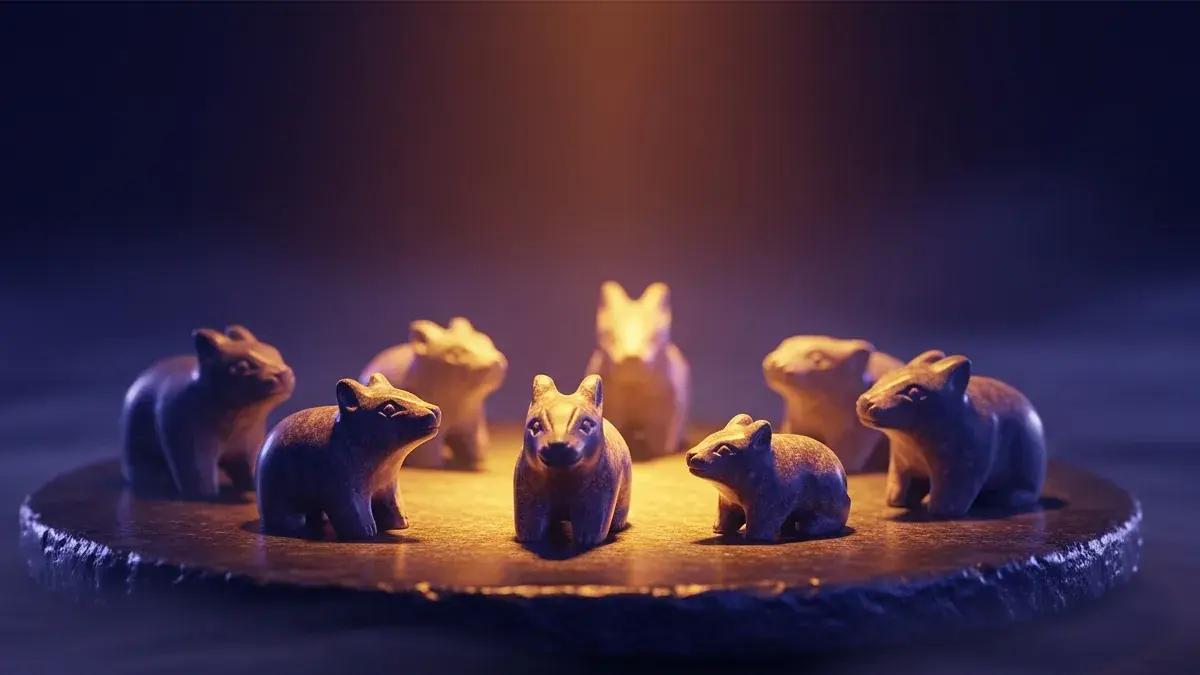
A Zuni fetish is a small hand-carved stone animal made by Shiwi (Zuni) carvers, who shape raw stone or crystal to reveal an animal spirit already believed to be inside it. Traditionally blessed pieces are thought to pass on traits like healing, fertility, or protection to their owner, while commercially sold fetishes carry the craft but aren't considered spiritually "active." Caring for one means keeping it in a small pouch with cornmeal or turquoise, giving it occasional water, and treating it with ongoing respect.
An almanac
- Origin
- Shiwi (Zuni) people, northwestern New Mexico
- Common Materials
- Turquoise and jet stone or crystal
- Sacred Structure
- Six directions, each tied to a color and animal
- Commercial Pieces
- Not blessed, so not "active" in the traditional sense
- Care Basics
- Small pouch with cornmeal or turquoise, plus occasional water
- Historical Record
- First documented in 1881 by ethnologist Frank Hamilton Cushing
- Most-Used Traditional Stone
- Serpentine, quarried locally in the Zuni Mountains
If you've ever come across a small, hand-carved stone animal at a gallery, a gift shop, or a friend's shelf, you may have been looking at a Zuni fetish. These carvings come from the Shiwi people of northwestern New Mexico, and there's more behind them than their size suggests. This guide covers what a fetish actually is, where the tradition comes from, how to tell a meaningful piece from a simple souvenir, and how to look after one if it comes into your life.
What Exactly Is a Zuni Fetish?
A fetish, in this context, is any object believed to hold a living spirit or carry some kind of magical or mystical pull. For the Zuni carvers, that object begins as a raw piece of stone or crystal. The carver's job isn't to impose a shape onto the material — it's to look closely at the stone and sense which animal is already waiting inside it.
Once that animal is identified, the carver shapes the stone to reveal it, and in doing so gives the piece a form of life and power. A fetish that has been properly blessed is thought to pass its traditional traits on to whoever carries it — healing, fertility, or a shift in how someone sees the world, among other things.
Turquoise and jet are two of the most commonly used stones for this work, prized both for their beauty and for how well they're believed to hold spiritual energy.
Where the Tradition Comes From
According to Zuni tradition, fetishes have been part of human life since people first became conscious beings, emerging from lower realms into daylight. The story goes that the sun had two Warrior twins who firmed up the swampy land, but couldn't stop dangerous animals from preying on humans.
To solve this, the twins crafted bows and arrows out of rainbows and lightning and used them to bring the animals down. Each creature they struck turned to stone, with its spirit sealed inside — leaving behind fetishes that still wait to be found and to share their blessings.
The Sacred Six and the cardinal directions:
- Zuni religion recognizes six sacred directions, and each one is tied to a specific color and a specific animal — some seen as prey, others as guardians.
- A fetish is considered especially potent when its color lines up correctly with its associated direction.
- The animals connected to the four cardinal directions are believed to act as mediators, carrying requests and intentions between a person (or the whole tribe) and the surrounding elements and spirits.
- Together, this circle of directions is how the Zuni describe the connection between humanity, the Creator, and the rest of creation.
The six guardians by name:
- North: the yellow mountain lion.
- West: the black (sometimes blue) bear.
- South: the red badger.
- East: the white wolf.
- Above, the sky: the multicolored eagle.
- Below, the underworld: the black mole, sometimes called shrew.
This framework was first written down for outsiders by ethnologist Frank Hamilton Cushing, who lived among the Zuni and submitted his findings to the Bureau of Ethnology in 1881. His report was published posthumously in 1966 as the book Zuni Fetishes, and it remains the primary non-Native scholarly source on the tradition.
Understanding the Difference Between Art and Faith
As Native American art gained wider recognition, Zuni fetishes started showing up in galleries and shops well beyond the Zuni community. It's worth knowing that fetishes sold commercially are not "active" in the traditional sense — they haven't been blessed the way a ceremonial piece would be. Even so, carvers still approach the work with the same respect for tradition.
A few things worth keeping in mind if you're evaluating a piece:
- Until fairly recently, most fetishes carried no maker's mark at all.
- Carvers tend to have a distinctive personal style passed down through generations, which acts almost like a signature on its own.
- Many carvers were also wary that even a small engraved mark could chip or crack the stone, which could damage whatever spiritual properties it held.
- This art form has also traditionally belonged to the tribe as a whole, meant to benefit the community rather than any one individual.
How Zuni Fetishes Fit Into Modern Life
Zuni carvers today still make fetishes, but they now work with a much wider range of materials than earlier generations had access to. Within that, you'll find two general approaches:
- Some carvers aim for lifelike, detailed pieces that appeal to collectors who want realism.
- Others deliberately keep their work simple, staying close to the natural form of the stone out of respect for the spirit already inside it.
Many carvers hold that the less a stone is altered from its original shape, the more powerful the finished fetish becomes. Neither approach is wrong — it comes down to preference. What does matter is being cautious about where you buy: plenty of imitation pieces on the market have nothing to do with actual Zuni artists.
If you want a genuine fetish, take the time to find a stone and crystal seller with a real, verifiable connection to Zuni carvers.
How to Care for a Zuni Fetish
In Zuni belief, carving a fetish is one way people reconnect with higher powers — spirit animals, totems, and power animals among them. Once made, the fetish acts as a go-between, linking its owner to the spirit world. That kind of ongoing spiritual work needs upkeep, much like a relationship you maintain over time.
Steps for caring for your fetish:
- Keep the fetish in a small pouch, traditionally filled with cornmeal or powdered turquoise.
- Give it occasional access to water as part of its upkeep.
- Handle it with the same respect you'd show a living relationship — the tradition holds that a fetish treated well responds in kind.
You don't need to overthink this. The core idea is consistency and genuine respect, not rigid ritual.
Hunting Fetishes vs. Sacred Guardians
Not every fetish plays the same role. Alongside the six directional guardians who watch over the tribe as a whole, Zuni tradition holds a separate set of Prey Gods — fetishes tied specifically to the hunt. A few roles shift here: the coyote steps in for the bear and the wildcat (bobcat) takes the badger's place, while the mountain lion, eagle, wolf, and mole keep their usual associations.
A hunting fetish wasn't something an individual simply owned. Communal hunting pieces were kept by a designated Keeper, who led the ceremonies required before a hunt could begin. Once blessed, a hunter carried his fetish inside a small buckskin pouch held close over the heart, trusting the animal within to guide the hunt and keep him safe.
Sacred, non-hunting fetishes work differently: they typically remain with their keeper permanently rather than traveling out with individual hunters. Much of this tradition is built around communal stewardship rather than personal possession.
The Heartline and Medicine Bundle: Reading a Fetish's Details
Look closely at many fetishes carved over the last century and you may notice a fine line — etched, inlaid, or painted — running from the animal's mouth toward its heart. This is the heartline, sometimes called a breathline, and it traces the path connecting an animal's breath to its own life force.
This detail is more modern than it looks: fetishes with a heartline were rarely found on older pieces, and the feature only became a popular carving element in the 20th century. That makes it part of the newer decorative tradition rather than an ancient one.
You may also spot a small medicine bundle lashed to a fetish's back — often a tiny carved arrowhead paired with heishe (thin disc) beads, tied on with sinew or thread. Rather than pure decoration, the bundle is treated as an offering of empowerment, an extra layer of blessing for the piece.
Beyond Turquoise: The Full Range of Carving Materials
Turquoise and jet get most of the attention, but Zuni carvers have always worked with a much wider palette. Historically, the most-used stone has been serpentine, a soft material found in abundance in the Zuni Mountains and also in parts of Arizona, prized for how readily it could be shaped by hand tools.
Beyond serpentine, carvers have long turned to travertine, jasper, pipestone, marble, bone, antler, and fossilized ivory, along with shell — including mother-of-pearl — and coral. In recent decades that list has grown further still, with some carvers using materials like slag glass and stones sourced from well beyond the Southwest.
Whatever the material, the underlying principle stays the same: the carver isn't imposing a shape from outside. They're drawing out whichever animal spirit the stone already holds.
What Other Fetish Animals Commonly Represent
Beyond the six directional guardians, Zuni carvers shape dozens of other animals, and each carries its own traditional association among carvers and collectors. A few of the meanings shared most often:
- Frog — tied to water and fertility, often chosen by those hoping for rain or a successful pregnancy.
- Turtle — associated with patience, longevity, and steady, grounded protection.
- Snake — linked to cycles of life, death, and renewal.
- Buffalo — connected to abundance, endurance, and provision for the community.
- Deer — associated with grace, gentleness, and gratitude.
- Hummingbird — seen as a messenger of joy and beauty.
These associations aren't fixed rules so much as living traditions, and individual carvers or families may lean on different qualities for the same animal. If one of these speaks to you, treat it the way you would the six central guardians: as an invitation to reflect, not a rigid label.
Frequently Asked Questions
What makes a stone carving a true Zuni fetish rather than just a decorative piece?
A true fetish is carved by seeking out the animal spirit already present in a stone or crystal, then shaping the material to reveal it — and traditionally, being blessed to activate its power. Pieces sold commercially are typically not blessed, so while they carry the tradition and craftsmanship of Zuni carving, they aren't considered "active" fetishes in the strictest sense.
Why do some Zuni fetishes have no maker's mark?
For much of the tradition's history, carvers avoided adding marks for two main reasons: their personal carving style already served as a distinctive signature, and engraving into the stone risked cracking or scratching it, which could harm its spiritual properties. There's also a broader view that this art form belongs to the tribe as a whole rather than to any single carver.
How do I take care of a Zuni fetish once I have one?
Traditionally, a fetish is kept in a small pouch with cornmeal or powdered turquoise and is periodically given access to water. Beyond the physical steps, the underlying idea is to treat the fetish with ongoing respect, much like tending to any meaningful relationship.
Which animal guards each of the six sacred Zuni directions?
In the traditional framework, the yellow mountain lion guards the north, the black (sometimes described as blue) bear guards the west, the red badger guards the south, the white wolf guards the east, the multicolored eagle guards the sky above, and the black mole (sometimes called shrew) guards the underworld below. Each pairing links a color, a direction, and an animal into one protective role.
What's the difference between a hunting fetish and one of the six directional guardians?
The six directional guardians watch over the tribe as a whole and largely stay with their keeper. Hunting fetishes, known as Prey Gods, are a separate set carried by individual hunters in a small buckskin pouch over the heart, with a Keeper managing the shared pieces and leading the ceremonies before a hunt — and a couple of animals swap roles, with the coyote standing in for the bear and the bobcat for the badger.
What does the heartline on a Zuni fetish mean?
The heartline, or breathline, is a fine line running from an animal fetish's mouth to its heart, meant to represent the path of breath connecting the carving to its own life force. It's a relatively modern touch — the feature was uncommon on older fetishes and only became widely popular in 20th-century carving.
Who first documented Zuni fetish traditions for outsiders?
The primary non-Native source on Zuni fetishes comes from ethnologist Frank Hamilton Cushing, who submitted his findings to the Bureau of Ethnology in 1881 after living among the Zuni; the material was published posthumously in 1966 as the book Zuni Fetishes, and it remains the foundational academic reference on the tradition.
More from Spirit Guides





Sources
Claims on this page were checked against these published sources.
- McKinley County, New Mexico
the northwestern section of the U.S. state of New Mexico
Read the source → - Zuni Pueblo, New Mexico
The community is within the Zuni Indian Reservation or Pueblo of Zuni in southwestern McKinley County, 37 miles (60 km) south of Gallup, the county seat, and 11 miles (18 km) east of the Arizona border.
Read the source → - Zuñi Fetiches
created for them a bow (Á-mi-to-lan-ne,=the Rain Bow) and an arrow (Wí-lo-lo-a-ne,=Lightning) ... Whenever they came across the pathway of one of these animals, were he great mountain lion or but a mere mole, they struck him with the fire of lightning which they carried in their magic shield. Thlu! and instantly he was shriveled and burnt into stone ... by the heart that shall endure forever within you, shall ye be made to serve instead of to devour mankind.
Read the source → - Zuni fetish
Yellow mountain to the north, blue mountain to the west, red mountain to the south, white mountain to the east, the multicolored mountain above, and the black mountain below.
Read the source → - Zuni fetishes
Yellow mountain to the north, blue mountain to the west, red mountain to the south, white mountain to the east, the multicolored mountain above, and the black mountain below.
Read the source →
Not sure which animal is yours?
Consult the quiz