Animal Dream Symbol
Amphibians Dream Meaning: Dreams About Amphibians Explained
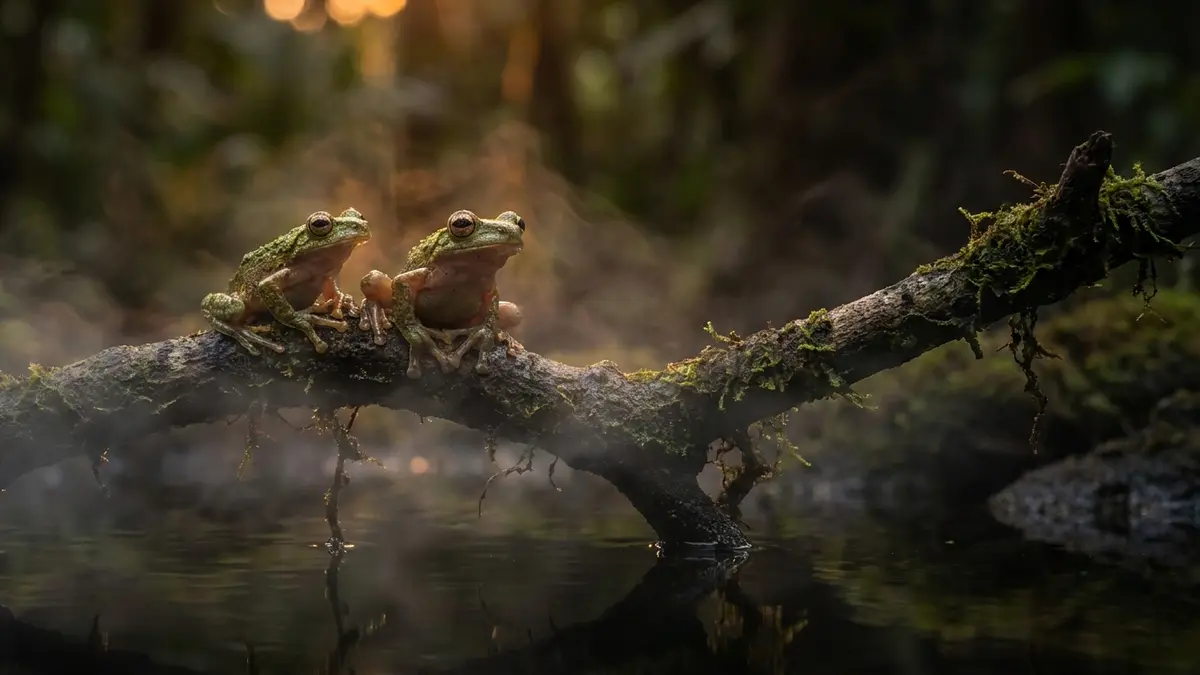
Dreaming about an amphibian usually means change or adaptability is afoot in your life. These creatures are able to move between water and land, so they represent a bridge between the inner world of your feelings and the outer world of things. The part that is shifting is signified by how far above water the amphibian moves.
An almanac
- Core message
- Flexibility amid change
- In dreams
- Water = emotion, land = grounding
- Best qualities
- Adaptability, transformation, balance
- Watch for
- Unresolved feelings in murky water
- Element
- Water and earth (salamander adds fire)
- Key figures
- Frog (emotional rhythm), salamander (willpower)
- Egyptian goddess
- Heqet, frog form, aided childbirth
- Chinese folklore
- Jin Chan, three-legged toad of wealth
Amphibians make for vivid dream symbols because they inhabit a gray area in nature. Seeing an amphibian in your dreams generally refers to a period of transition or emotional recalibration. These creatures start out completely dependent on water before they develop the ability to move about on solid ground, so when you see one in your dreams, it indicates that you are moving into a transitional space. Ask yourself where the amphibian is in your dream, whether it is swimming in water, wading, or totally on land. This will give you insight into exactly what's happening and where in your life.
What It Means
You often think more fluidly than you give yourself credit for, and you need to pay attention to what you learn when you do. Like water in your subconscious mind, amphibians move freely between two different environments. When they swim or rest in your dreams, it's an especially clear message from your intuitive side. They may even bring with them a message from beyond ordinary consciousness.
Whether an amphibian is underwater, on dry land, or moving between the two is important. If the animal is near water, it may be telling you that you're wrestling with deep feelings that need closer examination. But if it rests or moves on dry land, it may be telling you that practical matters need some attention after an emotional stretch.
Common Amphibian Dream Scenarios
What exactly your amphibian is doing in your dream is the key to interpreting its meaning. It might be any one of these:
- A frog hopping happily around — often points to good times ahead, or just shows you're in a good mood right now.
- A frog that jumps all over the place — points to restlessness, or hints you're running from one thing to the next without achieving anything.
- A frog gliding over one lily pad after another — points to a smooth change of pace, without emotional obstructions.
- Chasing frogs — reveals how badly you want something, and that you're not waiting for it to come to you.
- Frogs escaping — signals how much you don't want something that's happening.
- Kissing frogs — can point to an unexpected change coming up; whether it'll be a good one or bad depends on how the rest of the dream goes.
- Salamanders tucked under stones or inside damp woods — points out that you need some balance between your emotions and your daily life.
- Amphibians swimming in murky water — hint at feelings that need sorting out.
- Amphibians swimming from water into land inside your dreams — hint at changes already underway rather than at a start of them.
- Dead amphibians in your dreams — can point to changes that are stalled out, or ones that might have missed their opportunity.
- Amphibians in your house — can point at what's going on with your emotions and family, rather than just broad patterns affecting everything.
Symbolism & Message
Amphibians are connected to earth and water, which means they'll appear in dreams whenever you need to think about the balance between the material world and your emotions. Pay attention if an amphibian is in the water, because that usually means you need to reflect on your feelings and intuition. If it's on land, it means you should focus on grounding and security.
Amphibians are masters at blending two settings, so when one appears in your dream, you may be asked to combine emotional and practical elements. These creatures don't stand up to their environment; they change themselves to fit it. In this case, the dream could be a reminder to stop being so rigid. Stop clinging to old expectations, let go, and figure out how to move forward with what's happening now.
Spiritual Meaning
The symbolism of the amphibian has a lot to do with transformation, from their water-born larval stage to their adult life on land. Personal transformations are part of that symbolism, as well—metaphors for changing what you are and what you do into something else that better reflects who you are.
Part of that comes from the way amphibians evolve as they grow.
The salamander in particular has been used in mythology and folklore because it seems to be able to survive or thrive around fire. There are legends that it can even command it. But an earthly or physical connection to fire isn't the only thing salamanders symbolize. Fire can represent purification, passion, willpower, and vitality. You can think of this alongside the earth and water symbolism in the salamander's amphibian nature.
Frogs lean more toward fertility and mood shifts than straight-up transformations as a kind of messenger (though they're an important part of transformation on their own). All of these things have something to do with a seasonal reappearance near water.
Between them, frogs and salamanders connect to the differing aspects of the bigger family they're part of: one side is tied more heavily to emotional cycles, and one side is tied more heavily to transformative willpower.
Amphibians in Mythology and Folklore
Amphibians have been important symbols for centuries, which is why they're often seen in dream interpretation. Two specific traditions explain their meaning in dreams, and one of the reasons behind them is rooted in ancient Egypt.
The Egyptians worshipped the frog-headed goddess Heqet as a guardian of fertility, believing that frogs and toads appeared alongside the life-giving floodwaters in the Nile Valley. According to legend, Egyptian women wore amulets of Heqet during labor, believing she could hasten delivery and ease the final, hardest stretch of childbirth. In some versions of a myth involving the god Osiris, it was Heqet who gave life to his newborn son Horus — bringing together her frog form with resurrection and renewal.
Jin Chan is another very important symbol for prosperity in China's feng shui tradition — often seen as a three-legged toad holding a coin. In feng shui, this creature is meant to guide wealth inward toward its owner while guarding what's already been gathered. You could see an amphibian in your dream as a stroke of good luck and financial gain, even if it seems more like intuition than actual wealth.
The Biology Behind the Symbol
Amphibians have thin skin that stays moist and soft, thanks to the mucus it makes. This skin lets them breathe directly through the surface of their bodies—a process called cutaneous respiration—and that's why adult amphibians can stay underwater for a long time without moving. But having such permeable skin means amphibians are limited in the places they can live, because dry conditions will make their skin shrivel up and stop working like a lung.
It's no surprise then that amphibian transformation is such a potent dream symbol. Most amphibians start out as slimy, gilled baby-animals and eventually get lungs, so they can thrive on dry land. That takes some serious change! Not to mention: a lot of powerful things happen when a baby animal grows into an adult; it's only fitting that it also took real-life biology to shape the transformational promise inside the story.
Frequently Asked Questions
What does it generally mean to dream about an amphibian?
Dreaming about an amphibian usually refers to some changes or adjustments you've made lately. Because amphibians move back and forth between water and land, they sometimes represent your "inner world" (your thoughts and feelings) and your "outer world" (your activities and circumstances). Therefore, the dream may show that you need to spend more time paying attention to your thoughts and feelings or to paying attention to your outer circumstances, whichever needs a little more focus.
Does it matter whether the amphibian is in water or on land in my dream?
Yes, the water-living or land-living quality of the amphibian you dreamed about is an important clue. An amphibian near water often means that you need to pay attention to your feelings and your hunches. When the amphibian is on dry land, the dream probably suggests that you need to look after yourself in daily practical matters.
What's the difference between dreaming of a frog and dreaming of a salamander?
Frogs tend to reflect the emotional rhythms and mood of a situation, usually through their movement. They can be smooth and graceful, or erratic and disconnected. A salamander leans more toward the role of practicalities and willpower in that situation. It implies balancing emotional expression with the need for new transformations and directions.
What does it mean to dream about a dead frog or amphibian?
A dead amphibian is a sign that you may be in the middle of a significant personal change but unable to complete it. Perhaps you feel like you've missed an opportunity, or maybe you're resisting the upcoming change and putting off accepting it. You don't have to take it as a warning sign; instead, you can see it as a call to pay attention.
What does it mean if a frog or amphibian appears inside my house in a dream?
If you've dreamed of an amphibian in your home, it's a sign that you need to be adaptable or renew something in your personal life or in your relationship with family members or the routines you keep. It's likely that the subject of this dream is so important to you and so personal that it needs to be dealt with privately rather than handled out in the wider world.
Why are frogs and toads linked to wealth and fertility in folklore?
The connection between frogs and good fortune runs deep across human cultures. In ancient Egypt, for instance, the goddess Heqet took the shape of a frog and was tied to childbirth and fertility. In Chinese tradition, a three-legged toad called Jin Chan is believed to attract and guard prosperity in feng shui. These traditions probably arose because frogs are so closely associated with water and abundance. Frogs seem to appear in great numbers whenever water returns after a dry spell, which is why they've often been seen as natural stand-ins for fertility and good fortune.
Sources
Claims on this page were checked against these published sources.
- Amphibian
Young amphibians generally undergo metamorphosis from an aquatic larval form with gills to an air-breathing adult form with lungs.
Read the source → - Salamanders in folklore
This connection probably originates from a behavior common to many species of salamander: hibernating in and under rotting logs. When wood was brought indoors and put on the fire, the creatures "mysteriously" appeared from the flames.
Read the source → - Heqet
Frog amulets representing Heqet were probably worn by women during childbirth to ensure an easy delivery; she was called "she who hastens the birth", and in the Osiris myth she breathed life into the new body of Horus at birth.
Read the source → - Jin Chan
It represents a popular feng shui charm for prosperity... depicted as a bullfrog with red eyes, flared nostrils, and only three legs total, sitting atop a pile of traditional Chinese coins while holding one in its mouth... a Jin Chan statue should not be positioned facing the main door.
Read the source →